

Sound waves are vibrations that travel through air (or water, or a solid) as tiny, repeating changes in pressure, and you hear them when those changes make your eardrum vibrate and your ear turns that motion into nerve signals. It’s one more place where math and physics describe our world, except this time the measuring instrument is sitting on each side of your head.
By the end of this guide you’ll be able to explain what a compression and a rarefaction are, work out a wavelength with one short formula, estimate how far away a lightning strike is, and trace a sound through the ear step by step. You’ll also see why a sound that’s only 15 decibels louder can be safe for hours in one case and risky within minutes in another.
We’ll start with what a sound wave is, then pitch, loudness and speed, then a worked example, then the ear itself, and finish with decibels, common mix-ups and a short FAQ.
Quick answer
A sound wave is a pressure wave. A vibrating object pushes on the air next to it, that push passes along as alternating squeezes and stretches, and your eardrum, three tiny middle-ear bones and the fluid in your cochlea turn it into electrical signals that the auditory nerve delivers to your brain.
Key takeaways
- Sound needs a material to travel through, and it moves as a series of squeezes (compressions) and stretches (rarefactions).
- Frequency sets pitch, amplitude sets loudness, and the wavelength follows from speed divided by frequency.
- In air at 20 °C, sound moves about 343 meters per second, and the speed barely depends on pitch.
- Your ear converts the signal four times: air pressure, bone motion, fluid motion, then electricity.
- Every 3 dB increase halves the safe listening time, and human hair cells don’t grow back.
What Is a Sound Wave?
A sound wave is a pressure disturbance that moves outward from something that’s vibrating. Picture a speaker cone. When it moves forward, it squeezes the air in front of it into a region of higher pressure called a compression. When it pulls back, it leaves a region of lower pressure called a rarefaction. Do that hundreds of times a second and you get a train of squeezes and stretches rolling away from the speaker.
The air itself doesn’t travel from the speaker to your ear. Each bit of air moves a small distance back and forth along the direction the wave is heading, bumps its neighbor, and returns close to where it started. Think of a row of people passing a nudge down a line: the nudge crosses the whole row, but nobody leaves their spot. Waves built this way are called longitudinal waves.
That push on the air is also a nice example of Newton’s third law: the speaker pushes the air, and the air pushes back on the speaker. And because a wave carries energy outward, it connects to the ideas in our guide to kinetic and potential energy.
One consequence: no material, no sound. In a vacuum there’s nothing to squeeze, so a vibrating object makes no sound at all.
Which Three Properties Describe Every Sound?
Frequency and pitch
Frequency counts how many complete cycles of compression and rarefaction pass a point each second. One cycle per second is one hertz (Hz). The frequency of a sound wave matches the frequency of whatever made it, so a tuning fork vibrating 440 times a second makes a 440 Hz wave. What you perceive as pitch is your brain’s reading of that frequency. Small instruments such as a piccolo usually make high pitches, and large ones such as a tuba make low pitches.
Amplitude and loudness
Amplitude is how big the pressure swing is. A harder push from the source means bigger squeezes and stretches, which you hear as a louder sound. Amplitude and frequency are independent: you can play the same note softly or loudly, and you can shout or whisper at any pitch.
Wavelength
Wavelength is the distance from one compression to the next. You can’t sense it directly, but it explains a lot, including why bass notes seem to fill a whole room and why a high-pitched whistle is easy to aim at one spot.
| Property | What it measures | What you notice | Unit |
|---|---|---|---|
| Frequency | Cycles per second | Pitch (high or low) | Hertz (Hz) |
| Amplitude | Size of the pressure swing | Loudness | Decibels (dB) for the sound level |
| Wavelength | Distance between compressions | Nothing directly | Meters (m) |
How Are Frequency, Wavelength and Speed Connected?
They’re tied together by one formula that works for every wave: speed = frequency × wavelength, or v = fλ. In a given material at a fixed temperature the speed stays constant, so a higher frequency forces a shorter wavelength.
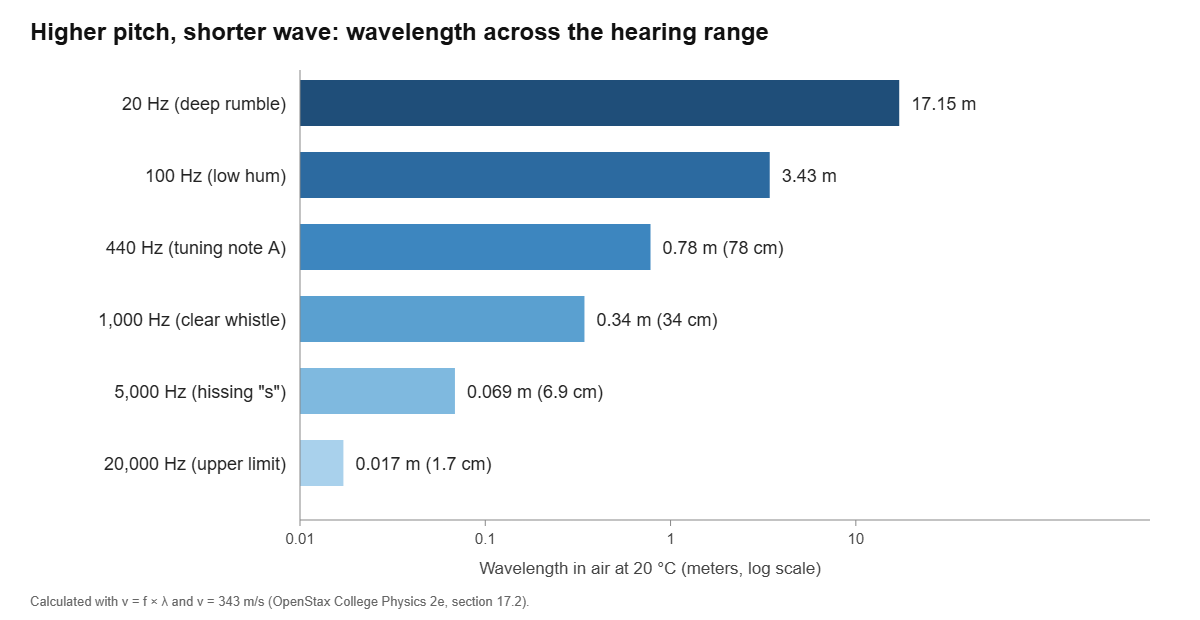
Using 343 m/s for air at 20 °C, a 440 Hz note (the tuning “A”) has a wavelength of 343 ÷ 440 ≈ 0.78 m. The lowest sounds most people can hear, around 20 Hz, stretch to about 17 m, while the highest, around 20,000 Hz, are only about 1.7 cm long.
| Frequency | Example | Wavelength in air (20 °C) |
|---|---|---|
| 20 Hz | Deep rumble at the edge of hearing | 17.15 m |
| 100 Hz | Low hum | 3.43 m |
| 440 Hz | Tuning note A | 0.78 m |
| 1,000 Hz | Clear whistle | 0.34 m |
| 5,000 Hz | Hissing “s” sound | 0.069 m |
| 20,000 Hz | Upper limit for most young adults | 0.017 m |
The lowest wave is longer than a school bus, and the highest would fit on your thumbnail. Here’s the same data as a chart.
Light obeys the same relationship, only with a speed of about 299,792 kilometers per second, which is why our guide to how light travels reads like a faster cousin of this one.
Source for the formula and the wavelength example: OpenStax, College Physics 2e, section 17.2.
How Fast Does Sound Travel?
In air at sea level, sound travels at 331 m/s at 0 °C and 343 m/s at 20 °C. That’s a gain of less than 4% for 20 degrees of warming. For air, the speed follows v = 331 × √(T ÷ 273), where T is the temperature in kelvin. Plug in 293 K (20 °C) and you get about 343 m/s, which is roughly 767 miles per hour. If you’d like to switch between units yourself, try the unit converter.
Two details are worth remembering. First, in one material at one temperature, every pitch travels at the same speed, so bass and treble from a distant band reach you together. Second, sound moves at different speeds in different materials, and the wavelength of a given note changes with it, because the frequency stays tied to the source.
You’ve seen the speed in action at a fireworks show: you see the burst first and hear it a moment later, because sound is far slower than light.
Worked Example: How Far Away Is the Lightning?
Here’s a real use of the speed of sound. You see a lightning flash, start counting, and hear thunder after 6 seconds. How far away was the strike?
Step 1: Write down what you know
The delay is t = 6 s, and the speed of sound is about v = 343 m/s on a mild day.
Step 2: Ignore the light’s travel time
Light covers the distance almost instantly (about 299,792 km every second), so the whole delay comes from the sound.
Step 3: Use distance = speed × time
d = 343 m/s × 6 s = 2,058 m.
Step 4: Convert to something familiar
That’s about 2.06 km, or roughly 1.3 miles. A handy shortcut falls out of this: every 3 seconds is about 1 km (343 × 3 = 1,029 m), and every 5 seconds is a little over a mile.
Step 5: Check how much temperature matters
On a freezing day, with sound at 331 m/s, the same delay gives 331 × 6 = 1,986 m. The answer shifts by only 72 meters, so the shortcut is fine for a quick estimate.
How Does Your Ear Turn Vibrations Into Hearing?
Your ear changes the form of the signal several times before your brain gets it: air pressure, then a vibrating membrane, then bone motion, then a wave in fluid, then electricity. The National Institute on Deafness and Other Communication Disorders (NIDCD) describes the chain like this.
| Stage | Part involved | What happens | Form of the signal |
|---|---|---|---|
| 1. Outer ear | Pinna and ear canal | Sound waves are collected and sent down the canal toward the eardrum | Air pressure wave |
| 2. Eardrum | Tympanic membrane | The membrane vibrates with each compression and rarefaction | Vibrating membrane |
| 3. Middle ear | Malleus, incus, stapes | Three tiny bones pass the vibration along and amplify it | Mechanical motion |
| 4. Cochlea | Fluid and basilar membrane | The fluid ripples and a traveling wave runs along the membrane | Fluid wave |
| 5. Hair cells | Stereocilia | Bristles bend, channels open, chemicals rush in | Electrical signal |
| 6. Auditory nerve | Nerve and brain | The nerve carries the signal to the brain, which turns it into a sound you recognize | Nerve impulses |
Source: NIDCD, “How Do We Hear?”
Hearing is one of the five senses, and you can compare how it works with sight, smell, taste and touch in our guide to how your five senses work. Here we’ll stay on the physics side.
How does the cochlea tell pitches apart?
The cochlea works a bit like a keyboard laid out along a spiral. NIDCD reports that hair cells near the wide end detect higher-pitched sounds, while those closer to the center detect lower-pitched ones. So pitch is decided by where along the cochlea the signal arises, and loudness by how strongly the fluid is pushed.
Why do you have two ears?
A sound from your left reaches your left ear a fraction of a second before your right ear, and it arrives slightly louder. Your brain compares the two signals to judge where the sound came from. That’s why covering one ear makes it harder to pinpoint a ringing phone.
What Range of Sounds Can You Hear?
Textbooks usually give the audible range as 20 to 20,000 Hz. Real ears vary: the University of Utah’s Genetic Science Learning Center says people can hear from about 12 to 28,000 Hz, with plenty of individual differences. Most adults lose the top of the range first as they age.
Sounds below the range are called infrasound and sounds above it are ultrasound, and both are perfectly real waves. You just don’t have the hair-cell machinery to pick them up.
How Is Loudness Measured, and When Does It Hurt?
Sound level is measured in decibels (dB). The scale is logarithmic, so the numbers don’t add the way inches do. NIDCD explains that a 10 dB increase seems about twice as loud to your ears, yet it’s actually 10 times more intense. Hearing researchers often use A-weighted decibels (dBA), which count the pitches human ears respond to most.
| Everyday sound | Typical level (dBA) |
|---|---|
| Normal conversation | 60–70 |
| Movie theater | 74–104 |
| Motorcycles and dirt bikes | 80–110 |
| Headphones at maximum volume, sporting events, concerts | 94–110 |
| Sirens | 110–129 |
| Fireworks show | 140–160 |
Source: NIDCD, “Noise-Induced Hearing Loss”. The same page says sounds at or below 70 dBA are unlikely to cause hearing loss even after long exposure, while long or repeated exposure to sounds at or above 85 dBA can.
Time matters as much as volume. The CDC’s National Institute for Occupational Safety and Health (NIOSH) sets its recommended limit at 85 dBA averaged over eight hours, and it uses a 3-decibel rule: each 3 dB increase cuts the allowed time in half.

Check the arithmetic yourself. Going from 85 to 100 dBA is 15 dB, which is five steps of 3 dB, so the time halves five times: 8 hours ÷ 2⁵ = 15 minutes, exactly what the chart shows. NIOSH notes that the limit applies to the workplace, but it also says protecting your hearing whenever sounds reach 85 dB(A) is good practice anywhere.
Source: CDC NIOSH, “Understanding Noise Exposure Limits”.
The stakes are real because the damage doesn’t heal. Most noise-induced hearing loss comes from the damage and death of hair cells, and NIDCD states that, unlike in birds and amphibians, human hair cells don’t grow back. The agency’s advice is to wear hearing protectors when noise is at or above 85 dBA.
What Are the Most Common Mix-Ups About Sound?
| Myth | Reality |
|---|---|
| Sound travels through empty space. | Sound is a disturbance of matter, so with no air, water or solid to squeeze, there’s nothing to carry it. |
| A louder sound has a higher pitch. | Pitch comes from frequency and loudness comes from amplitude. A shout and a whisper can share the same pitch. |
| A 10 dB increase is only a little louder. | It seems about twice as loud but carries 10 times the intensity. |
| Bass notes travel slower than treble. | In one material at one temperature all frequencies travel at the same speed. Only the wavelength differs. |
| Hair cells grow back after a loud concert. | In humans, hair cells don’t regenerate, so the loss from damaged ones is permanent. |
Sources: NIDCD, “How Loud Is Too Loud?” for the decibel row, and the OpenStax and NIDCD pages cited above for the rest.
Frequently Asked Questions
What are sound waves in simple words?
Sound waves are repeating squeezes and stretches of air (or another material) that start at something vibrating and spread outward. When they reach your ear, they make the eardrum vibrate, and your ear and brain turn that motion into the sounds you recognize.
Can sound travel through space?
No. Space is nearly a vacuum, and sound needs particles to pass the pressure changes along. Radio waves and light can cross space because they’re a different kind of wave that doesn’t need a material, which is why astronauts talk by radio.
Why does sound travel faster on a hot day?
In air, the speed of sound rises with temperature. OpenStax lists 331 m/s at 0 °C and 343 m/s at 20 °C, a gain of under 4%. The effect is small for everyday estimates but adds up over long distances.
What frequencies can humans hear?
The textbook range is 20 to 20,000 Hz, though it varies from person to person and shrinks at the high end with age and noise exposure. Sounds below 20 Hz are infrasound and those above 20,000 Hz are ultrasound.
What does a decibel measure?
A decibel measures sound intensity on a logarithmic scale. Every 10 dB step means ten times the intensity, though to your ears it seems about twice as loud. Zero decibels is roughly the quietest sound a healthy ear can detect.
Can hearing damage from loud noise be reversed?
Usually not. Noise can destroy the hair cells in the cochlea, and human hair cells don’t grow back. A brief dullness after a loud event can fade, but the safest plan is prevention: lower the volume, take breaks and use ear protection at 85 dBA or higher.
The Short Version
- Sound is a pressure wave made of compressions and rarefactions, and it needs a material to travel through.
- Frequency gives pitch, amplitude gives loudness, and v = fλ links speed, frequency and wavelength.
- In 20 °C air, sound moves about 343 m/s, enough to estimate lightning distance at 3 seconds per kilometer.
- The ear converts air pressure to bone motion, fluid waves and finally electrical signals.
- Every 3 dB halves safe listening time, so protect your hair cells: they don’t grow back.
Want to test what you’ve learned? Try the science quiz, turn the key terms (compression, rarefaction, hertz, decibel) into cards with the flashcard maker, or browse more topics in the physics category. For a deeper look at safe listening, read NIDCD’s guide to how loud is too loud.
Disclaimer
This article is for general educational purposes only. It does not replace a hearing test or medical advice. If you notice ringing in your ears, muffled hearing or any sudden change in your hearing, please talk to a doctor or an audiologist.