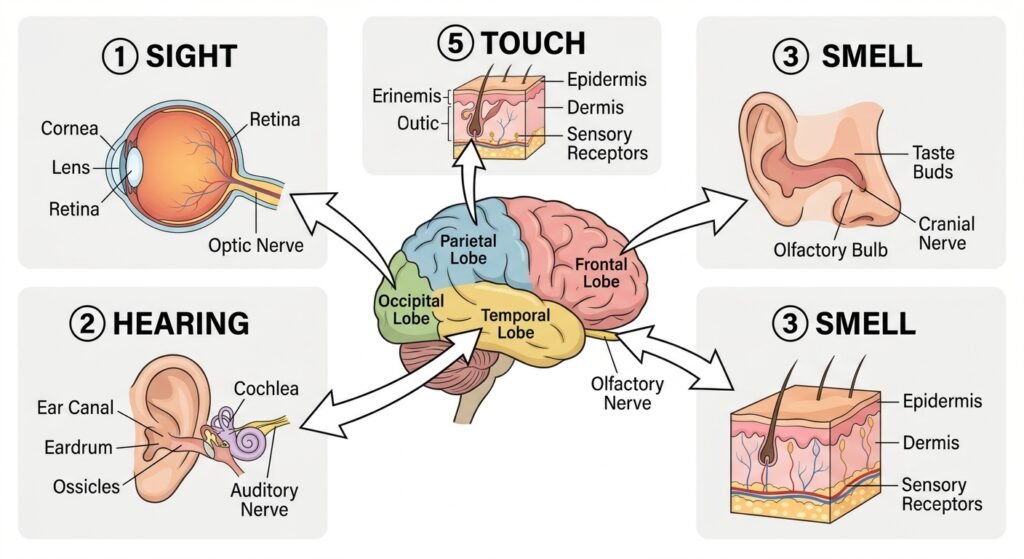
Each of your five senses works by turning something from the outside world (light, sound vibrations, chemicals or pressure) into electrical nerve signals. Special receptor cells in your eyes, ears, nose, tongue and skin do that conversion, and your brain then reads the signals as sights, sounds, smells, tastes and feelings.
That’s the core answer to how do our five senses work, and it hides a neat idea: every sense follows the same basic pattern. Once you know the pattern, learning each sense becomes a matter of filling in four blanks: what’s the stimulus, what’s the receptor, which nerve carries the signal, and where in the brain it ends up.
This guide fills in those blanks for sight, hearing, smell, taste and touch, with a single table that compares all five side by side. You’ll also see why smell takes a shortcut the other senses don’t, why food tastes bland when you have a cold, and which “extra” senses your body uses without you noticing.
We’ll start with the shared pattern, go through each sense, look at how they work together during one bite of food, and finish with myths and FAQs.
Quick answer
Our five senses work by converting outside stimuli into nerve signals. The eyes detect light, the ears detect vibrations, the nose and tongue detect chemicals, and the skin detects pressure, temperature and pain. Receptor cells turn each stimulus into electrical impulses, which nerves carry to the brain, where they become perception.
Key takeaways
- Every sense follows one pattern: stimulus, receptor, nerve signal, brain.
- The eyes use rods for dim light and three kinds of cones for color.
- Ears turn sound into fluid waves, and hair cells in the cochlea turn those waves into signals.
- Smell and taste are chemical senses; most of what people call “taste” is really smell.
- Humans also sense balance and body position, so “five senses” is a simplification.
What Do All Five Senses Have in Common?
All five senses share one pathway: a stimulus hits a receptor, the receptor makes an electrical signal, a nerve carries it, and the brain interprets it. Biologists call the receptor’s conversion step transduction, which just means changing one form of energy or signal into another.
The difference between the senses is mostly the receptor at the front end. Each type of receptor is tuned to one kind of stimulus:
| Sense | Stimulus | Receptor type | Where the receptors are | Signal goes to |
|---|---|---|---|---|
| Sight | Light | Photoreceptors (rods and cones) | Retina, at the back of the eye | Thalamus, then the visual cortex |
| Hearing | Sound vibrations | Mechanoreceptors (hair cells) | Cochlea, in the inner ear | Thalamus, then the auditory cortex |
| Smell | Airborne chemicals | Chemoreceptors (olfactory receptor neurons) | Top of the nasal cavity | Olfactory bulb, skipping the thalamus |
| Taste | Dissolved chemicals | Chemoreceptors (gustatory cells) | Taste buds in the papillae of the tongue | Thalamus, then the taste cortex |
| Touch | Pressure, vibration, stretch, temperature, damage | Mechanoreceptors, thermoreceptors, nociceptors | Skin and deeper tissues | Thalamus, then the touch area of the cortex |
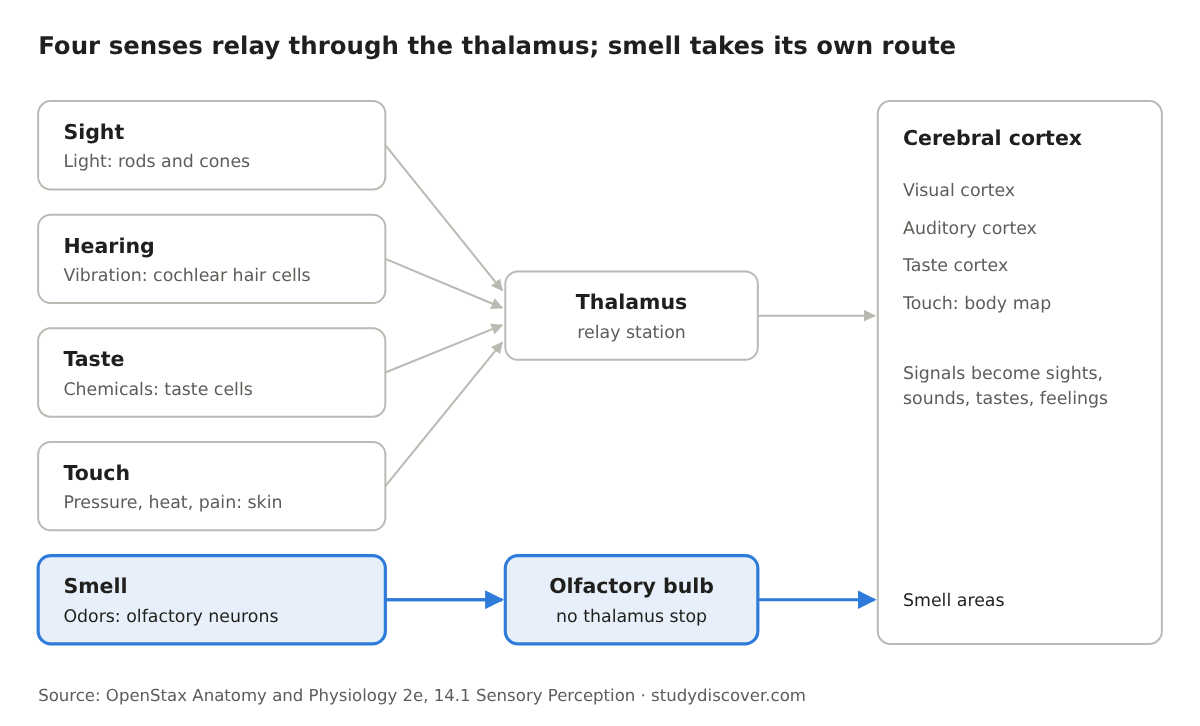
Picture of how our five senses work, showing sight, hearing, taste and touch relaying through the thalamus while smell goes to the olfactory bulb.
Think of the receptors as translators. Light, sound and chemicals all speak different languages, but each receptor translates its input into the one language the brain understands: electrical impulses. The brain then decides what those impulses mean, which is why the same kind of signal can become a color in one brain area and a musical note in another.
Which brain lobe handles which sense is covered in our guide to how the human brain works.
OpenStax Anatomy and Physiology 2e: 14.1 Sensory Perception
How Do Your Eyes See?
Your eyes see by focusing light onto the retina, where photoreceptor cells turn it into nerve signals. The clear cornea at the front bends incoming light, the lens fine-tunes the focus, and a sharp image lands on the retina at the back of the eyeball.
Your retina holds two kinds of photoreceptor:
- Rods work in dim light. They’re why you can still find your way around a dimly lit room, though colors fade.
- Cones need brighter light and handle color. There are three types, each holding a light-sensitive pigment (an opsin) tuned to a different range of wavelengths. Your brain compares how strongly each type responds to work out the color you’re looking at.
Vision is sharpest at the fovea, a small pit in the center of the retina packed with cones. That’s why you move your eyes to point straight at the words you’re reading. There’s also one spot with no photoreceptors at all, where the optic nerve leaves the eye: your blind spot. You never notice it because your brain fills in the gap.
From the retina, signals travel along the optic nerve to the thalamus and then to the visual cortex at the back of the brain.
How Do Your Ears Hear?
Your ears hear by turning air vibrations into fluid waves and then into nerve signals. Sound travels down the ear canal and makes the eardrum vibrate, and three tiny bones (the malleus, incus and stapes) pass that vibration on and boost it.
Here’s the chain inside the inner ear, step by step:
- The stapes pushes on the cochlea, a snail-shaped tube filled with fluid.
- The push makes the fluid ripple, sending a traveling wave along the basilar membrane that runs through the cochlea.
- Hair cells sitting on that membrane ride the wave. Tiny bristles on top of each cell (stereocilia) bend.
- Bending opens channels at the bristle tips, chemicals rush in, and the hair cell fires an electrical signal.
- The auditory nerve carries the signal to the brain, which recognizes it as a sound.
Pitch depends on where along the cochlea the wave peaks. Hair cells near the wide end respond to high-pitched sounds, and those closer to the center respond to low-pitched ones. According to OpenStax, the human cochlea handles frequencies from about 20 to 20,000 Hz.
How Does Your Nose Smell?
Your nose smells when airborne molecules land on olfactory sensory neurons in a small patch of tissue high inside the nasal cavity. Each of these neurons carries one type of odor receptor. A single odor molecule usually activates a combination of receptor types, and the brain reads that combination like a code.
That code is why you can tell apart so many smells. In a 2014 study published in Science, researchers at Rockefeller University asked 26 volunteers to pick the odd one out among three vials of mixed scents. From the results, they estimated that people can distinguish more than 1 trillion odors, far beyond the old estimate of about 10,000 from the 1920s, and they called even that a lower limit.
NIH Research Matters: Humans can identify more than 1 trillion smells
Smell is also the odd one out in how it reaches the brain. The olfactory neurons connect to the olfactory bulb on the underside of the frontal lobe, and smell is the one sense that doesn’t pass through the thalamus first.
How Does Your Tongue Taste?
Your tongue tastes when chemicals dissolved in saliva reach the taste buds tucked inside the small bumps (papillae) on its surface. Taste cells respond to at least five basic qualities, and each is detected a little differently:
| Taste | What the taste cells detect | Example food |
|---|---|---|
| Salty | Sodium ions | Chips |
| Sour | Hydrogen ions (acid) | Lemon juice |
| Sweet | Sugars such as glucose | Ripe mango |
| Bitter | Many different molecules, through special receptor proteins | Dark chocolate, coffee |
| Umami | The amino acid glutamate | Tomatoes, cheese, soy sauce |
The NIDCD says you have about 10,000 taste buds at birth, and you may start losing some after age 50. Along with smell cells, taste cells are among the only sensory cells your body keeps replacing throughout life. You’ll find more on what happens to food after it leaves your tongue in how the digestive system breaks down food.
Why Does Food Taste Bland When You Have a Cold?
Food tastes bland with a cold because most of what you call “flavor” is actually smell. When you chew, aromas travel from the back of your mouth up into your nose through a second channel at the roof of the throat. A blocked nose shuts that channel, so your tongue still detects sweet or salty, but the rich detail disappears.
According to the NIDCD, a smell problem is behind most cases where people believe their sense of taste has failed. Try it yourself: pinch your nose and eat a jelly bean. You’ll get “sweet,” but probably not “strawberry” until you let go.
How Does Your Skin Feel Touch?
Your skin feels touch through several kinds of receptors, each tuned to a different kind of contact. Touch is really a bundle of senses: light touch, pressure, vibration, stretch, temperature and pain.
| Receptor | What it senses | Everyday example |
|---|---|---|
| Tactile (Meissner) corpuscles | Light touch | A feather brushing your arm |
| Merkel cells | Steady pressure and low-frequency vibration | Feeling the edges of a coin in your pocket |
| Lamellated (Pacinian) corpuscles | Deep pressure and vibration | A phone buzzing in your hand |
| Bulbous (Ruffini) corpuscles | Skin stretching | Bending your fingers |
| Thermoreceptors | Heat or cold | Stepping onto a cold floor |
| Nociceptors | Chemicals released by damaged tissue (pain) | A paper cut |
Touch signals travel up the spinal cord to the thalamus and then to the part of the brain that maps your body surface.
Do Humans Really Have Only Five Senses?
No. The five classic senses are a useful starting point, but your body also tracks balance and body position all the time. Modern biology counts more.
- Balance (the vestibular sense): In your inner ear, next to the cochlea, two small sacs called the utricle and saccule sense the position of your head, and three fluid-filled semicircular canals sense when your head turns.
- Body position (proprioception): Stretch receptors in your muscles, tendons and joints tell your brain where your arms and legs are, which is why you can touch your nose with your eyes closed.
- Temperature and pain are often grouped under touch, but they use their own receptors, as the touch table shows.
Worked Example: All Five Senses in One Bite
Here’s an example scenario that shows the senses working together: eating a slice of hot pizza.
Step 1: Sight sets expectations
Light bouncing off the pizza reaches your retinas. Cones pick up the red of the sauce and the golden cheese, and your brain predicts “this will taste good” before you’ve touched it.
Step 2: Smell takes its own route
Aroma molecules float into your nose and hit olfactory neurons. Their signals take smell’s own route, straight to the olfactory bulb without stopping at the thalamus.
Step 3: Touch checks safety
Your fingertips register the warm crust through thermoreceptors and the soft weight through pressure receptors. If the cheese is too hot, nociceptors send a pain signal and you pull back.
Step 4: Hearing adds crunch
When you bite, vibrations from the crust travel through your jaw and the air into your ears. Hair cells in your cochlea turn them into the sound of a crunch.
Step 5: Taste and smell build flavor
Saliva dissolves salt and glutamate from the cheese and tomato, so taste cells report “salty” and “umami.” At the same time, aromas rise from the back of your mouth into your nose, and your brain merges both streams into the flavor you’d call “pizza.”
Common Mix-Ups About the Senses
| Myth | Reality |
|---|---|
| Humans have exactly five senses. | We also sense balance (utricle, saccule and semicircular canals) and body position (stretch receptors). |
| People can smell only about 10,000 different odors. | A 2014 study estimated people can tell apart more than 1 trillion odors. |
| A taste problem is usually a problem with the tongue. | Most suspected taste problems turn out to be smell problems. |
| All sense signals pass through the thalamus. | Smell connects to the olfactory bulb and does not synapse in the thalamus first. |
| Your ears pick up every sound around you. | Human hearing covers about 20 to 20,000 Hz; many sounds fall outside that range. |
Sources for the balance, thalamus and hearing-range rows:
OpenStax Anatomy and Physiology 2e: 14.1 Sensory Perception
Source for the smell-count row:
NIH Research Matters: Humans can identify more than 1 trillion smells
Source for the taste-problem row:
Frequently Asked Questions
What are the five senses and their organs?
The five senses are sight (eyes), hearing (ears), smell (nose), taste (tongue) and touch (skin). Each organ holds receptor cells built for one kind of stimulus: light for the eyes, vibrations for the ears, chemicals in air for the nose, chemicals in saliva for the tongue, and pressure, temperature and pain for the skin.
Which sense is the most important?
There’s no single answer, because each sense does a job the others can’t. Sight carries a lot of detail about distant objects, hearing works in the dark and around corners, and smell warns you about smoke or spoiled food. Touch and pain protect your body from injury. Most of the time the senses check each other, which gives the brain a more reliable picture.
How many tastes can humans detect?
Humans detect at least five basic tastes: sweet, salty, sour, bitter and umami. For a long time only four were recognized, and umami (a savory taste triggered by glutamate) was added later. The huge variety of flavors you notice comes from combining those tastes with smell, texture and temperature.
Why do we have two eyes and two ears?
Having two of each lets your brain compare slightly different inputs. Each eye sees from a slightly different angle, and your brain uses the difference to judge depth and distance. In the same way, a sound reaches one ear a fraction of a second before the other, which helps you tell where it came from.
Can you lose your sense of smell or taste?
Yes. Smell problems become more common with age, and the NIDCD lists causes such as sinus and respiratory infections, smoking, head injury, some medicines and conditions like Parkinson’s disease. In one study it cites, nearly a quarter of men aged 60 to 69 had a smell disorder. Anyone with a sudden or lasting change should see a doctor.
What is the difference between sensation and perception?
Sensation is the raw step: a receptor cell is activated by a stimulus, such as light hitting a cone. Perception is what your brain makes of the resulting signals, such as recognizing a red apple. The same sensation can be perceived differently depending on context and memory, which is why optical illusions fool you even when your eyes are working perfectly.
The Short Version
- Every sense follows the same path: stimulus, receptor, nerve signal, brain.
- Eyes use rods and three types of cones; ears use hair cells in the fluid-filled cochlea.
- Smell and taste are chemical senses, and smell supplies most of what we call flavor.
- Touch is a group of senses handled by different skin receptors, including ones for temperature and pain.
- Smell skips the thalamus, and balance and body position are senses too.
Ready to check yourself? Try the science quiz, or make a set of receptor-and-organ cards with the Flashcard Maker. To see how the nervous system fits with the rest of the body, read how the human body works, and browse more topics in Biology.
For more detail on smell, including what can cause it to fade, the NIDCD’s page is clear and free:
Disclaimer
This article is for general educational purposes only. It explains how healthy senses work and is not medical advice. If you notice a sudden or lasting change in your vision, hearing, smell, taste or touch, see a doctor or qualified health professional.