
So, how does the digestive system break down food? It works in two ways at once. Chewing and churning cut food into smaller pieces (mechanical digestion), while acid, bile and enzymes split starch, protein and fat into molecules small enough to enter the blood (chemical digestion). Most of that second job happens in the small intestine.
Nearly all of the work stays out of sight. About 9 liters of fluid pour into your small intestine every day, and only 2.3 liters of that comes from what you eat and drink. A full meal then takes 24 to 72 hours to finish its trip.
This guide follows a meal from the first bite to the last stop. You’ll see six stops in a labeled drawing, learn which enzyme splits which nutrient, find out how the small intestine absorbs the results, and work through the daily water budget with the math shown.
Quick answer
Digestion breaks food down in two ways. Teeth, stomach muscles and intestinal contractions physically shrink it, while saliva, stomach acid, pancreatic enzymes and bile split starch, protein and fat into sugars, amino acids and fatty acids. The small intestine then absorbs these nutrients, and the large intestine reclaims water.
Key takeaways
- Mechanical digestion shrinks food; chemical digestion turns it into absorbable building blocks.
- Starch digestion starts in the mouth, protein in the stomach, and most fat digestion in the small intestine.
- Bile is not an enzyme. It breaks fat into tiny droplets so the fat-splitting enzyme can reach it.
- Folds, villi and microvilli give the small intestine about 200 square meters of absorbing surface.
- A full meal takes about 24 to 72 hours to digest.
What Does the Digestive System Do?
It frees the nutrients locked inside food and moves them into your blood, using six activities. Your body can’t use a sandwich as it is, because cells can only take in small molecules.
| Activity | What happens | Where, mostly |
|---|---|---|
| Ingestion | Food enters and is chewed and mixed with saliva | Mouth |
| Propulsion | Swallowing, then waves of muscle push food along | Throat to anus |
| Mechanical digestion | Food is physically broken into smaller pieces, with no change to its chemistry | Mouth, stomach, small intestine |
| Chemical digestion | Secretions split large molecules into building blocks | Starts in the mouth, finishes in the small intestine |
| Absorption | Nutrients pass into the blood or lymph | Mainly the small intestine |
| Defecation | Undigested material leaves the body as feces | Rectum and anus |
The organs fall into two groups. The gastrointestinal (GI) tract is a hollow tube from mouth to anus: mouth, esophagus, stomach, small intestine, large intestine and anus. Three solid organs sit beside it and add fluids but never touch the food: the liver, the pancreas and the gallbladder. Gut bacteria, nerves and blood vessels help as well. The digestive system is one of 11 organ systems, and our human body guide shows how it teams up with the others.
Two kinds of muscle movement keep things going. In peristalsis, the muscle behind a lump of food squeezes while the muscle ahead relaxes, like pushing toothpaste along a tube. In segmentation, short stretches of the small intestine pinch and release in place, mixing food with juices and pressing it against the wall. The duodenum, the first part of the small intestine, does this about 12 times a minute.
OpenStax’s digestive system processes chapter lists the six activities and defines peristalsis and segmentation.
The NIDDK’s digestive system page names the six hollow organs and the three solid ones.
The 12-a-minute figure comes from OpenStax’s intestines chapter.
How Does Food Travel Through the Digestive System?
Food passes six stops from mouth to anus, and the small intestine is where most digestion and absorption happens. Three helper organs, the liver, gallbladder and pancreas, send their fluids to the small intestine through ducts.
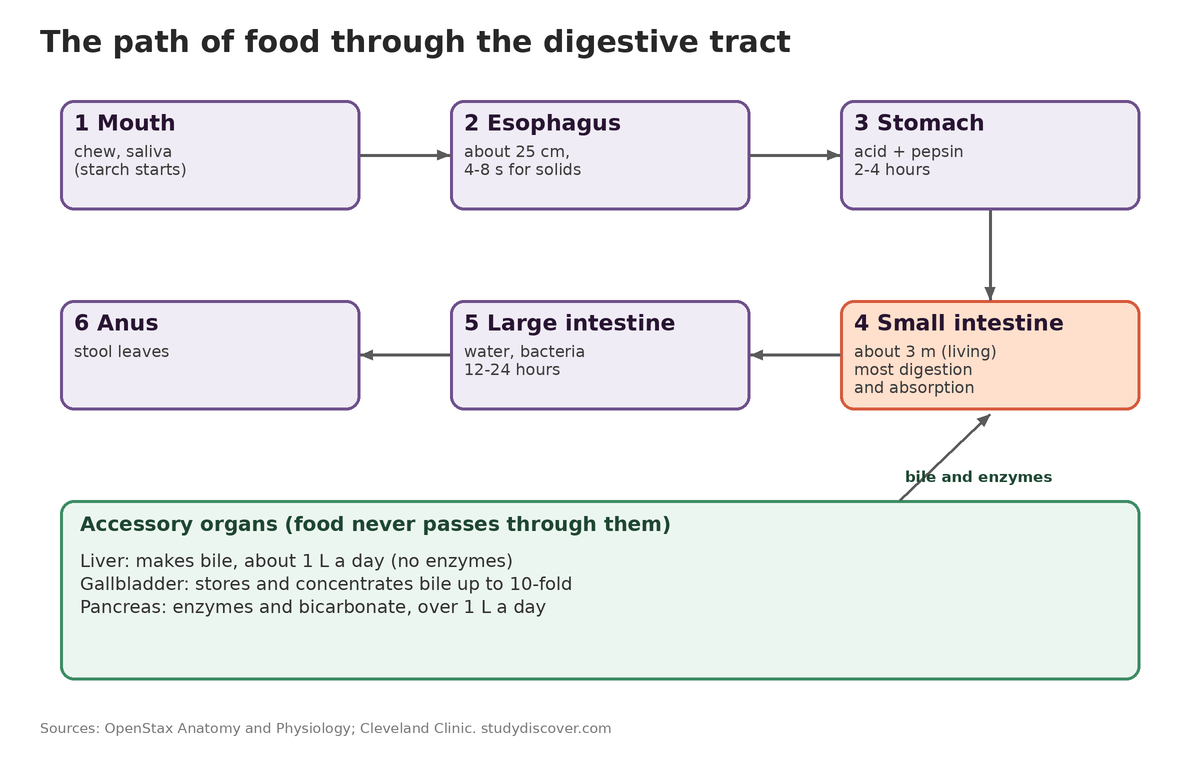
Follow the numbers: food goes in at 1, the small intestine at 4 does the heavy lifting, and what is left leaves at 6.
- Mouth. Teeth cut and grind the food, saliva moistens it, and the tongue shapes it into a rounded lump called a bolus.
- Esophagus. A muscular tube about 25 cm long pushes the bolus down by peristalsis.
- Stomach. A stretchy pouch mixes the food with acid and enzymes until it becomes a thick liquid called chyme.
- Small intestine. It is about 3 m long in a living person: the duodenum (25 cm), the jejunum (about 0.9 m) and the ileum (about 1.8 m). It receives bile and pancreatic juice, finishes chemical digestion and absorbs nearly everything useful.
- Large intestine. It is about half as long as the small intestine but wider, roughly 7.6 cm across. It reclaims water, hosts gut bacteria and shapes waste into stool.
- Rectum and anus. The rectum, about 20 cm long, stores stool until it leaves the body.
You may see longer figures. Cleveland Clinic gives about 30 feet (9 m) for the whole tract stretched out, and OpenStax notes that the small intestine is about twice as long in a cadaver as in a living person. The numbers above are the living ones.
The stop-by-stop lengths and the large intestine’s width come from OpenStax’s intestines chapter.
The esophagus length and the bolus come from OpenStax’s mouth, pharynx and esophagus chapter.
Cleveland Clinic’s digestive system page gives the 30-foot figure for the whole tract.
What Happens in the Mouth and Stomach?
The mouth starts starch digestion and the stomach starts protein digestion, and both shrink food mechanically along the way. Neither finishes the job, but both prepare food for the small intestine.
The mouth and swallowing
Adults have 32 permanent teeth: 8 incisors, 4 cuspids, 8 premolars and 12 molars. They do the mechanical work while three pairs of salivary glands release 1 to 1.5 liters of saliva a day. Saliva is 98 to 99.5% water, but it also carries salivary amylase, an enzyme that starts splitting starch. Amylase keeps working until stomach acid switches it off.
Swallowing takes about 4 to 8 seconds for solid food and about 1 second for liquids. As it starts, the epiglottis folds down over the entrance to your windpipe so food goes to the esophagus and not the lungs. Our guide to how the lungs breathe shows that same flap from the airway side. At the bottom of the esophagus, a ring of muscle called the lower esophageal sphincter opens to admit food and then closes to hold stomach acid back. When it leaks, you feel heartburn.
The stomach
An empty stomach is about the size of a fist, but it can stretch to hold up to 4 liters, more than 75 times its resting volume. Its glands make four things that matter here.
| Gland cell | Releases | Job |
|---|---|---|
| Surface mucus cells | Alkaline mucus | Coats and protects the stomach lining |
| Parietal cells | Hydrochloric acid and intrinsic factor | Acid activates pepsin, kills many bacteria and unfolds proteins; intrinsic factor is needed to absorb vitamin B12 later |
| Chief cells | Pepsinogen | Turns into the protein-splitting enzyme pepsin when acid meets it |
| G cells | Gastrin (a hormone) | Tells parietal cells to make more acid |
The contents are very acidic, with a pH between 1.5 and 3.5. Strong muscles churn the food with these juices, sending a mixing wave about every 20 seconds. Each wave pushes only about 3 mL of chyme through the pyloric sphincter at the exit, and the rest slides back for more mixing. The stomach empties within 2 to 4 hours of a meal. Carbohydrate-rich foods leave first, high-protein foods next, and a fatty meal can stay 6 hours or longer.
Little absorption happens here. The stomach takes in some alcohol and a few drugs such as aspirin, but nutrients wait for the small intestine.
OpenStax’s mouth, pharynx and esophagus chapter gives the teeth, saliva, swallowing and sphincter details.
OpenStax’s stomach chapter gives the capacity, gland cells, pH, mixing waves and emptying times.
How Do Enzymes Split Carbohydrates, Proteins and Fats?
Each nutrient is split by a relay of enzymes, and each enzyme fits only one kind of molecule. Starch, protein and fat start at different stops, but all three finish in the small intestine.
| Nutrient (example) | Where it starts | Main work in the small intestine | Ends as |
|---|---|---|---|
| Starch (bread) | Mouth: salivary amylase cuts it into short sugar chains | Pancreatic amylase does most of the work, then enzymes on the intestinal lining (maltase, sucrase, lactase and others) finish | Glucose, fructose, galactose |
| Protein (cheese) | Stomach: acid and pepsin cut it into polypeptides | Pancreatic enzymes such as trypsin and chymotrypsin make smaller peptides, then peptidases on the lining finish | Amino acids |
| Fat (butter) | Mouth and stomach: small amounts of lipase, a minor role | Bile breaks fat into tiny droplets, then pancreatic lipase splits it | Fatty acids and monoacylglycerides |
Virtually all fat digestion happens in the small intestine, which is why the helper organs matter so much.
What do bile and pancreatic juice add?
The liver makes about 1 liter of bile a day. Bile is a yellow-brown or green fluid that contains bile salts but no enzymes. The salts act like dish soap on a greasy pan: they break large fat globules into droplets about 1 micrometer across, which gives lipase far more surface to work on. The gallbladder, 8 to 10 cm long, stores bile between meals and concentrates it by up to 10 times.
The pancreas makes more than 1 liter of juice a day. It carries sodium bicarbonate, which neutralizes the acidic chyme from the stomach and switches off pepsin, so the intestinal enzymes get the conditions they need. Amylase and lipase leave the pancreas ready to work. The protein-splitting enzymes leave inactive, as trypsinogen and similar forms, and switch on only inside the duodenum. That delay stops the pancreas from digesting itself.
The enzymes on the lining finish the job one molecule at a time. If someone makes too little lactase, milk sugar goes undigested, which is lactose intolerance.
Who tells the organs when to work?
Hormones and nerves do. When food reaches the stomach, the hormone gastrin tells it to make more acid. When chyme reaches the duodenum, the hormone secretin tells the pancreas to release bicarbonate, and cholecystokinin (CCK) tells it to release enzymes and tells the gallbladder to release bile. Nerves in the gut wall handle short local reflexes, while the sight, smell or taste of food can start the stomach working through the medulla in the brainstem. Our brain guide shows where the brainstem sits.
OpenStax’s chemical digestion chapter supplies every enzyme and end product in the table, plus lactase and lactose intolerance.
OpenStax’s accessory organs chapter supplies the bile and pancreatic juice figures and the inactive-enzyme detail.
OpenStax’s processes and regulation chapter supplies gastrin, secretin, CCK and the nerve reflexes.
How Does the Small Intestine Absorb Nutrients?
It folds a 3-meter tube into about 200 square meters of absorbing surface and lets small molecules cross into the blood and lymph. That surface is more than 100 times the area of your skin.
Three layers of folding build it. Circular folds, villi and microvilli together increase the surface by more than 600 times. Villi are finger-like bumps 0.5 to 1 mm long, packed at about 20 to 40 per square millimeter. Each villus is covered in microvilli, hairs about 1 micrometer long, at an estimated 200 million per square millimeter. For comparison, a smooth tube 3.05 m long and 2.54 cm wide would have only about 0.24 square meters of inside surface (our own calculation).
Absorbed nutrients take one of two roads.
| What | Route | Where it goes first |
|---|---|---|
| Glucose, galactose, fructose, amino acids, glycerol, short-chain fatty acids | Capillaries in the villi, then the hepatic portal vein | The liver |
| Long-chain fatty acids and monoacylglycerides | Repackaged into chylomicrons, which enter lymph vessels called lacteals | The lymph, then the bloodstream through the thoracic duct |
Fat takes the lymph road because chylomicrons are too large to squeeze through the capillary walls. Bile salts help get fat to the lining in the first place by packing fatty acids into tiny carriers called micelles.
The small intestine absorbs nearly everything: about 90% of the water, 80% of the electrolytes, 95 to 98% of the protein and about 95% of the fat. It also handles the vitamins. Vitamins A, D, E and K ride in with fat. Iron enters in the duodenum. Vitamin B12 needs the intrinsic factor made in the stomach and is absorbed at the end of the ileum.
From the liver, the blood returns to the heart, which pumps it to every cell. Our guide to how the human heart works follows that trip, and cells then burn the glucose for energy. It is the same sugar plants build in photosynthesis.
OpenStax’s intestines chapter gives the surface area, the 600-fold increase, villus and microvillus sizes.
OpenStax’s chemical digestion and absorption chapter gives the absorption routes, the percentages absorbed and the vitamin details.
The NIDDK’s digestive system page confirms that blood carries sugars and amino acids to the liver and lymph carries fatty acids.
What Does the Large Intestine Do?
It reclaims water, houses trillions of bacteria and turns leftovers into stool. By the time food residue arrives, nearly all the nutrients are already gone.
The residue lingers here for 12 to 24 hours. More than 700 species of bacteria live in the large intestine, mostly harmless ones. They make biotin, pantothenic acid and vitamin K, and they break down some of the remaining material. Slow contractions every 30 minutes or so, each lasting about a minute, mix the contents, and bigger mass movements sweep them toward the rectum three or four times a day.
OpenStax’s intestines chapter supplies the residence time, bacteria, vitamins and contraction pattern.
Where Do 9 Liters of Digestive Fluid Go Each Day?
Almost all of it is absorbed and reused, and you can show that in five steps. This is a worked example using the typical figures printed in a standard anatomy textbook, so your own numbers will vary.
Step 1: Count what enters the small intestine
About 9 liters of fluid enter the small intestine in a day.
Step 2: Split it into two sources
Only 2.3 liters come from food and drink. The rest, 9 − 2.3 = 6.7 liters, is the body’s own secretions. Saliva (1 to 1.5 L), bile (about 1 L), pancreatic juice (over 1 L) and intestinal juice (0.95 to 1.9 L) are the named parts, and stomach juices and others make up the remainder.
Step 3: Find what the small intestine absorbs
About 90% of the water is absorbed there. 9 L × 0.90 = 8.1 liters.
Step 4: Find what moves on
9 − 8.1 = 0.9 liters continues toward the large intestine. That matches the textbook’s statement that less than a liter enters it.
Step 5: Find what leaves as stool
The textbook also says that of every 500 mL of residue reaching the start of the large intestine, about 150 mL becomes stool. So (500 − 150) ÷ 500 = 70% of that residue is reabsorbed on the way out. The 0.9 L and 500 mL figures describe different measurements, so treat both as rough.
The lesson is the size of the recycling. Most of the fluid your digestive system uses each day is body water that is taken back, not water you drink.
OpenStax’s chemical digestion and absorption chapter supplies the 9 liters, the 2.3 liters and the 90%.
The fluid volumes for saliva, bile, pancreatic juice and intestinal juice come from the mouth, accessory organs and intestines chapters, and the 500 mL and 150 mL figures from the intestines chapter.
How Long Does Digestion Take?
A full meal takes about 24 to 72 hours to digest, and much of that time is spent in the large intestine. The stages overlap, so their times don’t simply add up.
| Stage | Typical time |
|---|---|
| Swallowing | About 4 to 8 seconds for solid food |
| Stomach | Empties within 2 to 4 hours; a fatty meal can take 6 hours or longer |
| Small intestine | About 3 to 5 hours for the chyme to leave |
| Large intestine | Usually 12 to 24 hours |
| Whole trip | 24 to 72 hours |
What you eat changes the stomach time. Carbohydrate-rich foods leave first, high-protein foods follow, and fat slows things down. Meals also don’t leave in the order they went in.
OpenStax’s mouth chapter, stomach chapter and intestines chapter supply these times.
Common Mix-Ups About Digestion
| Myth | Reality |
|---|---|
| Most digestion happens in the stomach. | The stomach starts protein digestion, but virtually all fat digestion and most chemical digestion finish in the small intestine. Little absorption happens in the stomach. |
| Bile is a digestive enzyme. | Bile contains bile salts but no enzymes. It breaks fat into tiny droplets so the enzyme lipase can reach it. |
| Stomach acid should dissolve the stomach itself. | A bicarbonate-rich mucus layer, tight seals between lining cells and fast replacement of those cells (every 3 to 6 days) protect the wall. |
| The small intestine is 6 to 7 meters long in a living person. | It is about 3 meters in a living person and about twice that in a cadaver. |
| Food just falls down the esophagus. | Waves of muscle contraction push the bolus toward the stomach. |
OpenStax’s chemical digestion chapter backs the first row.
OpenStax’s accessory organs chapter backs the second row.
OpenStax’s stomach chapter backs the first and third rows.
OpenStax’s intestines chapter backs the fourth row, and its mouth chapter backs the fifth.
Frequently Asked Questions
What are the main organs of the digestive system?
Six hollow organs form the tube: the mouth, esophagus, stomach, small intestine, large intestine and anus. Three solid organs add fluids: the liver, which makes bile, the gallbladder, which stores it, and the pancreas, which makes enzymes and bicarbonate. Food passes through the tube but never through the three solid organs.
What is chyme?
Chyme is the thick liquid that forms when food is mixed with stomach juices. The stomach releases it into the small intestine in small spurts, about 3 mL with each mixing wave. By then the food has been softened by acid and partly split by pepsin, which makes it easier for the intestinal enzymes to finish the work.
What does the liver do in digestion?
Its digestive job is making bile, about 1 liter a day, and sending it to the duodenum. The liver also receives blood from the small intestine through the hepatic portal vein, so sugars and amino acids reach it first. It has other roles in metabolism that this guide doesn’t cover.
How long does it take food to go through the digestive system?
About 24 to 72 hours for a full meal. The stomach empties within 2 to 4 hours, the small intestine passes chyme on in about 3 to 5 hours, and residue spends roughly 12 to 24 hours in the large intestine. Fatty meals and individual differences change these times.
How long is the digestive tract?
Cleveland Clinic gives about 30 feet (9 m) for the whole tract stretched out. OpenStax puts the small intestine alone at about 3 m in a living person and about twice that in a cadaver. The answer depends on whether it is measured in life or after death, so quoted lengths differ.
What is the difference between digestion and absorption?
Digestion splits food into small molecules, and absorption moves those molecules across the intestinal lining into blood or lymph. A molecule can be fully digested and still not absorbed, as happens to milk sugar when someone lacks the enzyme lactase.
The Short Version
- Digestion has two parts: mechanical (breaking food into pieces) and chemical (splitting it into building blocks).
- Starch starts in the mouth, protein in the stomach, and fat in the small intestine, with bile, pancreatic juice and lining enzymes finishing the work.
- The small intestine absorbs about 90% of the water and nearly all the nutrients through about 200 square meters of folded surface.
- The large intestine reclaims water, hosts bacteria and forms stool.
- A full meal takes about 24 to 72 hours, and most of the fluid in the gut is the body’s own, recycled.
Test what you have learned with the Science Quiz, or turn the enzymes and organs in this guide into cards with the Flashcard Maker. For the bigger picture, read our human body guide, and for more explainers like this one, browse the Science category.
For the textbook version of the chemistry, see OpenStax’s chemical digestion and absorption chapter.
Disclaimer
This article is for general educational purposes only. It explains how a healthy digestive system works and does not diagnose or treat any condition. If you have lasting stomach pain, vomiting, blood in your stool or unexplained weight loss, talk to a doctor.