Your heart is about the size of a fist, yet it moves roughly 5 liters of blood every minute, which adds up to nearly 2,000 gallons a day. It does this without a single day off.
So, how does the human heart work? It is a muscular pump with four chambers and four one-way valves. The right side sends oxygen-poor blood to the lungs, the left side sends oxygen-rich blood to the rest of the body, and a small cluster of cells called the SA node sets the rhythm with an electrical signal. The heart and the blood vessels together make up the circulatory system.
This guide follows blood around the full loop, explains the chambers and valves in plain terms, walks through what happens in one heartbeat, and does the math on how much blood the heart really moves. It also clears up five common mix-ups, such as why veins look blue.
Quick answer
The heart is a four-chambered muscle that pumps blood in two loops. The right side sends blood to the lungs to pick up oxygen, and the left side sends it out to the body. Four valves keep the blood moving one way, and electrical signals from the SA node time every beat.
Key takeaways
- Four chambers, four valves: two atria receive blood, two ventricles push it out, and the valves stop it flowing backward.
- Two loops: blood travels heart to lungs and back, then heart to body and back, and both loops start and end in the heart.
- A built-in pacemaker: the SA node normally fires 60 to 100 times a minute at rest.
- Big numbers: about 5 liters of blood a minute and roughly 100,000 beats a day.
- More than a pump: the heart plus blood vessels that would stretch about 60,000 miles end to end form the circulatory system.
What Is the Circulatory System?
The circulatory system is the heart plus the blood vessels, and its job is to carry oxygen and nutrients to every cell while carrying waste away. You will also see it called the cardiovascular system. Blood leaves the heart through arteries, passes through tiny capillaries where the swap with your tissues happens, and returns through veins.
| Vessel | Job | What it looks like |
|---|---|---|
| Arteries | Carry blood away from the heart | Thick walls and a narrow channel |
| Capillaries | Swap oxygen, nutrients and waste with tissue | Microscopic, about 5 to 10 micrometers across |
| Veins | Carry blood back toward the heart | Thin walls and a wide channel, with one-way valves in the limbs |
Laid end to end, all of these vessels would stretch roughly 60,000 miles (more than 96,500 km). At any given moment, the veins hold about 64% of your blood, which is why they are described as blood reservoirs. The brain gets about 20% of the flow, and a stoppage lasting around 3 to 4 minutes typically causes lasting damage. Our guide to how the human brain works explains why that organ is so costly to run.
The definition and the 60,000-mile figure come from Cleveland Clinic’s page on the circulatory system, which Texas Heart Institute’s page on the cardiovascular system also reports in kilometers.
The vessel jobs, capillary size and the 64% figure are in OpenStax’s chapter on the structure and function of blood vessels.
The brain’s 20% share of blood flow and the 3 to 4 minute figure are in OpenStax’s section on circulatory pathways.
What Is the Heart Made Of?
The heart is a hollow muscle with four chambers, four valves and a three-layer wall. It sits in the middle of the chest between the lungs, tilted so that its tip points slightly to the left. An adult heart is about 12 cm long, 8 cm wide and 6 cm thick (roughly a fist), and it weighs about 250 to 300 g in women and 300 to 350 g in men.
The wall has three layers: the epicardium on the outside, the thick muscle layer called the myocardium in the middle, and the smooth endocardium lining the chambers. A tough sac, the pericardium, surrounds the heart and holds a little fluid that reduces friction as it beats.
The four chambers
The top two chambers are atria, which receive blood. The bottom two are ventricles, which push it out.
| Chamber | Receives blood from | Sends blood to |
|---|---|---|
| Right atrium | The body, through two large veins (the venae cavae) | Right ventricle |
| Right ventricle | Right atrium | The lungs, through the pulmonary trunk |
| Left atrium | The lungs, through four pulmonary veins | Left ventricle |
| Left ventricle | Left atrium | The whole body, through the aorta |
The left ventricle has a much thicker wall than the right. Both pump the same volume per beat, but the left must push blood around the long loop through the body, which offers more resistance than the shorter loop through the lungs.
The four valves
A valve works like a one-way door: it opens to let blood through and closes so it cannot slip back.
| Valve | Where it sits | Flaps |
|---|---|---|
| Tricuspid | Between the right atrium and right ventricle | 3 |
| Pulmonary | Where the right ventricle sends blood toward the lungs | 3 |
| Mitral | Between the left atrium and left ventricle | 2 |
| Aortic | Where the left ventricle sends blood into the aorta | 3 |
The size, weight, layers, chamber connections, valve positions and the thick-left-wall explanation come from OpenStax’s chapter on heart anatomy.
The flap counts and the one-way job of the valves are described by the American Heart Association in how the healthy heart works.
The chest position, tilted slightly left, is described by the British Heart Foundation in how your heart works.
How Does Blood Flow Through the Heart?
Blood travels in a double loop: it enters the right side of the heart, goes to the lungs for oxygen, returns to the left side, and is pumped out to the body. The drawing below follows it step by step.
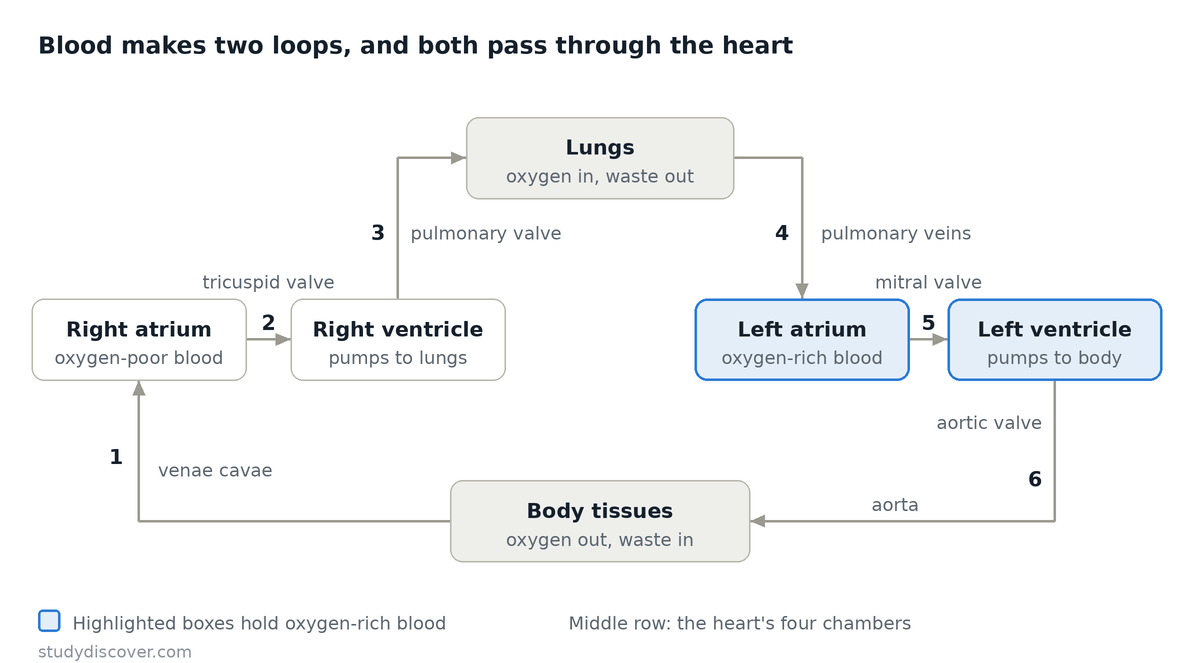
- Return. Oxygen-poor blood from the body flows through the venae cavae into the right atrium.
- Fill. It passes through the tricuspid valve into the right ventricle.
- To the lungs. The right ventricle pushes it through the pulmonary valve toward the lungs.
- Refuel. In the lung capillaries, carbon dioxide leaves the blood and oxygen enters. Four pulmonary veins carry the oxygen-rich blood to the left atrium.
- Fill again. It crosses the mitral valve into the left ventricle.
- To the body. The left ventricle pumps it through the aortic valve into the aorta, and it reaches the capillaries of every tissue before returning to step 1.
The lung loop (steps 3 and 4) is called the pulmonary circuit, and the body loop (steps 6 and 1) is the systemic circuit. Both ventricles pump the same volume of blood with each beat, so the two loops stay in balance.
The pulmonary and systemic circuit steps follow the chamber and circulation details in OpenStax’s chapter on heart anatomy, and the pulmonary veins and the aorta’s path are described in its section on circulatory pathways.
What Makes the Heart Beat?
A small cluster of cells called the SA node (sinoatrial node), in the upper right atrium, fires an electrical signal that spreads through the heart in a fixed order and makes the chambers squeeze one after another. The nervous system can speed this pacemaker up or slow it down, but the signal itself starts inside the heart.
Here is the route of one signal, in six steps.
- SA node fires. This natural pacemaker starts every beat.
- Atria contract. The signal spreads across both atria, which push blood down into the ventricles.
- AV node pauses the signal. Near the center of the heart, the atrioventricular (AV) node holds the signal for a fraction of a second so the atria can finish emptying first.
- Bundle of His. The signal then runs down the wall between the two ventricles.
- Bundle branches. The path splits into a left branch and a right branch, one for each ventricle.
- Purkinje fibers. These fibers carry the signal very quickly through the ventricle walls, and the ventricles contract and send blood out.
At rest, the SA node normally fires 60 to 100 times a minute. Left to itself it would settle near 100, but input from the vagus nerve slows it, which is why the average adult rests around 75 beats a minute. At that rate one full cycle lasts about 0.8 second. The atria squeeze for roughly 0.1 second and the ventricles for roughly 0.27 second, so most of each beat is spent relaxing and refilling.
What are the “lub-dub” sounds?
The two sounds of a heartbeat come from valves closing, not from the muscle squeezing.
| Sound | What causes it | When it happens |
|---|---|---|
| “Lub” | The tricuspid and mitral valves close | As the ventricles begin to contract |
| “Dub” | The pulmonary and aortic valves close | As the ventricles relax |
The six-step signal route follows Cleveland Clinic’s page on the heart’s conduction system.
The 60 to 100 beats a minute from the SA node is stated by Johns Hopkins Medicine in its page on the heart’s electrical system.
The resting rate near 100 without vagal slowing, the average of about 75 and the typical ranges are in OpenStax’s section on cardiac physiology.
The timings of the cycle and the cause of each heart sound come from OpenStax’s section on the cardiac cycle.
How Much Blood Does the Heart Pump?
At rest, an average adult’s heart pumps about 5.25 liters a minute, which is roughly 7,560 liters a day. The working below uses average resting values from textbooks, so it is an example scenario, not a measurement of any one person.
Step 1: Take the heart rate
A resting adult averages about 75 beats a minute, and most people fall between 60 and 100.
Step 2: Take the stroke volume
Stroke volume is the blood one ventricle ejects per beat. For a resting 70-kg adult it averages about 70 mL, with a normal range of 55 to 100 mL.
Step 3: Multiply to get cardiac output
Cardiac output is heart rate times stroke volume: 75 × 70 mL = 5,250 mL, or 5.25 liters a minute. Cleveland Clinic gives a normal range of about 5 to 6 liters a minute, so the result sits inside it.
Step 4: Scale it to one day
There are 1,440 minutes in a day, so 5.25 liters × 1,440 = 7,560 liters. That is about 1,997 US gallons, which matches Cleveland Clinic’s figure of about 2,000 gallons (more than 7,500 liters) a day.
Step 5: Count the beats
75 beats × 1,440 minutes = 108,000 beats a day, in line with the British Heart Foundation’s “about 100,000.” Over 70 years that is roughly 2.76 billion beats, consistent with Healthline’s “over 2.5 billion.”
The three sources line up with the calculation, but a hard workout or a very fit heart will shift every number in the steps above.
The resting heart rate, stroke volume and 5.25 liters a minute come from OpenStax’s section on cardiac physiology.
The 5 to 6 liter range and the cardiac output formula are on Cleveland Clinic’s page on cardiac output.
The 2,000 gallons a day figure is on Cleveland Clinic’s circulatory system page, the beat count is on the British Heart Foundation’s how your heart works, and the 70-year figure is on Healthline’s circulatory system page. The conversions and totals (7,560 liters, 1,997 gallons, 108,000 beats, 2.76 billion beats) are our own arithmetic.
How Does the Heart Get Its Own Blood?
The heart muscle is fed by its own arteries, the coronary arteries, and they are the very first branches off the aorta, starting just above the aortic valve.
| Artery | Main branches | Mainly supplies |
|---|---|---|
| Left coronary artery | Left anterior descending and circumflex | The left atrium, left ventricle and the wall between the ventricles |
| Right coronary artery | Marginal and posterior descending | The right atrium, parts of both ventricles and the conduction system |
One detail surprises most students: coronary blood flow peaks when the heart muscle relaxes and almost stops while it contracts. Coronary veins then collect the used blood and empty into a channel called the coronary sinus, which opens into the right atrium.
The coronary arteries, their branches and the flow pattern are described in OpenStax’s chapter on heart anatomy, and the aortic origin is repeated in its section on circulatory pathways.
How Do You Check Your Heart Rate?
You can count your heart rate yourself by feeling your pulse for 15 seconds and multiplying by four. A normal resting rate for adults is 60 to 100 beats a minute.
- Pick the right moment. Check in the morning after you wake up, while you are calm and still.
- Find the pulse. Place your index and middle fingers on the inside of your wrist, below the thumb, or on the side of your neck next to the windpipe.
- Count. Count the beats for 15 seconds and multiply by four. Counting for 30 seconds and multiplying by two also works.
- Compare. For example, 18 beats in 15 seconds is 18 × 4 = 72 beats a minute (an example scenario), which is well inside the normal range.
Very fit athletes can rest closer to 40 beats a minute, because a stronger heart does not need to beat as often to move the same blood. A rate that is often too high or too low can signal a health problem, so mention it to a doctor.
The pulse steps, the 60 to 100 range and the athlete figure come from Mayo Clinic’s page on what a normal heart rate is, reviewed October 22, 2025.
Common Mix-Ups About the Heart and Blood
Five popular ideas about the heart and circulation sound right but are not.
| Myth | Reality |
|---|---|
| Blood in your veins is blue. | All blood is red, colored by hemoglobin. Oxygen-poor blood in veins only looks bluish through the skin. |
| Arteries always carry oxygen-rich blood. | The pulmonary arteries carry oxygen-poor blood to the lungs, and the pulmonary veins carry oxygen-rich blood back. |
| The heart sits on the left side of the chest. | It sits in the middle of the chest, tilted slightly to the left. |
| “Lub-dub” is the heart muscle squeezing. | The sounds are valves closing. |
| Blood travels in one big loop. | It makes two loops, one through the lungs and one through the body, and both pass through the heart. |
The blue-blood and artery points are explained on Cleveland Clinic’s page on the circulatory system.
The heart’s position is described by the British Heart Foundation in how your heart works, and the two loops and the cause of the heart sounds are in OpenStax’s chapters on heart anatomy and the cardiac cycle.
Frequently Asked Questions
How many times does the heart beat in a day?
About 100,000 times, according to the British Heart Foundation. At an average resting rate of 75 beats a minute, the arithmetic gives 108,000 (75 × 1,440 minutes). Exercise and fitness change the real number, so treat both figures as averages, not a count for any one person.
What is the difference between the heart and the circulatory system?
The heart is the pump. The circulatory system is the heart plus all the blood vessels (arteries, capillaries and veins) that carry blood around the body, and it is also called the cardiovascular system. Think of the heart as the engine and the vessels as the pipes it pushes blood through.
Why is the left side of the heart stronger than the right?
The left ventricle has a much thicker wall because it must push blood around the long loop through the whole body, which meets more resistance than the shorter loop through the lungs. Both ventricles pump the same volume per beat, so the left side simply works at higher pressure.
What is a normal resting heart rate?
For adults it is 60 to 100 beats a minute, with an average near 75. Very fit athletes may rest closer to 40. A rate that is often too high or too low can point to a health problem, so it is worth mentioning to a doctor.
How long are all the blood vessels in the body?
Laid end to end they would stretch roughly 60,000 miles, which is more than 96,500 km. Capillaries are the smallest and most numerous of them, and they are where oxygen, nutrients and waste move between the blood and your tissues.
The FAQ figures come from the same pages cited above: Cleveland Clinic’s circulatory system, the British Heart Foundation’s how your heart works, OpenStax’s cardiac physiology and Mayo Clinic’s heart rate guide.
The Short Version
- The heart is a four-chambered muscle with four valves that pumps blood in two loops, one to the lungs and one to the body.
- The SA node starts every beat, and the signal travels from the atria through the AV node to the ventricles.
- At rest, an average heart pumps about 5.25 liters a minute, roughly 7,560 liters a day.
- The “lub-dub” is valves closing, and the heart muscle has its own coronary arteries.
- A normal resting heart rate is 60 to 100 beats a minute, and you can check yours with a 15-second pulse count.
To check what you remember, try the Science Quiz, then turn the chamber and valve tables into cards with the Flashcard Maker. For the bigger picture, read how the human body works, and for the framework that surrounds the organs, see how many bones are in the human body. You can also browse the Science category for more guides like this one.
For a medically reviewed overview of heart anatomy, see Cleveland Clinic’s heart page.
Disclaimer
This article is for general educational purposes only. The numbers in the worked example are textbook averages, not measurements of any one person. It is not medical advice, so for chest pain, fainting, a racing or irregular pulse, or any other concern about your heart, see a doctor or call your local emergency number.