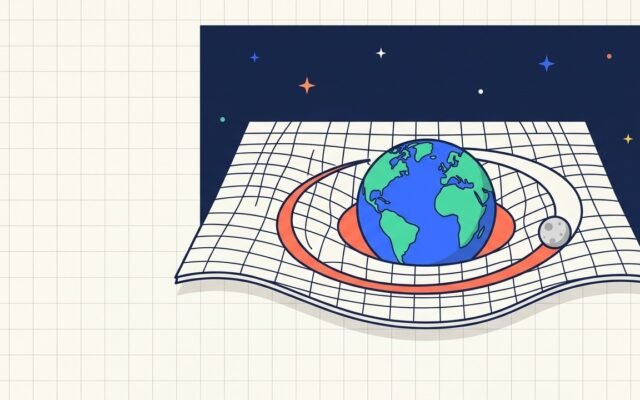
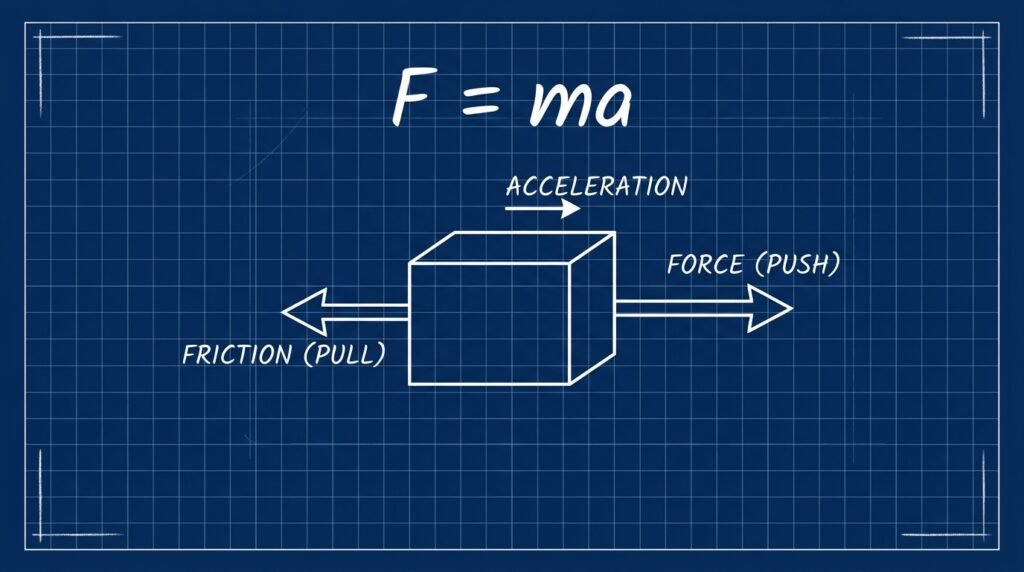
Newton’s three laws of motion explain how forces change the way things move: an object keeps its motion until a force changes it, a bigger force or a smaller mass gives more acceleration, and every push is met by an equal push back. They show how math and physics describe our world, because one short equation, F = ma, predicts the motion of everything from a rolling ball to a rocket.
Most students can recite the laws and still get stuck on exam questions, usually in the same three places: what “net force” means, why friction matters, and why action and reaction forces do not cancel out. This guide clears up each one with real examples and numbers you can check yourself.
You will get every law in plain words, a worked force calculation, a table of force pairs, and a list of the mix-ups that cost marks.
Quick answer: Newton’s first law says an object keeps its motion unless an unbalanced force acts on it. The second law says net force equals mass times acceleration (F = ma). The third law says that when object A pushes on object B, B pushes back on A with an equal force in the opposite direction.
Key takeaways
- First law: no net force means no change in motion, so a moving object keeps its speed and direction.
- Second law: acceleration = net force ÷ mass, so the same push moves a light object more than a heavy one.
- Third law: forces come in pairs, and the two forces in a pair act on different objects.
- Friction is a real force, which is why everyday objects seem to “need” a push to keep moving.
- One newton is the force that gives a 1 kg mass an acceleration of 1 m/s².
What Are Newton’s Three Laws of Motion?
Newton’s three laws of motion are three rules that describe how forces and motion are linked, and together they cover how almost every everyday object speeds up, slows down, or stays put. The table gives each law in one line before we unpack it.
| Law | In plain words | Key idea | Everyday sign |
|---|---|---|---|
| First (inertia) | Motion stays the same unless a net force acts | Net force = 0 means constant velocity | You lurch forward when a bus brakes |
| Second (force) | More net force means more acceleration, more mass means less | F = ma | An empty cart is easier to speed up than a full one |
| Third (action and reaction) | Pushes come in equal, opposite pairs | Pair forces act on different objects | A swimmer pushes water back and moves forward |
Which Words Do You Need to Know First?
Five terms carry almost every Newton’s-laws question: force, net force, mass, acceleration, and inertia. Learn them once and the laws stop feeling slippery.
| Term | Meaning | Unit |
|---|---|---|
| Force | A push or pull on an object | newton (N) |
| Net force | All the forces on an object added together, with direction counted | newton (N) |
| Mass | How much matter an object has, and how strongly it resists changes in motion | kilogram (kg) |
| Acceleration | How quickly velocity changes: speeding up, slowing down, or turning | m/s² |
| Inertia | An object’s tendency to resist changes in its motion | No unit (it is measured by mass) |
Mass and weight are different things. Mass stays the same everywhere, while weight is the pull of gravity on that mass. If you want the full story on weight, our guide on how gravity works covers it with a worked example.
OpenStax College Physics defines the newton precisely: one newton is the force that gives a 1 kg mass an acceleration of 1 m/s², so 1 N = 1 kg·m/s².
That definition is spelled out in the OpenStax chapter on Newton’s second law and the concept of a system.
What Is Newton’s First Law of Motion?
Newton’s first law says an object at rest stays at rest, and an object in motion keeps moving in a straight line at constant speed, unless an unbalanced force acts on it. This is why it is also called the law of inertia.
The phrase that trips people up is “unbalanced.” Forces on an object can cancel. A book on a desk has gravity pulling it down and the desk pushing it up with equal strength, so the net force is zero and the book does not accelerate. NASA’s Glenn Research Center states the same rule: if the external forces cancel out, the net force is zero and the velocity stays constant.
You can read NASA’s version in its beginner’s guide to Newton’s laws of motion.
Why does a rolling ball stop if no force is needed to keep it moving?
It stops because friction and air resistance are forces too. On a bowling lane the ball rolls far, on grass it stops quickly, and on a frictionless surface it would keep going. The law is not wrong, you are just not seeing every force acting. Most “motion needs a push” ideas come from forgetting friction.
Real example: why seat belts matter
When a car stops suddenly, the car slows but your body keeps moving at the old speed until something pushes on it. That something should be the belt. The National Highway Traffic Safety Administration reports that buckling up cuts the risk of fatal injury for front-seat passenger car occupants by 45%, and that seat belts saved an estimated 14,955 lives in 2017.
Those figures come from NHTSA’s page on seat belts.
What Is Newton’s Second Law of Motion?
Newton’s second law says the acceleration of an object equals the net force on it divided by its mass. As an equation, it is the most used formula in introductory physics.
Fnet = m × a or a = Fnet ÷ m
Three things follow from it. Double the net force and the acceleration doubles. Double the mass and the acceleration halves. And acceleration points the same way as the net force. NASA adds one condition: the simple form F = ma applies when the mass stays constant. If you need to rearrange the equation, the steps are the same ones in our introduction to algebra.
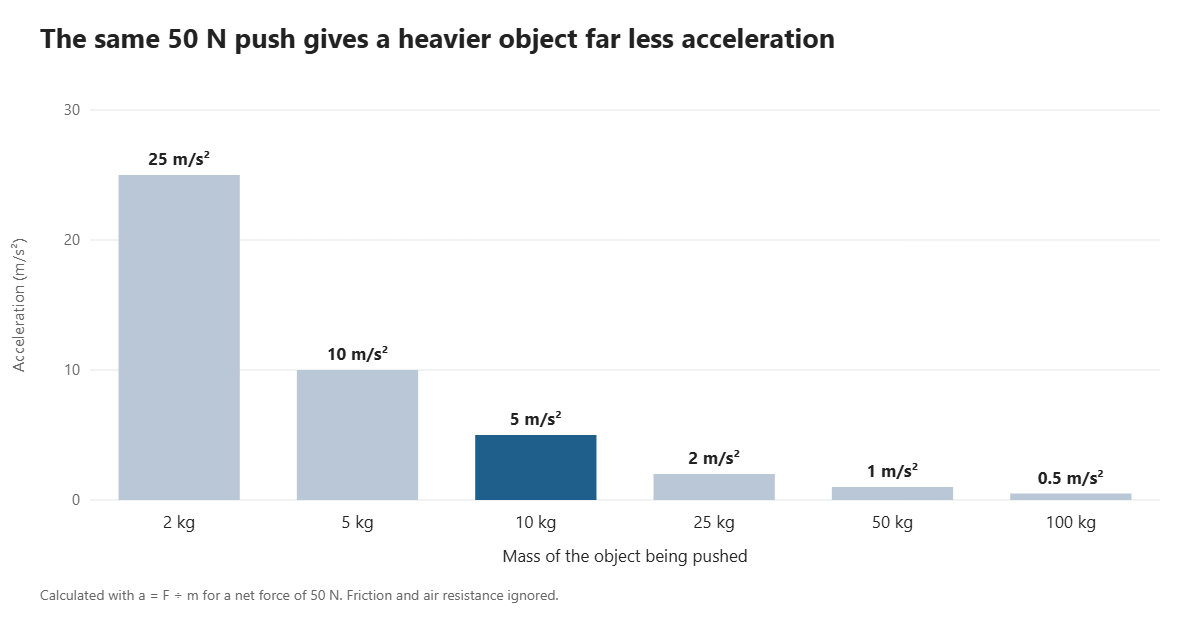
The chart makes the mass effect easy to see. A 50 N push gives a 2 kg object 25 m/s², but only 0.5 m/s² to a 100 kg object.
Worked Example: How Much Force Does a Car Need to Accelerate?
Take an example scenario: a 1,200 kg car speeds up from rest to 27 m/s (about 60 mph) in 8 seconds. How much net force does it need?
Step 1: Find the acceleration
Acceleration is the change in velocity divided by time: a = 27 ÷ 8 = 3.375 m/s².
Step 2: Apply F = ma
F = 1,200 kg × 3.375 m/s² = 4,050 N. This is the net force, the push left over after friction and air resistance are subtracted.
Step 3: Add the forces that push back
Suppose friction and air drag together push back with 500 N. The engine, through the tires, must then supply 4,050 + 500 = 4,550 N. Many textbook errors come from skipping this step.
Step 4: Check the units and test a change
kg × m/s² is a newton, so the units work. Now add 300 kg of passengers. The mass becomes 1,500 kg, and the same 4,050 N net force gives only 4,050 ÷ 1,500 = 2.7 m/s². Extra mass means slower acceleration, just as the chart showed.
The scientific calculator on this site is handy for checking arithmetic like this, and the unit converter helps when a problem gives mass in pounds or speed in mph.
What Is Newton’s Third Law of Motion?
Newton’s third law says that when one object pushes on a second object, the second pushes back on the first with an equal force in the opposite direction. The key detail is that the two forces act on different objects, so they never cancel each other out.
NASA gives two clear cases: a jet engine pushes hot gas backward and the gas pushes the engine forward, and a wing deflects air downward while the air pushes the wing up. The table below lists more force pairs and shows what each force acts on.
| Situation | Action force | Reaction force | What the reaction moves |
|---|---|---|---|
| Walking | Your foot pushes the ground backward | The ground pushes your foot forward | You |
| Swimming | Your hand pushes water backward | The water pushes your hand forward | You |
| Rocket launch | The rocket pushes exhaust gas downward | The gas pushes the rocket upward | The rocket |
| Airplane wing | The wing pushes air downward | The air pushes the wing upward | The plane |
If the forces are equal, why do the objects move differently?
Equal force does not mean equal acceleration. Take an example scenario on smooth ice: a 70 kg skater pushes a 50 kg skater with 140 N, ignoring friction. The 50 kg skater pushes back on the first with 140 N. The lighter skater accelerates at 140 ÷ 50 = 2.8 m/s², while the heavier one accelerates at 140 ÷ 70 = 2 m/s² in the opposite direction. The forces match, but the second law turns them into different accelerations.
The NASA examples above come from the same NASA beginner’s guide.
How Do the Three Laws Work Together in One Scene?
All three laws usually act in the same moment, which is why real situations feel harder than textbook ones. Picture a soccer ball being kicked across grass.
| Moment | Law at work | What happens |
|---|---|---|
| The ball sits on the grass | First | Gravity and the ground’s push balance, so the net force is zero and the ball stays put |
| A player kicks it | Second | A harder kick gives more acceleration, and a heavier ball would accelerate less |
| The foot meets the ball | Third | The foot pushes the ball, and the ball pushes back on the foot with an equal force |
| The ball rolls and slows | First and second | Friction and air resistance are unbalanced forces, so the ball decelerates |
What Are the Most Common Mix-Ups About Newton’s Laws?
Most lost marks come from five repeat mistakes. Check your own thinking against this table before an exam.
| Mix-up | Reality |
|---|---|
| “A moving object needs a constant force to keep moving.” | Constant velocity needs zero net force. A push only balances friction. |
| “Action and reaction cancel, so nothing can ever move.” | They act on different objects, so they cannot cancel each other. |
| “A book’s weight and the desk’s push are an action-reaction pair.” | Both act on the same book. The pair of the book’s weight is the book pulling up on Earth. |
| “Zero net force means the object is not moving.” | It means the object is not accelerating. It can still move at constant velocity. |
| “Mass and weight are the same thing.” | Mass is in kilograms and stays fixed. Weight is a force: a 1.0 kg object weighs about 9.8 N on Earth and about 1.7 N on the Moon. |
The weight figures come from the same OpenStax chapter on Newton’s second law.
Frequently Asked Questions
What are Newton’s three laws of motion in simple words?
First, things keep doing what they are doing unless a force changes it. Second, a bigger force makes a bigger change in motion, and a heavier object changes less for the same force. Third, every push has an equal push back. Together they explain how forces make objects start, stop, speed up, or turn.
What is the formula for Newton’s second law?
The formula is F = ma, where F is the net force in newtons, m is mass in kilograms, and a is acceleration in meters per second squared. Rearranged, a = F ÷ m. A 10 kg object under a 30 N net force accelerates at 3 m/s². The formula assumes the mass stays constant.
What is the law of inertia?
The law of inertia is another name for Newton’s first law. Inertia is an object’s tendency to resist changes in its motion, and a larger mass has more of it. A parked truck is hard to start moving, and once it is rolling it is just as hard to stop.
Why don’t action and reaction forces cancel out?
They act on different objects. When you push a wall, your push acts on the wall and the wall’s push acts on you. To cancel, two forces must act on the same object. Each object responds only to the force acting on it, so both can move.
What is a newton in physics?
A newton (N) is the unit of force. One newton gives a 1 kg mass an acceleration of 1 m/s², so 1 N = 1 kg·m/s². In everyday terms, a small apple weighs roughly 1 N on Earth. In pounds, 1 N is about 0.225 lb.
What is the difference between mass and weight?
Mass is the amount of matter in an object, measured in kilograms, and it does not change with location. Weight is the force of gravity on that mass, measured in newtons. A 1.0 kg object weighs about 9.8 N on Earth but only about 1.7 N on the Moon.
The Short Version
- First law: with zero net force, velocity does not change, which is why seat belts and friction matter.
- Second law: F = ma, so for a fixed force, more mass means less acceleration.
- Third law: force pairs are equal and opposite but act on different objects.
- Always find the net force first, and do not forget friction and air resistance.
- Check units: 1 N = 1 kg·m/s².
Test what you learned with the science quiz, build revision cards in the Flashcard Maker, or browse more explainers in the Physics category. For a standards-grade reference, NASA’s Newton’s laws page is worth bookmarking.
Sources
- NASA Glenn Research Center, “Newton’s Laws of Motion” (last updated June 27, 2024)
- OpenStax, “Newton’s Second Law of Motion: Concept of a System,” College Physics
- National Highway Traffic Safety Administration, “Seat Belts”
Disclaimer
This article is for general educational purposes only. The numbers in the worked examples are illustrative and ignore air resistance and friction unless stated. For homework or exams, follow the method and notation your teacher or exam board uses.