Physics measures things in nature, such as distance, time, mass and charge, and math connects those measurements with equations. That is how math and physics describe our world: an equation sums up what we have already measured and then predicts what we haven’t measured yet. If the prediction keeps coming true, the equation earns the name “law.”
Here is how good that can get. In 1846 the French astronomer Urbain Le Verrier found a planet with a pen. Using Newton’s laws and the wobbles in Uranus’s orbit, he worked out where an unseen planet had to be. The night his letter reached Berlin, Johann Galle aimed a telescope at that spot and found Neptune less than one degree away.
This guide explains why math fits nature so well, which branch of math handles which part of the world, and how an equation is actually built from data. You’ll test a 400-year-old law on real NASA numbers, see five predictions that came true, and learn where math still falls short.
Quick answer
Physics turns parts of nature into numbers by measuring them. Math supplies the patterns that link those numbers, written as equations. Physicists then use each equation to predict something new and go measure it. When predictions keep matching, the equation becomes a law. It works because nature follows the same rules in every place and at every time.
Key takeaways
- Measure, relate, predict: physics measures, math relates the measurements, and the equation predicts new results.
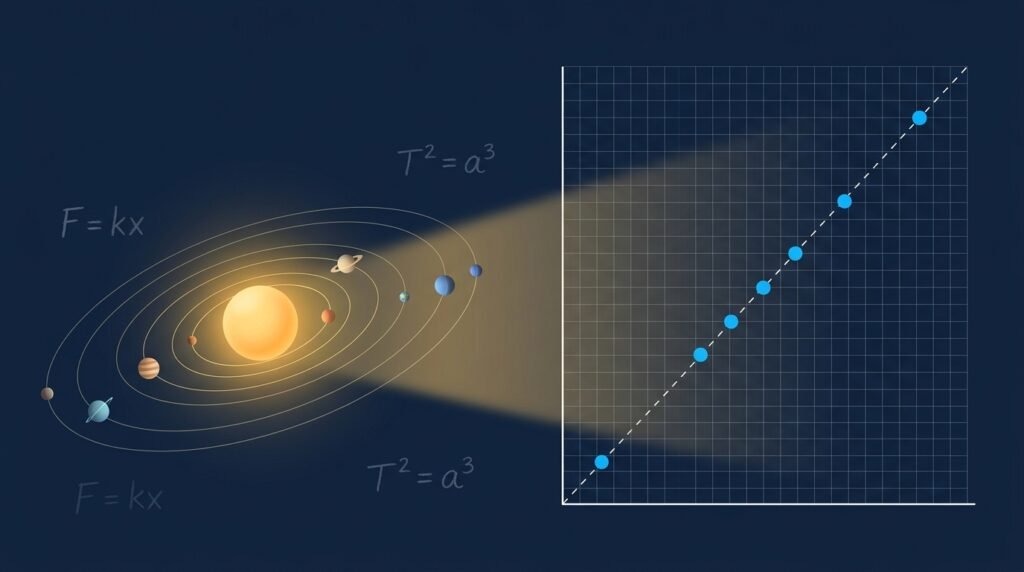
- One equation, endless cases: T² = a³ predicts the year of every planet, from Mercury to Neptune, within about 1.3 percent.
- Math has called its shot: Neptune, radio waves, antimatter and the Higgs boson were all on paper before anyone saw them.
- Since 2019, our units rest on nature: the meter, kilogram and other SI units are now defined by fixed constants.
- Math has limits: three moving bodies, chaos and quantum chance still resist neat formulas.
Why Is Math Called the Language of Physics?
Math is called the language of physics because it is the only language exact enough to state a rule of nature so that anyone, anywhere, can test it. Words describe; equations commit.
Take a stretched spring. In words you might say, “The more you stretch it, the harder it pulls back.” True, but vague. How much harder? Robert Hooke’s law says it with symbols: F = kx, where F is the pulling force, x is how far you stretched it, and k is the spring’s stiffness. Now the rule makes promises. Stretch it twice as far and it pulls twice as hard. Measure k once, and you can predict the force for any stretch until the spring starts to bend out of shape.
Galileo argued as early as 1623 that nature is like a book whose alphabet is geometry, so nobody can read it without math. Three centuries later, physicist Eugene Wigner called the fit between math and nature “unreasonable” in a famous 1960 essay. He wasn’t complaining. He was amazed it works at all.
The three jobs math does in physics
- Measure. Math turns a quality (“heavy,” “fast,” “bright”) into a number with a unit: 2.5 kilograms, 30 meters per second, 800 lumens.
- Relate. An equation links several measured quantities, so knowing some tells you the rest.
- Predict. Solve the equation for a case nobody has tried, then go check. A failed check sends physicists back to fix the equation.
So why does math fit nature so well?
Nobody has a final answer, but three explanations carry most of the weight, and they work together:
- Nature’s rules don’t change with place or time. A spring in Chicago obeys the same law as one on the Moon, today and a thousand years from now. Any pattern that repeats like that can be written down exactly. In 1918 the mathematician Emmy Noether went further and proved that each of these “sameness” rules (symmetries) produces a conservation law. Sameness over time gives conservation of energy; sameness from place to place gives conservation of momentum.
- A lot of math was built by studying the physical world. Newton and Leibniz created calculus in the late 1600s precisely to handle motion and change. It fits motion because motion is what it was made for.
- We remember the hits. Physicists choose the math that works and quietly drop what doesn’t. Biology, economics and weather are full of problems where tidy equations do far worse.
The surprising part is the math that was invented for no practical reason and later fit nature perfectly. That story gets its own section below.
Which Branches of Math Describe Which Parts of the World?
Each branch of math is a tool for one kind of pattern: algebra for fixed relationships, geometry for shape, calculus for change, probability for chance. Physics borrows whichever tool matches the job, so the fastest way to see how math and physics describe our world is to match them up.
| Branch of math | What it handles | Physics example | Where you meet it |
|---|---|---|---|
| Arithmetic and ratios | Amounts, units, scaling | Density = mass ÷ volume | Doubling a recipe, converting miles to kilometers |
| Algebra | Fixed links between quantities | Ohm’s law: voltage = current × resistance | Working out a charger’s watts from volts × amps |
| Geometry and trigonometry | Shapes, angles, distances | Angle of reflection in a mirror, circles in orbits | Finding a tree’s height from its shadow |
| Calculus | Change and rates of change | Speed is the rate position changes; acceleration is the rate speed changes | Your car’s speedometer |
| Vectors | Quantities that have a direction | Adding forces, wind pushing a plane off course | A boat crossing a river with a current |
| Probability and statistics | Chance and huge crowds of particles | Gas pressure from trillions of molecule hits, radioactive half-life | A 70 percent chance of rain |
| Matrices and complex numbers | Rotations, waves, quantum states | Alternating current, quantum mechanics | Rotating a photo on your phone |
Circles deserve a special mention, since they show up in wheels, waves and orbits alike. Our guide on what pi is and why it never ends covers the number at the heart of every one of them. And light itself follows wave math: the reason why the sky is blue comes down to how strongly air scatters short wavelengths compared with long ones.
How Does an Equation Get Made? From Measurements to a Law
An equation gets made in a loop: measure something, find a pattern in the numbers, write the pattern as an equation, use it to predict a new case, and test that prediction. A failed test sends you back to rethink, which is exactly what happened with Vulcan.
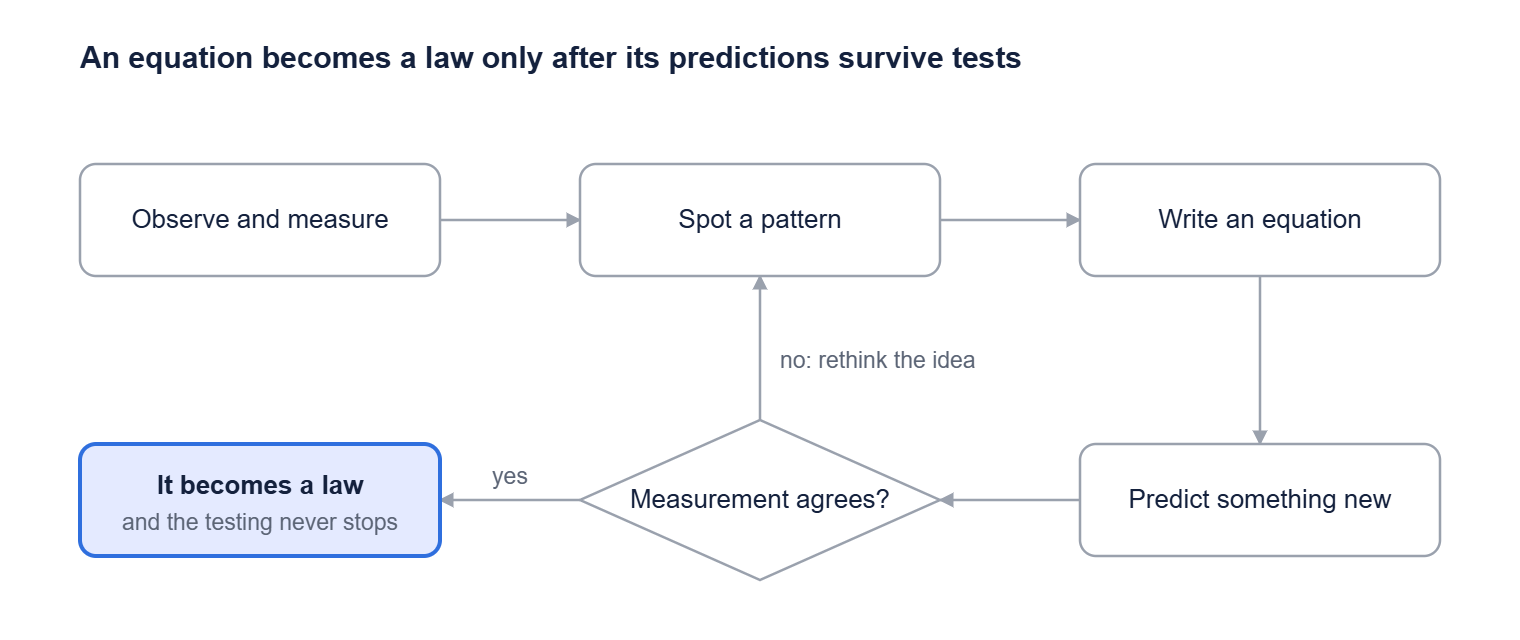
The loop never truly ends. Even Newton’s laws, after 300 years of passing tests, were eventually shown to need Einstein’s corrections in extreme conditions.
Worked example: finding Kepler’s third law with NASA data
In 1619 Johannes Kepler found a rule linking a planet’s distance from the Sun to the length of its year. He had only rough data for six planets. You can redo his discovery in five steps with far better numbers from NASA.
Step 1: Gather the measurements
NASA’s Planetary Fact Sheet lists each planet’s average distance from the Sun in millions of kilometers and its orbital period in days. To make the numbers friendlier, divide by Earth’s values (149.6 million km and 365.2 days). Now distance is in astronomical units (AU, Earth = 1) and time is in Earth years. Jupiter, for example, comes out at 778.5 ÷ 149.6 = 5.20 AU and 4,331 ÷ 365.2 = 11.86 years.
Step 2: Look for the pattern
Farther planets have longer years, but not in simple proportion. Jupiter is 5.2 times farther out than Earth, yet its year is 11.9 times longer. So try powers. Square Jupiter’s period: 11.86² = 140.6. Cube its distance: 5.204³ = 140.9. Those two numbers are almost the same, and the same thing happens for every other planet.
Step 3: Write the equation
With T in years and a in AU, the pattern is T² = a³. Solving for the period gives T = a^1.5 (a to the power 1.5). Kepler had no idea why it worked. Decades later, Newton showed it follows directly from his law of gravity, which turned a pattern into an explanation.
Step 4: Test it on every planet
On a graph with log scales, T² = a³ becomes a straight line, so any planet that obeys the law lands on it.
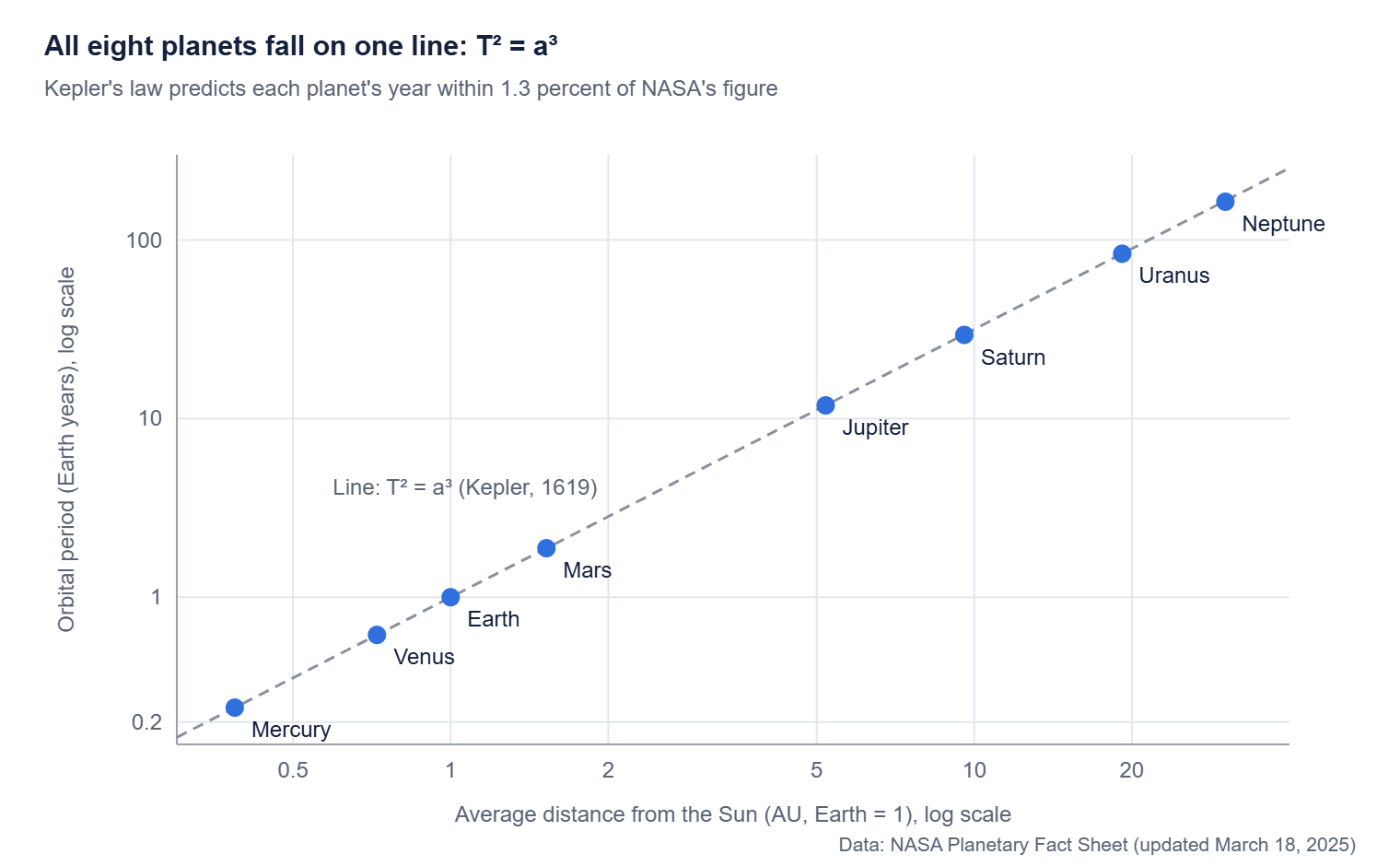
All eight planets land on the line. The largest gap is Neptune’s, at about 1.3 percent, and part of that comes from NASA’s rounded distance figure. Earth’s own year in the data, 365.2 days, is also the reason the calendar needs leap years.
Step 5: Predict something you haven’t measured
Now use the law on an object that wasn’t in your data. The dwarf planet Ceres orbits about 415 million km from the Sun, which is 415 ÷ 149.6 = 2.77 AU. The law predicts T = 2.77^1.5 = 4.62 years. NASA lists Ceres’s year as 4.6 Earth years. One line of algebra, and you’ve predicted the year of a world you have never seen.
Predictions That Came True: Math Ahead of the Telescope
The strongest proof that math describes the world is that it has repeatedly described things nobody had seen yet. Each case below started as symbols on paper and ended with a measurement.
| Predicted | By | The math said | Confirmed |
|---|---|---|---|
| 1846 | Urbain Le Verrier, using Newton’s laws | An unseen planet is tugging Uranus off course, and it sits here | Sept. 23, 1846: Johann Galle finds Neptune within 1° of the spot |
| 1865 | James Clerk Maxwell, with his equations of electricity and magnetism | Invisible electromagnetic waves exist and travel at the speed of light | 1887: Heinrich Hertz makes and detects radio waves |
| 1916 | Karl Schwarzschild, solving Einstein’s equations | Pack enough mass into a small enough space and nothing escapes | 2019: the Event Horizon Telescope images a black hole’s shadow |
| 1928 | Paul Dirac, with an equation for the electron | Every electron should have an opposite twin with positive charge | Aug. 1932: Carl Anderson photographs the positron |
| 1964 | Robert Brout, François Englert and Peter Higgs | A hidden field gives particles their mass, and it comes with its own particle | July 4, 2012: the ATLAS and CMS teams at CERN announce the Higgs boson |
Notice the gaps. Hertz waited 22 years, Anderson 4, and the Higgs boson 48 years, which CERN notes is the longest wait between prediction and discovery for any elementary particle. In each case the math didn’t change; technology simply caught up.
CERN’s own history series tells the Higgs boson story from 1964 to 2012, including the fact that one of Higgs’s papers was first rejected.
Inside the Neptune prediction
Neptune is the cleanest example because the math is the same math students learn. By the 1840s, Uranus kept drifting from the path Newton’s laws gave it. Le Verrier assumed the laws were right and the solar system was incomplete. He then ran the equations backward: what mass, at what distance, would pull Uranus exactly that way? The answer pointed to one patch of sky.
Britannica records that Galle needed only about an hour of searching on September 23, 1846, and found the planet within one degree of Le Verrier’s computed position.
The same man then tried the same trick on Mercury, whose orbit also drifted. He predicted another hidden planet, nicknamed Vulcan. It doesn’t exist. Mercury’s drift was finally explained in 1915 by Einstein’s new theory of gravity, which our guide on how gravity works explains. That failure is part of the lesson: math tells you what follows from your assumptions, and only measurement tells you whether the assumptions were right.
The Numbers Nature Hands Us: Constants and Units
Every equation needs units, and since May 20, 2019, the units themselves have been built from fixed numbers of nature rather than from objects in a vault. Before that date, the kilogram was literally a metal cylinder kept near Paris. If it picked up a speck of dust, in principle, the whole world’s kilogram changed.
Now the International System of Units (SI) rests on seven “defining constants.” Scientists fixed their values exactly, and every unit follows from them.
| Constant | Symbol | Exact value | Main unit it defines |
|---|---|---|---|
| Cesium-133 frequency | ΔνCs | 9,192,631,770 hertz | Second |
| Speed of light in a vacuum | c | 299,792,458 m/s | Meter |
| Planck constant | h | 6.62607015 × 10⁻³⁴ J·s | Kilogram |
| Elementary charge | e | 1.602176634 × 10⁻¹⁹ C | Ampere |
| Boltzmann constant | k | 1.380649 × 10⁻²³ J/K | Kelvin |
| Avogadro constant | Nᴀ | 6.02214076 × 10²³ per mole | Mole |
| Luminous efficacy | Kcd | 683 lm/W | Candela |
This is math and physics describing the world in the most literal way possible. A meter is no longer a mark on a bar; it is the distance light travels in 1/299,792,458 of a second, and a second is a fixed count of a cesium atom’s vibrations. Anyone with the right lab can rebuild the units from scratch.
NIST, the US measurement agency, has a short page on how the 2019 SI redefinition works, including the vote by 60 countries in November 2018.
Units are also where students lose the most marks. An equation only works when both sides are in matching units, so check them before you plug in numbers. The free Unit Converter handles length, mass, speed and temperature if you need a quick check.
Where Does Math Fall Short in Describing the World?
Math describes the world extremely well inside clear limits, and good physics students learn where those limits are. Four show up again and again.
- Every equation is an idealization. Hooke’s law assumes a spring that never bends out of shape. Textbook motion assumes no air. Real objects are messier, so physicists say a law “holds” within a range, not everywhere.
- Three bodies are already too many. Newton’s law gives an exact formula for two objects orbiting each other. Add a third (Sun, Earth and Moon, say) and there is no general formula at all. Computers have to approximate the answer step by step.
- Chaos magnifies tiny errors. A double pendulum follows exact, known rules, yet a starting difference too small to measure grows until the motion is unpredictable. Weather behaves the same way, which is why long-range forecasts get vague.
- Quantum physics speaks in odds. Its equations predict the chance of each result, not which result you’ll get on a single try. They are astonishingly accurate about averages and silent about individual events.
There is also a big unsolved puzzle. Einstein’s gravity and quantum physics each pass every test in their own domain, but nobody has yet found a single set of equations that joins them.
Mathematics that was waiting for physics
The strangest part of the story runs the other way: math invented for its own sake that later fit nature exactly. Around 200 BCE the Greek geometer Apollonius studied the curves you get by slicing a cone, including the ellipse. About 1,800 years later, Johannes Kepler discovered that planets move in ellipses. Imaginary numbers, invented in the 1500s to solve equations, now sit inside the basic equation of quantum mechanics. Non-Euclidean geometry, worked out in the 1800s as a puzzle about parallel lines, became the shape of space in Einstein’s 1915 theory.
Common mix-ups about math and physics
| Myth | Reality |
|---|---|
| Physics is just math with units. | An equation only becomes physics when measurements back it up. Le Verrier’s math for Vulcan was as careful as his math for Neptune, and Vulcan doesn’t exist. |
| Laws of physics are perfectly exact. | Each law works inside a range. Newton’s gravity still steers spacecraft, but Mercury’s orbit needs Einstein. |
| You can’t understand physics if you’re weak at math. | Ideas come first. Michael Faraday pictured electric and magnetic fields with almost no math, and Maxwell later turned his pictures into equations. |
| Physical constants keep being measured more exactly. | Since 2019, c, h, e, k and Nᴀ have exact, fixed values by definition. Measurement now improves the units that rest on them. |
| Math was created to serve physics. | Much of it wasn’t. Ellipses, matrices and imaginary numbers all existed long before physicists needed them. |
The fixed values in row four come from NIST’s list of the seven defining constants.
Frequently Asked Questions
Why is math important in physics?
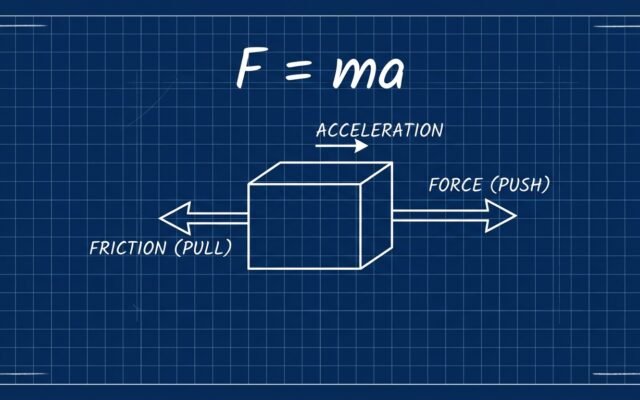
Math lets physics make exact, testable claims. A sentence like “heavier things are harder to push” can’t be proved wrong, but F = ma can, because it gives a number you can measure. That testability is what separates a physics law from a hunch, and it’s why every physics course leans on algebra from day one.
Is math invented or discovered?
Both views have serious defenders. Some say math is a human invention that we keep because it’s useful. Others think mathematical truths exist on their own and we uncover them, which would explain why old math keeps fitting new physics. Many mathematicians take a middle line: we invent the starting rules, then discover what follows from them.
What math do you need for high school physics?
Solid algebra (rearranging equations), basic geometry, and right-angle trigonometry (sine, cosine, tangent) cover nearly every high school physics topic. Scientific notation and unit conversion matter too. Calculus helps in AP Physics C and college courses, but most introductory physics can be done without it.
Can you do physics without math?
You can understand a lot of physics without math: why a satellite stays up, why ice floats, why the sky is blue. What you can’t do without math is make precise predictions or check them. Conceptual physics courses teach the ideas first, and the math follows once the picture is clear.
What is the unreasonable effectiveness of mathematics?
It’s a phrase from a 1960 essay by physicist Eugene Wigner. He pointed out that math developed for pure curiosity, such as matrices or curved geometry, often turns out to describe nature perfectly years later. He found no full explanation and called the fit a gift. The question is still debated by physicists and philosophers.
What are everyday examples of math describing physics?
Your phone’s map app uses geometry and timing equations to find your location. A speedometer shows a rate of change, the core idea of calculus. Engineers use force equations to size every bridge beam. Even a weather forecast is physics equations solved on a computer, with probability added for the uncertainty.
The Short Version
- Physics measures nature; math links the measurements in equations; predictions test the equations.
- One law, T² = a³, matches the orbits of all eight planets, using NASA’s own numbers.
- Neptune, radio waves, the positron, black holes and the Higgs boson were all predicted on paper first.
- Since 2019 the SI units are defined by seven exact constants of nature.
- Math still struggles with three-body orbits, chaos and quantum chance, and gravity hasn’t been joined to quantum physics.
Check what stuck with the free Science Quiz, turn the key equations into a deck with the Flashcard Maker, or test the orbit formula yourself on the Scientific Calculator. For more topics like this one, browse our physics guides. The raw planet data used above is on NASA’s Planetary Fact Sheet.
Disclaimer
This article is for general educational purposes only. Historical dates and physical values were checked against the sources listed above at the time of writing. For exams, follow the formulas, symbols and rounding rules your teacher or exam board uses.