Drop your pencil and it falls. Toss a ball and it curves back down. Gravity is so familiar that it is easy to forget how strange it is: an invisible pull that reaches across empty space, holds the Moon in orbit and shapes entire galaxies. So how does gravity work?
Two great answers exist. Isaac Newton described gravity as a force between masses, and Albert Einstein later described it as curved space and time. This guide explains both in plain English, with the formulas and worked examples you need for physics class.
Quick answer
Gravity is the attraction between anything that has mass. Newton’s law says the pull between two objects grows with their masses and weakens with the square of the distance between them: double the distance and the force drops to a quarter. Einstein’s general relativity explains why: mass and energy curve spacetime, and objects follow the straightest possible paths through that curve, which we see as falling or orbiting. On Earth’s surface, gravity makes falling objects speed up by about 9.8 meters per second every second.
Key takeaways
- Everything with mass attracts everything else, though the pull is tiny unless one object is huge.
- Inverse square rule: twice as far away means one quarter of the force.
- Mass is not weight: mass stays the same everywhere, weight depends on local gravity.
- Einstein’s view: gravity is the shape of spacetime, not a pull through it.
- Astronauts float because they are falling around Earth, not because gravity disappears.
What Is Gravity?
Gravity is one of the four fundamental forces of nature, along with electromagnetism and the strong and weak nuclear forces. It is by far the weakest of the four. A small fridge magnet can hold a paper clip up against the gravity of the entire planet.
So why does gravity rule the universe? Because it only attracts and it never cancels out. Electric charges come in plus and minus, and they mostly balance each other. Mass is always positive, so gravity keeps adding up. Pile up enough mass, a planet or a star, and gravity wins.
Newton’s Law of Universal Gravitation
In 1687 Isaac Newton published a single rule that explained both a falling apple and the orbit of the Moon. Written in modern symbols, it looks like this:
F = G × (m₁ × m₂) ÷ r²
- F is the force of gravity, in newtons.
- m₁ and m₂ are the two masses, in kilograms.
- r is the distance between their centers, in meters.
- G is the gravitational constant, about 6.674 × 10⁻¹¹ N·m²/kg². It is tiny, which is why you do not feel a pull toward your desk.
The inverse square rule in action
The r² on the bottom is the part teachers love to test. It means gravity fades quickly with distance:
| Distance from center | Force compared with the start |
|---|---|
| 1× (starting distance) | 1 (full strength) |
| 2× | 1/4 |
| 3× | 1/9 |
| 10× | 1/100 |
Mass vs. Weight: A Worked Example
Mass is how much matter an object contains. It does not change when you travel. Weight is the force of gravity on that mass, and it changes from place to place. The formula is W = m × g, where g is the local gravitational acceleration.
Take a student with a mass of 60 kilograms:
- On Earth, g is about 9.8 m/s². Weight = 60 × 9.8 = 588 newtons.
- On the Moon, g is about 1.62 m/s². Weight = 60 × 1.62 ≈ 97 newtons.
- That is roughly one sixth of the Earth weight, but the mass is still 60 kilograms.
A bathroom scale shows pounds or kilograms, but it really measures the force pushing down on it. On the Moon the same scale would read about one sixth as much. Use our free Scientific Calculator to try it with your own numbers.
Why Do Heavy and Light Objects Fall Together?
A bowling ball feels a much stronger pull of gravity than a tennis ball. It also has much more mass to get moving. The two effects cancel exactly, so without air resistance every object falls with the same acceleration.
Galileo argued this around 1600. In 1971, Apollo 15 astronaut David Scott tested it on the airless Moon by dropping a hammer and a falcon feather at the same moment. They hit the ground together. On Earth a feather drifts slowly only because air pushes against it.
How Einstein Changed the Picture
Newton’s law predicts motion extremely well, but it never explained how one mass “knows” to pull on another across empty space. In 1915 Einstein offered an answer in his general theory of relativity.
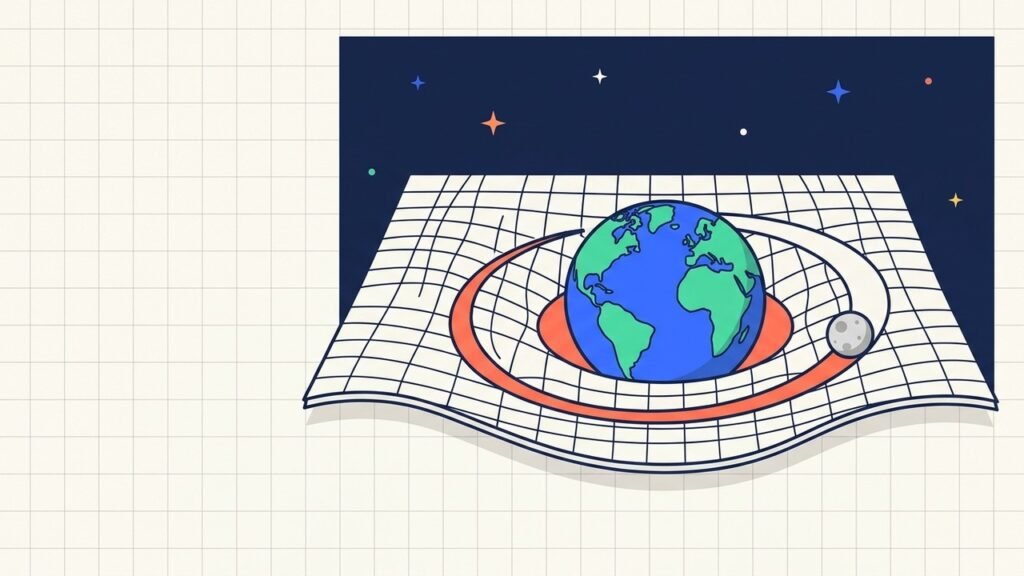
Einstein treated space and time as one connected fabric called spacetime. Mass and energy bend that fabric. Objects moving through curved spacetime follow the straightest path available, and that path curves around heavy objects. Earth is not being tugged toward the Sun on an invisible rope. It is following the curve the Sun makes in spacetime.
A common model is a heavy ball on a stretched trampoline, with marbles rolling around the dip. The model is imperfect (it uses gravity to explain gravity), but it captures the key idea: mass shapes the path.
The evidence
- Bending starlight: during the 1919 solar eclipse, astronomers measured stars near the Sun shifted by the amount Einstein predicted.
- Mercury’s orbit: relativity explained a small drift in Mercury’s orbit that Newton’s law could not.
- GPS: clocks on GPS satellites tick at a slightly different rate than clocks on the ground. Without relativity corrections, positions would drift by kilometers a day.
- Gravitational waves: in September 2015 the LIGO detectors recorded ripples in spacetime from two black holes merging over a billion light-years away.
Gravity at Work: Orbits and Tides
Orbits. The International Space Station is only about 400 kilometers up, where gravity is still about 90 percent as strong as on the ground. Astronauts float because the station and everything in it are falling toward Earth together. They also move sideways so fast, about 28,000 kilometers per hour, that they keep missing the ground. That endless fall is an orbit.
Tides. The Moon pulls harder on the side of Earth facing it than on the far side. That difference stretches the oceans into two bulges, one toward the Moon and one away from it. As Earth spins through both bulges, most coastlines get two high tides and two low tides about every 24 hours and 50 minutes.
Common Mix-Ups About Gravity
Myth: There is no gravity in space. Gravity reaches everywhere and only weakens with distance. It keeps the Moon in orbit 384,000 kilometers away.
Myth: Heavier objects fall faster. Without air, everything falls at the same rate. Air resistance is what slows a feather or a sheet of paper.
Myth: Mass and weight are the same thing. Mass is measured in kilograms and never changes with location. Weight is a force measured in newtons and depends on gravity.
Myth: Einstein proved Newton wrong. Newton’s law is still used to launch rockets and plan space missions. Relativity matters for extreme gravity, very high speeds and very precise timing.
Frequently Asked Questions
What causes gravity?
Mass and energy cause gravity. In Einstein’s theory, they curve spacetime, and that curvature guides how other objects move. Physicists are still working on how gravity fits with quantum physics.
Why is gravity 9.8 m/s² on Earth?
The value comes from Earth’s mass and radius in Newton’s formula. It varies slightly, from about 9.78 at the equator to about 9.83 at the poles, because Earth spins and bulges at the equator.
Does the Moon have gravity?
Yes. The Moon’s surface gravity is about one sixth of Earth’s, which is why astronauts could bounce and carry heavy packs easily. The Moon’s gravity also drives Earth’s tides.
Is gravity the strongest force?
No, it is the weakest of the four fundamental forces. It dominates on large scales because it always attracts and adds up across huge amounts of mass.
Could gravity ever be switched off?
No known method can block or cancel gravity. Free fall, as on the space station, only removes the feeling of weight.
The Short Version
- Gravity is the attraction between masses, and it reaches across all of space.
- Newton: F = G × m₁ × m₂ ÷ r². Double the distance and the force drops to a quarter.
- Einstein: mass curves spacetime, and objects follow that curve.
- Weight changes with location; mass does not.
NASA’s Space Place gravity explainer is great for a quick review, and Caltech’s LIGO team explains what gravitational waves are. Read more on our physics page, see why Earth’s orbit shapes the calendar, and convert units for homework with the free Unit Converter.