The apple in your lunch, the bread in your sandwich and the oxygen in your next breath all trace back to the same process. Every green leaf is a small solar-powered factory, quietly turning air and water into food. So how does photosynthesis work, and why does it matter so much?
This guide walks through the equation, where the process happens inside a leaf, and its two stages, with a few memory tricks to help it stick before your next biology test.
Quick answer
Photosynthesis is how plants, algae and some bacteria use light energy to turn carbon dioxide and water into glucose (a sugar) and oxygen. It happens in chloroplasts, where the green pigment chlorophyll absorbs mostly red and blue light. In the first stage, the light-dependent reactions, light splits water, releases oxygen and makes the energy carriers ATP and NADPH. During the second stage, the Calvin cycle, that energy is used to build glucose from carbon dioxide. The overall equation is 6CO₂ + 6H₂O + light → C₆H₁₂O₆ + 6O₂.
Key takeaways
- Inputs: carbon dioxide, water and light energy.
- Outputs: glucose for the plant and oxygen released into the air.
- Location: chloroplasts, mostly in leaf cells.
- Two stages: light-dependent reactions in the thylakoids, then the Calvin cycle in the stroma.
- The oxygen comes from water, not from carbon dioxide.
The Photosynthesis Equation
Biology textbooks sum the whole process up in one balanced equation:
6CO₂ + 6H₂O + light energy → C₆H₁₂O₆ + 6O₂
Read it from left to right. Six molecules of carbon dioxide and six molecules of water, powered by light, become one molecule of glucose and six molecules of oxygen.
Check that it balances
Counting atoms on each side is a classic test question, so here is the tally:
| Atom | Left side | Right side |
|---|---|---|
| Carbon (C) | 6 (from 6CO₂) | 6 (in C₆H₁₂O₆) |
| Hydrogen (H) | 12 (from 6H₂O) | 12 (in C₆H₁₂O₆) |
| Oxygen (O) | 18 (12 + 6) | 18 (6 in glucose + 12 in 6O₂) |
Nothing is created or lost. Light provides the energy to rearrange the atoms into a molecule that stores that energy in its chemical bonds.
Where Does Photosynthesis Happen?
Most photosynthesis takes place in leaves, inside structures called chloroplasts. A single leaf cell can hold dozens of them. Each chloroplast is packed with chlorophyll, a pigment that absorbs red and blue light very well. It reflects most green light, which is why leaves look green to us.
Inside the chloroplast are stacks of flattened membrane sacs called thylakoids. A stack is called a granum. The thick fluid around the stacks is the stroma. Remember those two words, because each stage of photosynthesis has its own address.
How the ingredients get there
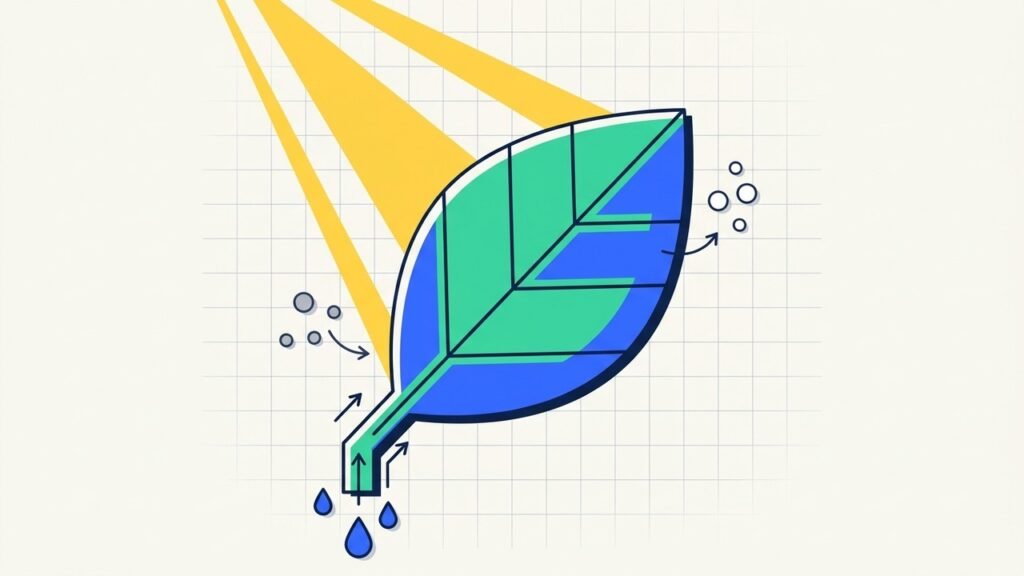
- Water enters through the roots and travels up the stem in tubes called xylem.
- Carbon dioxide enters through tiny pores on the leaf surface, called stomata.
- Oxygen leaves through the same stomata.
- Glucose moves around the plant through a second set of tubes, called phloem.
Stage 1: The Light-Dependent Reactions
The first stage happens in the thylakoid membranes, and it needs light. Think of it as charging the batteries.
- Chlorophyll absorbs light energy, which excites some of its electrons.
- To replace those electrons, the plant splits water molecules. This step is called photolysis.
- Splitting water releases oxygen gas, which drifts out of the leaf.
- The excited electrons pass along a chain of proteins, and their energy is used to make two energy carriers: ATP and NADPH.
At the end of stage 1 the plant has released oxygen and has a supply of charged batteries (ATP and NADPH). It has not made any sugar yet.
Stage 2: The Calvin Cycle
The second stage happens in the stroma. It is named after the American chemist Melvin Calvin, who mapped it in the 1950s and won the 1961 Nobel Prize in Chemistry for the work. Some textbooks call it the light-independent reactions, because light does not drive it directly.
- Carbon fixation: an enzyme called RuBisCO attaches carbon dioxide from the air to a five-carbon molecule already in the stroma.
- Reduction: the ATP and NADPH from stage 1 power the conversion of the new molecules into a three-carbon sugar called G3P.
- Regeneration: most of the G3P is recycled to rebuild the starting molecule, so the cycle can turn again.
The leftover G3P is the real product. The plant joins G3P molecules to make glucose, then turns glucose into starch for storage, cellulose for cell walls, and other building blocks.
RuBisCO is worth remembering. It is often described as the most abundant protein on Earth, because every photosynthesizing plant needs so much of it.
What Affects the Rate of Photosynthesis?
Lab experiments on photosynthesis usually test one of three factors. Each can become the limiting factor, the one thing holding the process back.
| Factor | What happens as it increases | Why there is a limit |
|---|---|---|
| Light intensity | Rate rises | Levels off once chloroplasts are working at full speed |
| Carbon dioxide | Rate rises | Levels off when RuBisCO cannot work any faster |
| Temperature | Rate rises, then falls | Enzymes stop working well when it gets too hot |
A classic classroom demo counts the oxygen bubbles rising from pondweed under a lamp. Move the lamp closer and the bubbles speed up, until another factor takes over as the limit.
Why Photosynthesis Matters
Almost every food chain on land begins with photosynthesis. Plants make the sugar, animals eat the plants, and other animals eat those animals. Even the energy in fossil fuels such as coal came from photosynthesis millions of years ago.
It also built the air we breathe. Land plants are only part of the story: tiny ocean algae called phytoplankton produce a large share of Earth’s oxygen. NOAA estimates that at least half of it comes from the ocean.
Finally, photosynthesis pulls carbon dioxide out of the atmosphere. That makes forests and oceans an important part of the carbon cycle, and of discussions about climate change.
Common Mix-Ups About Photosynthesis
Myth: Plants get their food from the soil. Soil provides water and minerals such as nitrogen. The bulk of a plant’s mass is built from carbon taken out of the air.
Myth: The oxygen plants release comes from carbon dioxide. Experiments with labeled oxygen atoms show it comes from splitting water in stage 1.
Myth: Plants do photosynthesis instead of respiration. Plants do both. They respire all the time, day and night, to release energy from their glucose. In daylight, photosynthesis simply outpaces respiration.
Myth: The Calvin cycle only happens at night. “Light-independent” means light is not used directly. The cycle runs mostly in daytime, because it depends on a fresh supply of ATP and NADPH from stage 1.
Frequently Asked Questions
What are the reactants and products of photosynthesis?
The reactants are carbon dioxide and water, with light as the energy source. The products are glucose and oxygen.
Why are leaves green?
Chlorophyll absorbs red and blue light strongly but reflects much of the green light. That reflected green light is what reaches your eyes.
How is photosynthesis related to cellular respiration?
They are close to opposites. Photosynthesis stores energy by building glucose and releasing oxygen. Cellular respiration releases that energy by breaking glucose down with oxygen, giving off carbon dioxide and water.
Can photosynthesis happen without sunlight?
The light-dependent reactions need light, but it does not have to be sunlight. Plants grow under artificial grow lights, which supply the red and blue wavelengths chlorophyll absorbs best.
Do all plants do photosynthesis the same way?
Most use the standard process, called C3. Some plants in hot or dry places, such as corn and cacti, use variations called C4 and CAM that save water and reduce waste.
Quick Recap
- Photosynthesis turns carbon dioxide and water into glucose and oxygen, using light energy.
- It happens in chloroplasts, powered by chlorophyll.
- Stage 1 (thylakoids) splits water, releases oxygen and makes ATP and NADPH.
- Stage 2, the Calvin cycle (stroma), uses that energy to build sugar from carbon dioxide.
National Geographic’s photosynthesis encyclopedia entry is a good next read, and NOAA explains how ocean plankton make oxygen. Find more on our biology page, see how sunlight splits into colors, then turn the key terms into cards with the free Flashcard Maker or try the Science Quiz.