

Light travels in straight lines, moving through empty space at about 299,792 kilometers per second, and it only changes direction when it bounces off something (reflection) or crosses into a new material (refraction). Put the two together inside a raindrop and you get a rainbow. Scientists use this kind of rule-based thinking to describe how math and physics describe our world, and light is one of the cleanest examples. This guide explains how light travels, with a worked refraction problem, a raindrop diagram and the angles behind rainbows.
Quick answer
Light travels as rays in straight lines and needs no material to move through. It slows down inside water or glass, which bends its path (refraction), and it bounces off surfaces at equal angles (reflection). A rainbow forms when sunlight refracts into a raindrop, reflects off the back, and refracts out again, split into colors.
Key takeaways
- Speed: about 299,792 km/s in a vacuum, and slower in any material.
- Reflection: the angle in equals the angle out.
- Refraction: light bends when its speed changes, and Snell’s law gives the angle.
- Dispersion: each color bends by a slightly different amount, which is how a prism or a drop separates white light.
- Rainbow: refract, reflect once, refract. Red leaves at about 42° and violet at about 40°.
How does light travel through space and materials?
Light travels in straight lines called rays, and it does not need air, water or anything else to carry it. In a vacuum its speed is exactly 299,792,458 m/s, usually rounded to 3.00 × 10⁸ m/s. Sunlight crosses the empty space between the Sun and Earth the same way.
Inside matter, light slows down. The slowdown is measured by the index of refraction, n = c ÷ v, where c is the speed in a vacuum and v is the speed in the material. Because v can never beat c, n is always 1 or more. The higher n is, the slower the light.
OpenStax University Physics Volume 3: 1.1 The Propagation of Light.
| Material | Index of refraction (n) | Speed of light (km/s) |
|---|---|---|
| Vacuum | 1 | 299,792 |
| Air (0 °C, 1 atm) | 1.000293 | about 299,705 |
| Water (20 °C) | 1.333 | about 224,900 |
| Crown glass | 1.52 | about 197,200 |
| Diamond | 2.419 | about 123,900 |

Light’s speed is enormous, but it is still just a speed with a direction. If that distinction is fuzzy, how speed differs from velocity clears it up.
OpenStax College Physics 2e: 25.3 The Law of Refraction (index values in Table 25.1).
What is reflection?
Reflection is light bouncing off a surface, and it follows one rule: the angle at which light arrives equals the angle at which it leaves. Both angles are measured from the normal, an imaginary line perpendicular to the surface. If a flashlight beam hits a mirror at 30° from the normal, it leaves at 30° on the other side.
A smooth surface such as a mirror or still water keeps the rays organized, so you see a clear image. A rough surface such as paper or a wall scatters rays in many directions. Each ray still obeys the same rule, but the surface is uneven, so no image forms. That is why you can read a page from any seat but cannot see your face in it.
What is refraction, and how does Snell’s law work?
Refraction is the bending of light as it passes from one material into another, caused by the change in its speed. Snell’s law gives the exact angle: n₁ sin θ₁ = n₂ sin θ₂. Here n₁ and n₂ are the indices of the two materials, and θ₁ and θ₂ are the angles measured from the normal.
Going into a material with a higher n, light bends toward the normal. Coming out, it bends away. This is why a straw in a glass of water looks broken at the surface: the light from the submerged part bends as it leaves the water, so your eye places that part in the wrong spot.
A worked example: air to water, then air to glass
This is an example scenario. A beam in air hits a flat surface at 40° from the normal. How far does it bend in water (n = 1.333) and in crown glass (n = 1.52)? We treat air as n = 1.
Step 1: Write Snell’s law
1 × sin 40° = n₂ × sin θ₂, so sin θ₂ = sin 40° ÷ n₂. And sin 40° ≈ 0.6428.
Step 2: Solve for water
sin θ₂ = 0.6428 ÷ 1.333 = 0.4822, so θ₂ ≈ 28.8°.
Step 3: Solve for glass
sin θ₂ = 0.6428 ÷ 1.52 = 0.4229, so θ₂ ≈ 25.0°.
Step 4: Compare
Glass has the higher n, so it bends the beam closer to the normal (25.0° against 28.8°). A bigger index means a bigger bend.
What is total internal reflection?
Total internal reflection happens when light tries to leave a slow material for a faster one at too steep an angle, and instead of escaping, it reflects fully back inside. The smallest angle where this happens is the critical angle, found from sin θc = 1 ÷ n (going out into air).
| Material | n | Critical angle | What it explains |
|---|---|---|---|
| Water | 1.333 | about 48.6° | The silvery ceiling a diver sees looking up at a steep angle |
| Crown glass | 1.52 | about 41.1° | Light trapped inside glass and prisms |
| Diamond | 2.419 | about 24.4° | Why cut diamonds sparkle: light is trapped and reflected many times |
Why does white light split into colors?
White light is a mix of colors, and each color has its own wavelength. NASA notes that human eyes detect wavelengths from about 380 nanometers (violet) to about 700 nanometers (red). The index of refraction changes slightly with wavelength, so each color bends by a slightly different amount. Violet bends the most and red the least, which is how a prism spreads one beam into a band.
NASA Science: Visible Light.
Splitting by refraction is different from the scattering that makes the sky blue. For that story, read why the sky is blue. And to see how your eyes turn these wavelengths into color, see how our five senses work.
How does a rainbow form?
A rainbow forms when sunlight enters a raindrop, reflects once off the back inside surface, and leaves again, with the colors spread out along the way. Each drop acts like a tiny round prism that sends colors back toward the side the Sun is on.
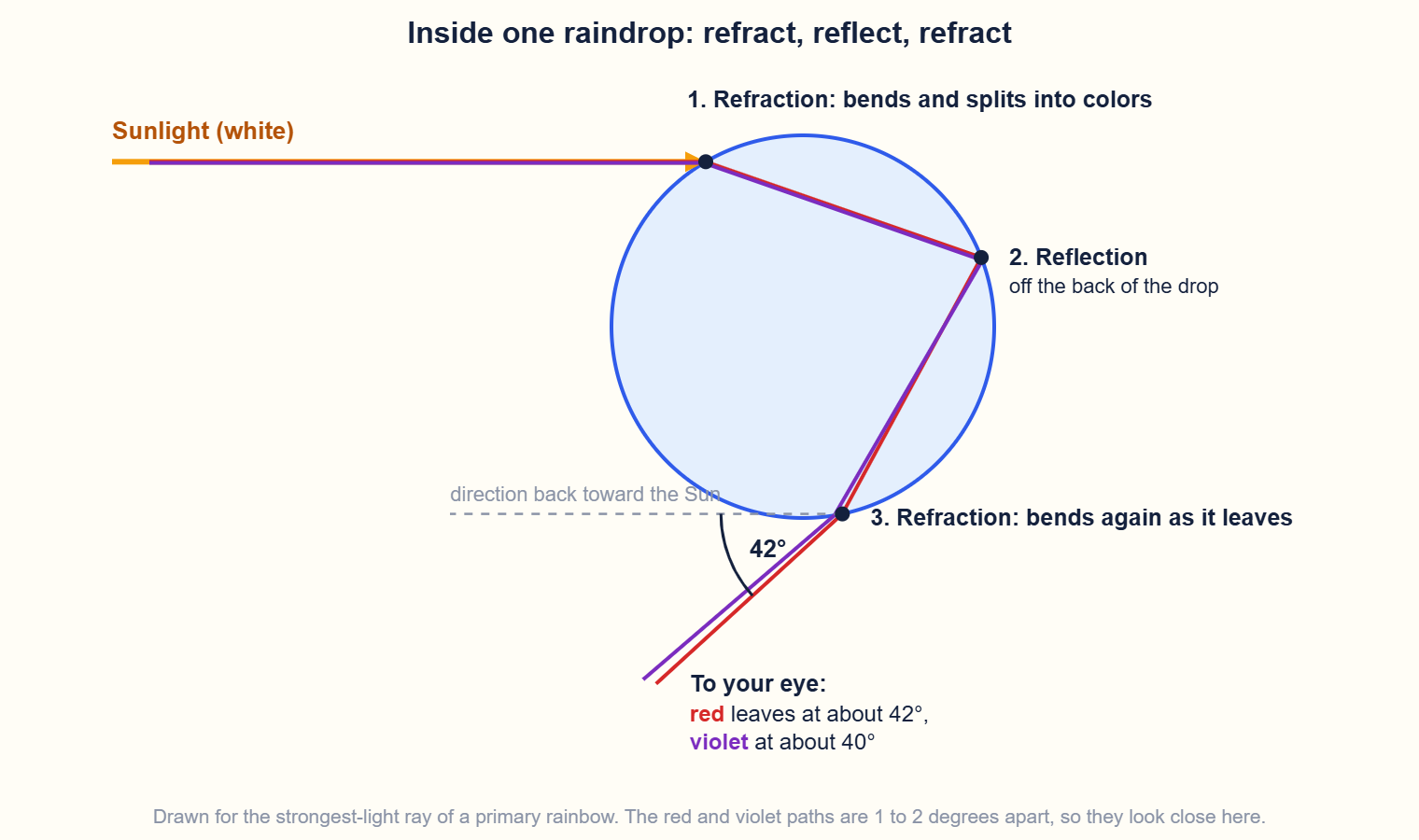
Step 1: Sunlight refracts as it enters the drop
The ray slows and bends at the surface, and the colors begin to separate.
Step 2: The light reflects off the back
Some of the light bounces off the inside rear surface of the drop and turns back toward the front.
Step 3: The light refracts as it leaves
It bends again when it exits, which widens the gap between colors. The National Weather Service says the primary bow’s light leaves each drop at about 42° from the incoming sunlight. Red exits near 42° and violet nearer 40°, so red sits on the outside of the arc.
National Weather Service Flagstaff: How Do Rainbows Form?
Why do you need the Sun behind you to see a rainbow?
Because the light comes back almost toward the Sun, the drops that show you color are the ones at about 42° around the point directly opposite the Sun (the antisolar point). That is also why a rainbow is a circle arc, not a straight band, and why the National Weather Service says it needs the Sun below 42° above the horizon. If the Sun is higher, the arc falls below the ground.
The rule explains a familiar pattern: rainbows are common in the morning and late afternoon, when the Sun is low, and rare around midday in summer. Two people standing next to each other also see slightly different rainbows, since each one is formed by different drops.
What is a double rainbow?
A double rainbow shows a second, fainter arc outside the main one, made by light that reflects twice inside each drop instead of once. The extra reflection flips the color order, so red is on the inner edge of the upper bow.
| Feature | Primary rainbow | Secondary rainbow |
|---|---|---|
| Reflections inside the drop | 1 | 2 |
| Angle from the antisolar point | about 42° (red) | about 50° |
| Brightness | Brighter | Fainter |
| Color order (outside to inside) | Red to violet | Violet to red |
Where do you see reflection and refraction in daily life?
You meet both every day, usually without noticing. The table links each everyday sight to the idea that explains it.
| Everyday sight | What is happening | Main idea |
|---|---|---|
| Your face in a mirror | Light bounces off at equal angles | Reflection |
| A bent straw in a glass | Light bends as it leaves the water | Refraction |
| Eyeglass lenses | Curved glass bends light to change where it focuses | Refraction |
| A prism’s color band | Each color bends by a different amount | Dispersion |
| Fiber optic cable | Light stays trapped inside thin glass strands | Total internal reflection |
Common myths about light and rainbows
| Myth | Reality |
|---|---|
| Light needs air or another material to travel. | Light crosses a vacuum at about 299,792 km/s. Sunlight reaches Earth through empty space. |
| A rainbow is bounced sunlight. | It needs refraction, one internal reflection and a second refraction. |
| Light moves at the same speed everywhere. | It slows in water (about 224,900 km/s) and glass (about 197,200 km/s). |
| A rainbow sits at one place in the sky for everyone. | Each viewer sees light from different drops, so each person gets their own bow. |
| Rainbows can appear at any time of day. | The Sun must be lower than 42° above the horizon. |
The law of refraction and index values: OpenStax College Physics 2e, 25.3.
Frequently asked questions
How fast does light travel?
In a vacuum, 299,792,458 meters per second, about 299,792 km/s. In water it drops to roughly 224,900 km/s and in diamond to about 123,900 km/s, because those materials have higher indices of refraction.
What is the difference between reflection and refraction?
Reflection is light bouncing off a surface and staying in the same material. Refraction is light passing into a new material and bending because its speed changes. Rainbows need both.
Why does light bend when it enters water?
Light slows down in water, so the part of a wave that enters first slows first and the wave turns. The amount of bending comes from Snell’s law: n₁ sin θ₁ = n₂ sin θ₂.
Why are rainbows curved?
The drops that send you color sit at a fixed angle of about 42° from the point opposite the Sun. Points at one angle from a center form a circle, so you see part of a circle.
Why are there seven colors in a rainbow?
The color band is continuous, with wavelength changing smoothly from about 700 nm (red) to about 380 nm (violet). Naming seven colors is a custom for describing it. Your eye can pick out more or fewer bands.
Can you see a rainbow at noon?
Sometimes, but only when the Sun is lower than 42° above the horizon. In many places in summer the midday Sun is higher than that, so rainbows are mostly seen in the morning and late afternoon.
The Short Version
- Light moves in straight rays and travels fastest in a vacuum, at about 299,792 km/s.
- Reflection follows angle in = angle out; refraction follows Snell’s law.
- Different colors bend by slightly different amounts, which is dispersion.
- A rainbow is refract, reflect, refract inside raindrops, with red at about 42° and violet at about 40°.
- A double rainbow adds a second reflection and reverses the colors.
To keep going, learn why the sky is blue in our sky color guide. For the formulas in this article, the OpenStax chapter on the law of refraction is a free, trusted reference.
Disclaimer
This article is for general educational purposes only. The worked examples use simplified ray optics, and rainbow angles are approximate and vary slightly with drop size and color. Check your course materials or ask a teacher for the exact methods your exams require.