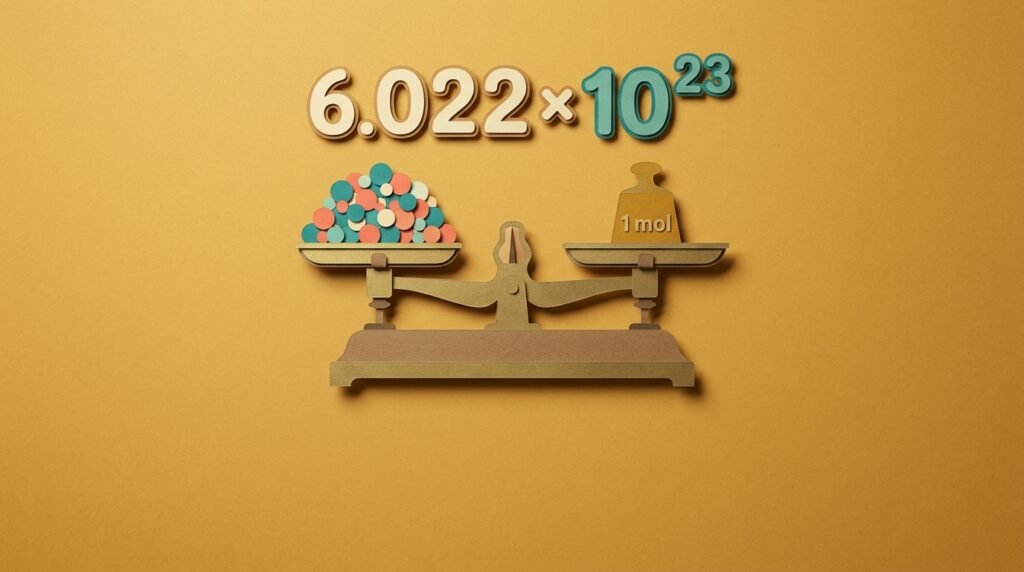
A mole in chemistry is a counting unit: one mole of anything contains exactly 6.02214076 × 10²³ particles, a value called Avogadro’s number. It works like a dozen, only far bigger, and it lets you count atoms by weighing them, using the atomic masses printed on the periodic table.
Atoms are so small that a single drop of water holds more of them than you could count in a lifetime. Chemists needed a unit that turns those impossible numbers into grams you can put on a scale. The mole is that unit.
Below you will find what the mole and Avogadro’s number actually mean, why the number is so odd, what changed in 2019, how to find molar mass, a “mole map” for every conversion, a fully worked example, common mix-ups and practice problems with answers.
Quick answer
A mole (symbol mol) is the SI unit for amount of substance. One mole contains exactly 6.02214076 × 10²³ particles, usually rounded to 6.022 × 10²³. This is Avogadro’s number. One mole of a substance weighs its atomic or formula mass in grams, so one mole of carbon is about 12 g and one mole of water about 18 g.
Key takeaways
- A mole is a number: 6.022 × 10²³ of whatever you are counting.
- It is exact: since the 2019 SI revision, Avogadro’s number is fixed by definition, not measured.
- Molar mass links moles to grams: read it from the periodic table in g/mol.
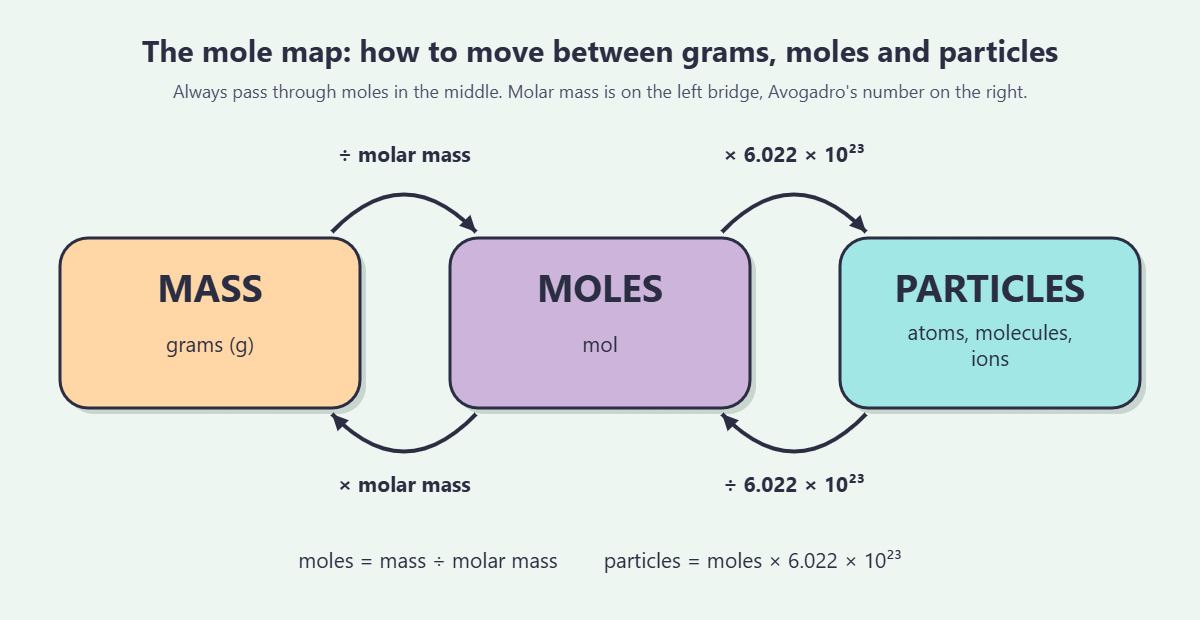
- Two conversions do almost everything: moles = mass ÷ molar mass, and particles = moles × 6.022 × 10²³.
- Say what you are counting: one mole of O2 molecules holds two moles of O atoms.
What Is a Mole in Chemistry?
A mole is a fixed count of particles, exactly 6.02214076 × 10²³ of them, used to measure the amount of a substance. The U.S. National Institute of Standards and Technology lists it as one of the seven SI base units, next to the meter, kilogram and second, with the symbol mol.
Think of how a baker buys eggs. Nobody counts 144 eggs one by one; they order a gross (12 dozen). A mole is the same idea scaled up for things far too small to see. “One mole of iron atoms” simply means 6.022 × 10²³ iron atoms, the way “a dozen eggs” means 12 eggs.
The particles can be anything you name: atoms, molecules, ions, electrons or formula units. That is why a chemist always says what kind of particle is being counted, a point we come back to below. If those words still blur together, our guide to atoms, elements and molecules sorts them out.
| Counting word | How many | Used for |
|---|---|---|
| Pair | 2 | Shoes, socks |
| Dozen | 12 | Eggs, donuts |
| Gross | 144 | Pencils, screws |
| Ream | 500 | Sheets of paper |
| Mole | 6.022 × 10²³ | Atoms, molecules, ions |
What Is Avogadro’s Number?
Avogadro’s number is the number of particles in one mole: 6.02214076 × 10²³. Written out, that is 602,214,076,000,000,000,000,000. For homework, 6.022 × 10²³ is accurate enough, and 6.02 × 10²³ works for quick estimates.
You will also see the Avogadro constant, written NA. It has the same digits but carries a unit: 6.022 × 10²³ mol−1, which reads “particles per mole.” The unit is what lets it work as a conversion factor in calculations.
The name honors Amedeo Avogadro, the Italian scientist who proposed that equal volumes of gases at the same temperature and pressure hold the same number of molecules. He never knew the value of his own number. According to Britannica, French physicist Jean Perrin attached Avogadro’s name to it in the early 20th century.
Why is the number so strange?
It was chosen so that grams and atomic mass units line up. For decades, one mole was defined as the number of atoms in exactly 12 grams of carbon-12. A carbon-12 atom has a mass of 12 atomic mass units (u), so counting out Avogadro’s number of them gives 12 grams.
That neat match is the whole point. An element’s atomic mass in u is the same number as the mass of one mole of it in grams. Without this choice, every chemistry calculation would need an extra conversion step.
What changed in 2019?
Since the 2019 revision of the SI, the mole is no longer tied to a lump of carbon. It is defined by fixing Avogadro’s number at exactly 6.02214076 × 10²³, so the value is now exact by definition rather than a measured result with an uncertainty attached. NIST notes that the redefined units all rest on unchanging constants of nature.
For your calculations, nothing changes. One mole of carbon-12 still weighs 12 grams to well beyond the number of digits any school problem uses.
How Big Is Avogadro’s Number, Really?
It is big enough that everyday comparisons break down. These figures are calculated from 6.022 × 10²³, so you can check each one yourself:
| If you had one mole of… | What it means |
|---|---|
| Seconds | About 19 quadrillion years (1.9 × 10¹⁶) if you counted one per second |
| Water molecules | About 18 g, or roughly 1.2 US tablespoons of water |
| Carbon-12 atoms | Exactly 12 g; one single atom weighs about 2.0 × 10⁻²³ g |
| Water in a 500 mL bottle | About 27.8 mol, or 1.67 × 1025 molecules |
The contrast in the second row is the reason the mole exists. A spoonful of water is something you can see and weigh, yet it holds a number of molecules you could never count.
Molar Mass: How Moles Turn Into Grams
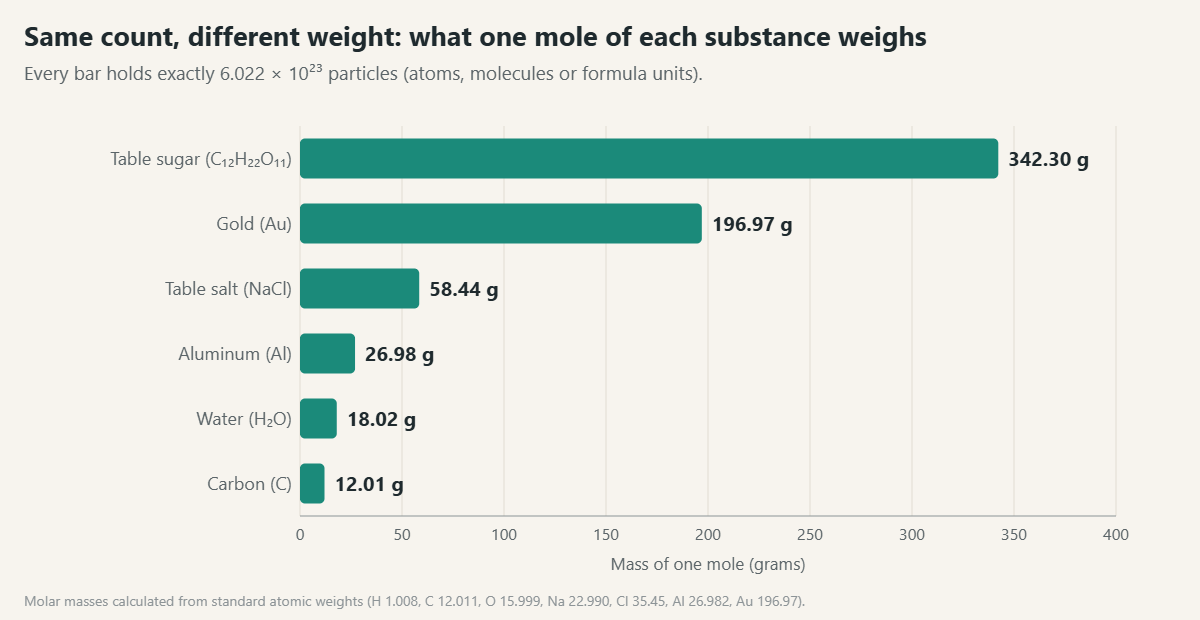
Molar mass is the mass of one mole of a substance, in grams per mole (g/mol). For an element, it is simply the atomic mass on the periodic table with “g/mol” attached: carbon is 12.011 g/mol and gold is 196.97 g/mol.
For a compound, add up the atomic masses of every atom in the formula. A mole of each substance contains the same number of particles, but because those particles have different masses, one mole of each weighs a different amount.
The chart shows how much one mole of six familiar substances weighs.
How to calculate the molar mass of a compound
Multiply each element’s atomic mass by how many of its atoms appear in the formula, then add. Here is table sugar, sucrose (C12H22O11):
| Element | Atoms in formula | Atomic mass (g/mol) | Subtotal (g/mol) |
|---|---|---|---|
| Carbon (C) | 12 | 12.011 | 144.132 |
| Hydrogen (H) | 22 | 1.008 | 22.176 |
| Oxygen (O) | 11 | 15.999 | 175.989 |
| Total | 342.297 ≈ 342.30 |
Watch for brackets. In calcium carbonate (CaCO3) the count is simple, but in calcium hydroxide, Ca(OH)2, the 2 doubles both the O and the H.
The Mole Map: Converting Between Grams, Moles and Particles
Every mole problem is a trip between three places: mass, moles and particles, with moles always in the middle. You cross from grams to moles using molar mass, and from moles to particles using Avogadro’s number.
| You have | You want | Do this |
|---|---|---|
| Grams | Moles | Divide by molar mass (g/mol) |
| Moles | Grams | Multiply by molar mass |
| Moles | Particles | Multiply by 6.022 × 10²³ |
| Particles | Moles | Divide by 6.022 × 10²³ |
| Grams | Particles | Two steps: grams → moles → particles |
Not sure whether to multiply or divide? Write the units and let them cancel. It is the same factor-label trick used in any unit conversion: g ÷ (g/mol) leaves mol, and mol × (particles/mol) leaves particles. If the units don’t cancel to what you want, you picked the wrong operation.
Worked Example: How Many Molecules Are in a Bottle of Water?
A standard 500 mL bottle of water holds about 1.67 × 1025 water molecules. Here is how to get there.
Step 1: Turn volume into mass
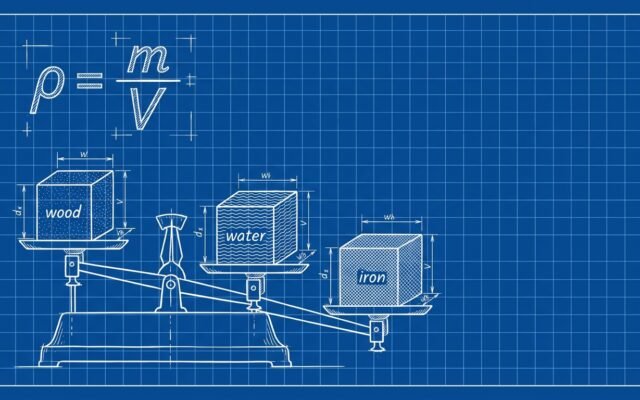
Water has a density close to 1 g/mL, so 500 mL weighs about 500 g. (If density is new to you, see how density is calculated.)
Step 2: Find the molar mass
H2O has two hydrogens and one oxygen: (2 × 1.008) + 15.999 = 18.015 g/mol.
Step 3: Convert grams to moles
500 g ÷ 18.015 g/mol = 27.75 mol of water.
Step 4: Convert moles to molecules
27.75 mol × 6.022 × 1023 molecules/mol = 1.67 × 1025 molecules.
Step 5: Sense-check the answer
Each mole is about 18 g, and 500 g is a little under 28 of those, so 27.75 mol looks right. The final number should be bigger than 6 × 10²³ because you have more than one mole. It is.
Three more quick examples
| Question | Working | Answer |
|---|---|---|
| How many carbon atoms are in a 1-carat diamond (0.200 g)? | 0.200 ÷ 12.011 = 0.01665 mol; × 6.022 × 10²³ | 1.00 × 10²² atoms |
| What is the mass of 0.25 mol of table salt? | 0.25 × 58.44 g/mol | 14.61 g |
| How many moles is 100 g of chalk (CaCO3)? | 100 ÷ 100.09 g/mol | 1.00 mol |
Atoms, Molecules or Formula Units: What Are You Counting?
A mole of a molecule contains more than a mole of atoms, so always name the particle. One mole of O2 is 6.022 × 10²³ molecules but 1.204 × 1024 oxygen atoms, because each molecule holds two.
Use the subscripts to scale up. One mole of H2O contains 2 mol of H atoms and 1 mol of O atoms. Two moles of H2O contain 4 mol of H atoms, which is 2.409 × 1024 hydrogen atoms.
Table salt is a special case. NaCl does not form separate molecules; it is a lattice of ions, a difference covered in ionic vs. covalent bonds. So chemists count “formula units” of NaCl: one mole is 6.022 × 10²³ formula units, each with one Na+ ion and one Cl− ion.
How Moles Are Used in Chemical Reactions
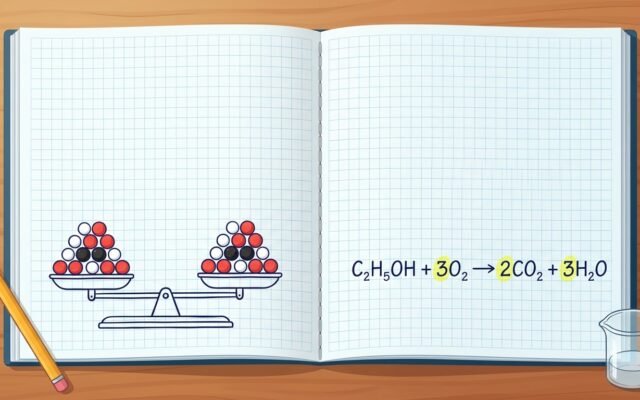
The numbers in front of formulas in a balanced equation are mole ratios. In 2H2 + O2 → 2H2O, two moles of hydrogen react with one mole of oxygen to make two moles of water.
That ratio is why the mole matters so much. You cannot count molecules in a lab, but you can weigh 4.03 g of hydrogen (2 mol) and know it needs 32.00 g of oxygen (1 mol) to react completely. The equation gives a ratio of particles, and the mole turns that ratio into masses you can measure.
Recipes work the same way. “2 cups flour to 1 cup sugar” scales to any batch size, and “2 mol H2 to 1 mol O2” scales to any amount of reactant.
Common Mix-Ups About Moles
These five mix-ups come up again and again in mole questions.
| Mix-up | What is actually true |
|---|---|
| “A mole is a mass.” | A mole is a count. Its mass depends on the substance, from 2.016 g for H2 to 342.30 g for sugar. |
| “Avogadro’s number is an estimate.” | Since 2019 it is exact: 6.02214076 × 10²³. The rounded 6.022 is your choice, not uncertainty. |
| “One mole of O2 is 16 g.” | 16 g is one mole of O atoms. One mole of O2 molecules is about 32 g. |
| “Molar mass and atomic mass are the same thing.” | Same number, different units: u for one atom, g/mol for one mole of atoms. |
| “Bigger atoms mean more particles per mole.” | Every mole holds the same count. Heavier particles just make the mole heavier. |
Stephen Lower’s Chem1 Virtual Textbook calls Avogadro’s number a “chemist’s dozen,” which is the clearest way to keep the first row straight.
Practice Problems (Answers Below)
Work each one on paper first. Use H 1.008, C 12.011, N 14.007, O 15.999, Fe 55.845 and Cu 63.546.
- How many iron atoms are in 3.00 mol of iron?
- How many moles are in 88.0 g of carbon dioxide (CO2)?
- A sample holds 1.204 × 1024 ammonia (NH3) molecules. How many moles is that?
- What is the mass of 2.50 mol of oxygen gas (O2)?
- How many copper atoms are in a 10.0 g piece of copper wire?
- How many oxygen atoms are in 0.500 mol of CO2?
Answers:
| # | Working | Answer |
|---|---|---|
| 1 | 3.00 × 6.022 × 1023 | 1.81 × 1024 atoms |
| 2 | 88.0 ÷ 44.009 | 2.00 mol |
| 3 | 1.204 × 1024 ÷ 6.022 × 10²³ | 2.00 mol |
| 4 | 2.50 × 31.998 | 80.0 g |
| 5 | 10.0 ÷ 63.546 = 0.1574 mol; × 6.022 × 10²³ | 9.48 × 10²² atoms |
| 6 | 0.500 mol × 2 O per molecule = 1.00 mol O; × 6.022 × 10²³ | 6.02 × 10²³ atoms |
Frequently Asked Questions
How many particles are in one mole?
Exactly 6.02214076 × 10²³, whatever the particle is. One mole of helium holds that many atoms, one mole of water holds that many molecules, and one mole of salt holds that many formula units. For most problems, 6.022 × 10²³ is precise enough.
Why is Avogadro’s number 6.022 × 10²³ and not a round number?
Because it was built to match grams to atomic mass units. It was originally set as the number of atoms in exactly 12 g of carbon-12, and that count happens to be about 6.022 × 10²³. A round number like 1024 would break the handy rule that an element’s atomic mass equals its molar mass in grams.
Is Avogadro’s number exact?
Yes. Before 2019 it was measured and had a small uncertainty. The revised SI fixed it at exactly 6.02214076 × 10²³, and the mole is now defined from that number. Rounding to 6.022 × 10²³ in homework is a choice about significant figures, not a sign the value is unknown.
How do you calculate moles from grams?
Divide the mass in grams by the molar mass in g/mol. For example, 36 g of water ÷ 18.015 g/mol = 2.0 mol. Find the molar mass by adding the atomic masses of every atom in the formula.
What is the difference between a mole and molar mass?
A mole is an amount (a count of particles). Molar mass is how much one mole of a particular substance weighs, in g/mol. Every substance has the same number of particles per mole but its own molar mass.
Is one mole of every substance the same size?
No. Every mole has the same number of particles, but masses and volumes differ. One mole of carbon is about 12 g, while one mole of sugar is about 342 g, because sugar molecules are much heavier than carbon atoms.
The Short Version
- A mole is a counting unit: 6.022 × 10²³ particles.
- Avogadro’s number is exact, 6.02214076 × 10²³, since the 2019 SI revision.
- Molar mass (g/mol) equals the atomic or formula mass, and links moles to grams.
- Go through moles: grams ÷ molar mass, then moles × Avogadro’s number.
- Always state the particle: molecules, atoms or formula units.
To get faster at reading atomic masses, revisit how to read the periodic table, then browse more chemistry explainers. NIST’s definitions of the SI base units show the mole alongside the other six.
Disclaimer
This article is for general educational purposes only. Values are rounded for learning, so use the atomic masses and significant-figure rules your teacher or exam board specifies. For lab work, follow your instructor’s safety and measurement procedures.