
Atoms, elements, and molecules sound like three names for the same tiny thing, but they describe three different levels of matter. An atom is a single particle, an element is a kind of atom, and a molecule is a group of atoms joined together. If you can already read the periodic table, you hold the key to the first two. This guide connects all three, and adds compounds, so the terms stop blurring together.
Ask a class whether oxygen is an atom, an element or a molecule and you will usually hear three different answers. All three can be right, depending on what you are pointing at: one oxygen atom, the kind of matter called oxygen, or the O₂ gas you are breathing right now. Textbooks, websites and teachers use the words loosely, which is why so many students lose marks on them.
Below you will find plain definitions, a flowchart that sorts any formula in two questions, a worked example for counting atoms, a real look at the air around you, and the mix-ups that keep showing up on tests.
Quick answer
An atom is a single particle of matter. An element is a pure substance made of only one kind of atom, identified by its number of protons. A molecule is two or more atoms bonded together, either the same kind (O₂) or different kinds (H₂O). A compound contains two or more different elements bonded together in a fixed ratio.
Key takeaways
- Atom: one particle. Its proton count decides which element it belongs to.
- Element: one kind of atom only. Oxygen, gold and helium are elements.
- Molecule: a neutral group of bonded atoms, from one element (O₂) or several (H₂O).
- Compound: two or more different elements bonded together. Water is one, oxygen gas is not.
- Watch out: table salt and metals are not made of molecules.
What Is an Atom?
An atom is the smallest particle of an element that still has that element’s chemical identity. Everything you can touch, from a pencil to your own hand, is built from atoms, and a single atom is far too small to see through an ordinary classroom microscope.
Every atom has the same basic layout. A tiny, dense nucleus at the center holds protons (positive charge) and neutrons (no charge). Electrons (negative charge) occupy the space around it. A neutral atom has equal numbers of protons and electrons, so the charges cancel. The familiar picture of electrons circling like planets is a handy simplification. Chemists treat them as a cloud of probability around the nucleus.
The number of protons matters most, because it decides which element an atom belongs to. Neutrons and electrons can change without changing the element:
| If this changes | What you get | Example |
|---|---|---|
| Number of protons | A different element | 6 protons is carbon, 7 protons is nitrogen |
| Number of neutrons | The same element, a different isotope | Carbon-12 and carbon-14 |
| Number of electrons | The same element, now an ion | A sodium atom that loses one electron becomes Na⁺ |
Ordinary chemistry never changes the proton count. Burning, rusting, dissolving and cooking all rearrange electrons and bonds, but the nuclei stay as they were. Our guide to the atomic number and isotopes in the periodic table goes deeper on those two ideas, so this article does not repeat it.
What Is an Element?
An element is a pure substance made of only one kind of atom, meaning every atom in it has the same number of protons. Gold is an element because every atom in a gold bar has 79 protons. Oxygen is an element because every oxygen atom has 8.
The word “element” gets used in two ways, and that is where a lot of the confusion starts. It can name a type (“oxygen is an element”) or a sample of that type (“this can is made of the element aluminum”). Either way, an element cannot be broken into simpler substances by chemical means. Chemists have confirmed 118 elements. Roughly 90 turn up in nature, and laboratories made the remainder.
Elements Made of Single Atoms
Helium, neon and argon, the noble gases, exist as separate, unbonded atoms. A balloon of helium really is a gas of lone helium atoms. Metals such as iron, copper and gold are also made of atoms, but those atoms are packed together in a repeating lattice instead of being grouped into small molecules. Chemists do not talk about “a molecule of iron.”
Elements That Come as Molecules
Several nonmetal elements are not found as lone atoms under normal conditions. Seven of them form pairs, called diatomic molecules: hydrogen (H₂), nitrogen (N₂), oxygen (O₂), fluorine (F₂), chlorine (Cl₂), bromine (Br₂) and iodine (I₂). Sulfur’s most common form is a ring of eight atoms, S₈. A memory trick for the seven pairs is “Have No Fear Of Ice Cold Beer”: H, N, F, O, I, Cl, Br.
These molecules are still elements. A flask of pure oxygen gas holds only oxygen atoms, just paired up. That single fact answers a surprising number of exam questions.
Same Element, Different Molecules: Oxygen and Ozone
One element can build more than one kind of molecule. Oxygen gas (O₂) has two atoms per molecule, while ozone (O₃) has three. Both contain only oxygen atoms, yet they are different substances with different behavior. The oxygen in air keeps you alive, while ozone near the ground is a pollutant that harms plant and animal cells. The lesson: the element tells you which atoms are present, and the molecule tells you how they are grouped.
What Is a Molecule?
A molecule is a group of two or more atoms held together by chemical bonds. The IUPAC Gold Book, the standard glossary of chemistry terms, describes it as an electrically neutral particle made of more than one atom. Within a molecule, the atoms can all be the same (O₂) or different (H₂O), and molecules range from tiny to enormous:
| Substance | Formula | Atoms per molecule | Different elements |
|---|---|---|---|
| Oxygen gas | O₂ | 2 | 1 |
| Water | H₂O | 3 | 2 |
| Carbon dioxide | CO₂ | 3 | 2 |
| Methane | CH₄ | 5 | 2 |
| Glucose (blood sugar) | C₆H₁₂O₆ | 24 | 3 |
Why Do Atoms Bond in the First Place?
Atoms bond through their outer electrons. In a covalent bond, two atoms share electrons, which is how water and carbon dioxide molecules hold together. In an ionic bond, one atom hands electrons to another, and the resulting charged ions attract each other. In a metal, electrons move freely through a lattice of atoms. The noble gases already have full outer shells, so they rarely bond at all and stay as single atoms.
This sharing-or-transferring split is the reason one substance forms molecules and another does not, which comes up again in the section on compounds.
How to Read a Chemical Formula
A chemical formula is shorthand for what a molecule contains. The letters are element symbols, and a small subscript after a symbol says how many atoms of that element are present. No subscript means one atom. A larger number written in front of the whole formula, called a coefficient, says how many molecules there are. So H₂ is one hydrogen molecule made of two atoms, while 2H means two separate hydrogen atoms.
Here is how to count atoms in 3 H₂SO₄, three molecules of sulfuric acid.
Step 1: List the symbols
The formula has H (hydrogen), S (sulfur) and O (oxygen), so three elements are involved.
Step 2: Read the subscripts
H has a 2 and O has a 4. S has no subscript, so it counts as 1.
Step 3: Add up one molecule
2 + 1 + 4 = 7 atoms in each H₂SO₄ molecule.
Step 4: Apply the coefficient
The 3 in front means three molecules, so 3 × 7 = 21 atoms in total: 6 hydrogen, 3 sulfur and 12 oxygen.
Molecular, Empirical and Structural Formulas
Chemists can write one substance in more than one way. A molecular formula gives the actual number of each atom, such as C₆H₁₂O₆ for glucose. An empirical formula gives only the simplest whole-number ratio, which turns glucose into CH₂O and hydrogen peroxide (H₂O₂) into HO. A structural formula goes further and shows which atoms are bonded to which. For counting atoms in a molecule, the molecular formula is the one to use.
What Is a Compound, and How Is It Different From a Molecule?
A compound is a pure substance made of two or more different elements chemically bonded in a fixed ratio. Water always has two hydrogen atoms for every oxygen atom. Change the ratio and you get a different substance: H₂O₂ is hydrogen peroxide. A compound can also look nothing like its elements. Hydrogen and oxygen are both gases at room temperature, yet the water they form is a liquid.
“Molecule” and “compound” overlap, but they answer different questions. The first label asks whether the atoms are grouped into separate particles. The second asks whether more than one element is present. Mixing the two up is the most common error on this topic, so here are both labels side by side:
| Substance | Molecule? | Compound? | Why |
|---|---|---|---|
| O₂ (oxygen gas) | Yes | No | Bonded atoms, but only one element |
| H₂O (water) | Yes | Yes | Separate molecules of different elements |
| NaCl (table salt) | No | Yes | A lattice of ions, not separate molecules |
| He (helium) | No | No | Single atoms of one element |
| Fe (iron) | No | No | A metal lattice of one element |
Why Table Salt Is a Compound but Not a Molecule
Sodium chloride forms when sodium atoms hand electrons to chlorine atoms, creating the ions Na⁺ and Cl⁻. Ionic compounds are held together by the pull between opposite charges, so a salt crystal is a huge repeating grid of ions, not a pile of separate NaCl molecules. The formula only gives the ratio: one sodium ion for every chloride ion. That strong grid also explains why salt melts at 801 °C, far hotter than any home oven.
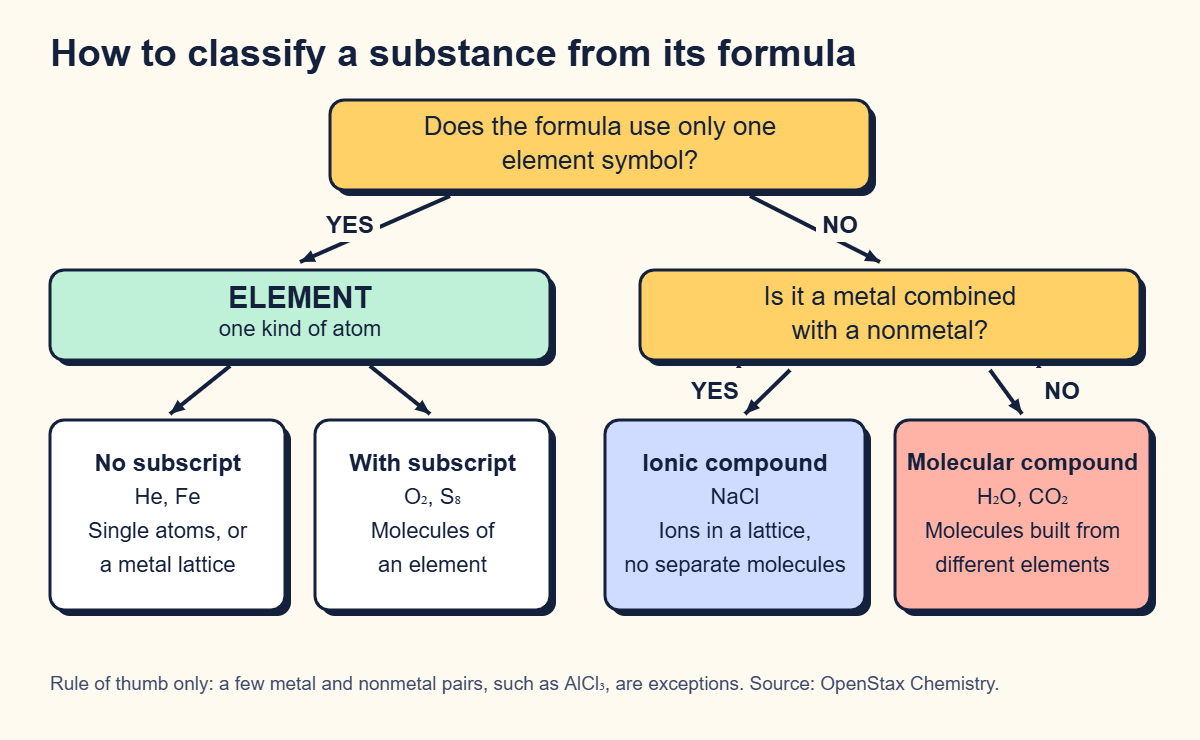
As a rough guide, a metal combined with a nonmetal usually gives an ionic compound, and nonmetals combined with each other usually give molecular compounds such as water and carbon dioxide. Treat that as a rule of thumb, because a few metal and nonmetal pairs, such as AlCl₃, break it.
How Atoms, Elements, Molecules and Compounds Fit Together
Think of letters. A single letter on a card is an atom. A whole stack of cards that all show the letter O is an element. A word like “OO” is a molecule of an element, while a word like “HHO” is a molecule of a compound, because it needs more than one kind of letter. The analogy has limits, since an ionic crystal is closer to a long repeating pattern than to a short word, but it keeps the levels straight.
| Term | What it is | Made of | Example |
|---|---|---|---|
| Atom | One particle | Protons, neutrons, electrons | A single neon atom (Ne) |
| Element | A pure substance with one kind of atom | Atoms with the same proton count | Gold (Au), oxygen (O) |
| Molecule | A neutral group of bonded atoms | Two or more atoms, same or different | O₂, H₂O |
| Compound | A pure substance with two or more elements | Different elements in a fixed ratio | H₂O, NaCl |
When you meet an unfamiliar formula, two questions sort almost anything you will see in a school course:
Everyday Examples of Each Type
| Everyday item | Formula | What it is |
|---|---|---|
| Helium in a party balloon | He | Element, single atoms |
| Aluminum foil | Al | Element, atoms in a metal lattice |
| The oxygen you breathe | O₂ | Element, molecules of two atoms |
| Distilled water | H₂O | Compound, molecules of three atoms |
| Table sugar (sucrose) | C₁₂H₂₂O₁₁ | Compound, molecules of 45 atoms |
| Baking soda | NaHCO₃ | Ionic compound of sodium ions and bicarbonate ions |
A Real Example: What Is Air Made Of?
Air is a handy test case because it contains all three kinds of particles. By volume, dry air is about 78 percent nitrogen and about 21 percent oxygen, with argon near 0.93 percent and carbon dioxide near 0.04 percent. Sort them with what you now know:
- Nitrogen (N₂) and oxygen (O₂): molecules of elements. Each particle has two atoms of the same kind, so they are molecules but not compounds.
- Argon (Ar): single atoms. It is an element, but not a molecule.
- Carbon dioxide (CO₂): a molecule of a compound, with one carbon atom and two oxygen atoms.
About 99 percent of dry air is molecules of just two elements, and only a sliver is compound molecules.
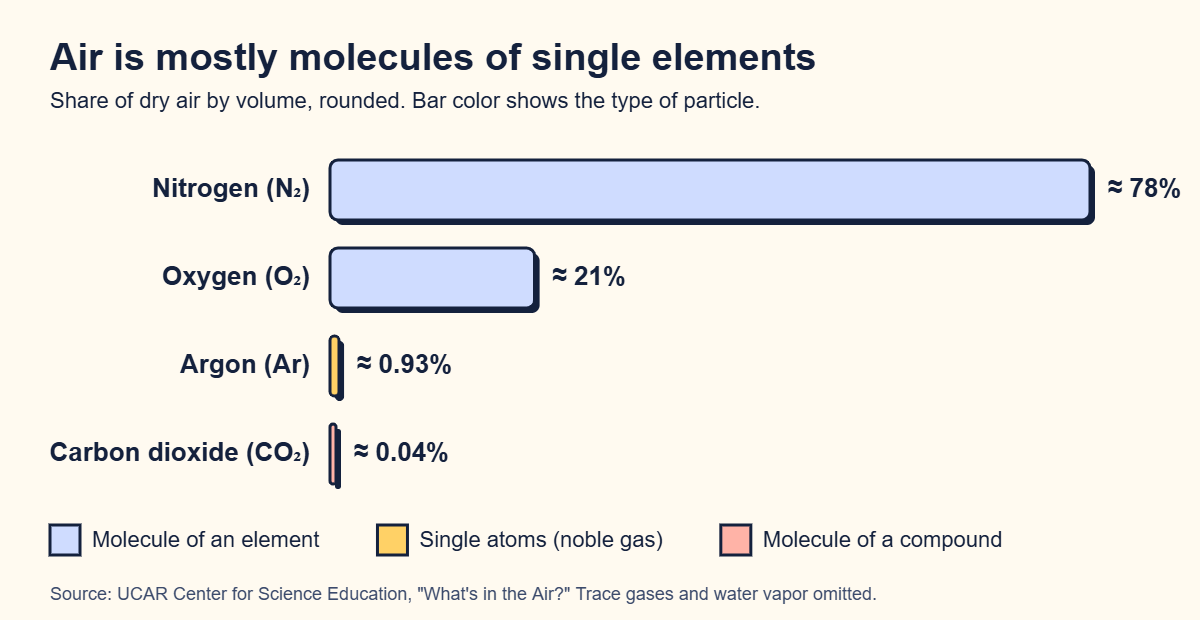
Air itself is neither an element nor a compound. It is a mixture: its gases sit side by side without bonding to each other, and their proportions can vary from place to place. That is why air can be separated into its gases without any chemical reaction, and why scientists quote its makeup for dry air.
Those molecules explain everyday things, too. Nitrogen and oxygen molecules are what scatter blue sunlight across the sky, which we unpack in why the sky is blue. Plants then take carbon dioxide and water molecules and rebuild their atoms into glucose, as shown in how photosynthesis works.
What Happens to Atoms in a Chemical Reaction?
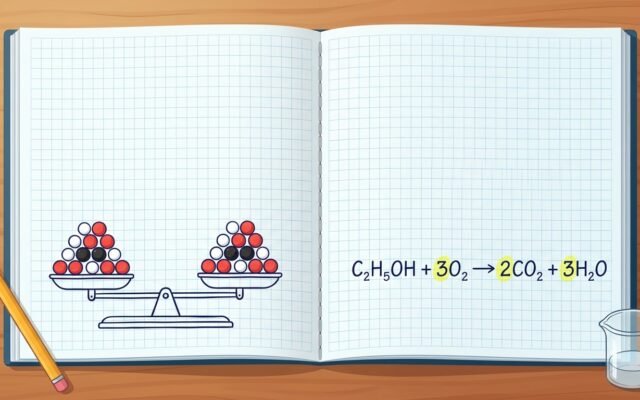
Atoms are rearranged, not created or destroyed. Bonds in the starting molecules break, and the same atoms form new bonds in the products. Water forming from its elements shows it: 2H₂ + O₂ → 2H₂O. The left side has four hydrogen atoms (2 × 2) and two oxygen atoms. The right side has the same four hydrogen atoms (2 × 2) and two oxygen atoms (2 × 1). The atoms did not change. Their partners did.
Photosynthesis works the same way. Count each atom on both sides of 6CO₂ + 6H₂O → C₆H₁₂O₆ + 6O₂:
| Atom | Left side | Right side |
|---|---|---|
| Carbon | 6 | 6 |
| Hydrogen | 12 | 12 |
| Oxygen | 12 + 6 = 18 | 6 + 12 = 18 |
Common Mix-Ups About Atoms, Elements and Molecules
| Myth | Reality |
|---|---|
| An atom and an element are the same thing. | An atom is one particle. An element is the pure substance in which every atom has the same number of protons. |
| Every molecule is a compound. | A molecule can be made of one element, as in O₂, N₂ and S₈. A compound needs at least two different elements. |
| Every compound is made of molecules. | Ionic compounds such as NaCl are lattices of ions, not collections of single discrete molecules. |
| Atoms cannot be divided. | Atoms contain protons, neutrons and electrons. Ordinary chemical reactions leave the nucleus alone, which is why an element keeps its identity through them. |
| Air and salt water are compounds. | They are mixtures. Their parts are not chemically bonded to each other and can appear in different proportions. |
Quick Practice: Classify These Substances
Cover the right-hand column, decide what each substance is, then check yourself.
| Substance | Formula | Answer |
|---|---|---|
| Helium | He | Element, single atoms, not a molecule |
| Iron | Fe | Element, metal lattice, no molecules |
| Ozone | O₃ | Element, a molecule of three oxygen atoms, not a compound |
| Sulfur | S₈ | Element, a molecule of eight sulfur atoms |
| Water | H₂O | Compound, molecular |
| Table salt | NaCl | Compound, ionic, no separate molecules |
| Glucose | C₆H₁₂O₆ | Compound, a molecule of 24 atoms |
How to Remember the Difference for an Exam
You do not need to memorize four definitions in isolation. Two questions about any substance sort it, and they work independently of each other:
- How many kinds of atom are in it? One kind means an element. Two or more kinds means a compound.
- Are the atoms bonded into separate groups? If yes, the groups are molecules. If the atoms form a lattice, as in iron or salt, they are not.
- Remember the overlap. A substance can be a molecule only (O₂), a molecule and a compound (H₂O), a compound only (NaCl), or neither (He).
To practice, copy ten formulas from your textbook and label each one with both questions. Wrong answers show you exactly which idea is still shaky.
Frequently Asked Questions
Is oxygen an atom, an element, or a molecule?
It can be all three, depending on what you mean. One oxygen atom has 8 protons. Oxygen as a kind of matter is an element. The oxygen gas in air is made of O₂ molecules, each with two oxygen atoms. In everyday chemistry, “oxygen” usually means that O₂ molecule.
Is water an element, a molecule, or a compound?
Water is both a molecule and a compound. Each H₂O molecule has two hydrogen atoms bonded to one oxygen atom, and because two different elements are involved, the substance is a compound. It is not an element, since chemical means can split it into hydrogen and oxygen.
Is salt (NaCl) a molecule?
No. Table salt is an ionic compound: sodium ions and chloride ions packed into a repeating crystal in a 1:1 ratio. It has no separate NaCl molecules. The formula gives a ratio, not a particle you could pick out and hold.
Can a molecule contain only one element?
Yes. O₂, N₂, H₂, O₃ and S₈ are all molecules built from a single element. They are molecules but not compounds, because a compound needs two or more different elements bonded together.
Are atoms and elements the same thing?
No, though they are closely linked. An atom is one particle. An element is the pure substance made of one kind of atom, defined by its proton count. You can say “a gold atom” for one particle and “gold” for the element.
How many atoms make up a molecule?
At least two. There is no upper limit. O₂ has 2 atoms, water has 3, glucose has 24, and large biological molecules contain far more. The count comes from adding the subscripts in the formula.
The Short Version
- An atom is one particle, and its proton count decides which element it is.
- An element is a pure substance made of one kind of atom, whether single atoms (He), a lattice (Fe) or molecules (O₂).
- A molecule is a neutral group of two or more bonded atoms, and it can be one element or several.
- A compound has at least two different elements, and not every compound is made of molecules.
- Two questions sort most formulas: how many element symbols, and is it a metal plus a nonmetal?
Want to check what stuck? Take the science quiz, build term cards in the Flashcard Maker, or browse the chemistry category for related topics. Formulas are the hard part for many students, and our guide to studying effectively explains how spaced practice helps.
Disclaimer
This article is for general educational purposes only. Examples and figures are simplified and rounded for teaching, and some textbooks define “molecule” and “compound” slightly differently, so follow the definitions your teacher or exam board uses. For help with a specific course or exam, check with your teacher, tutor, or the official requirements.