

Speed tells you how fast something moves, and velocity tells you how fast it moves and in which direction. That one extra piece, direction, is why physics keeps the two words apart. The same split sits behind distance and displacement: distance counts every meter you actually walked, while displacement only cares where you ended up compared with where you started. Both ideas are part of the bigger picture in how math and physics describe our world.
Quick answer
Speed is a scalar: it is the distance traveled divided by the time taken, and it has no direction. Velocity is a vector: it is the displacement divided by the time taken, and it always includes a direction. If you walk 100 m around a block and end up where you began, your average speed is greater than zero, but your average velocity is exactly zero.
Key takeaways
- Distance: the total length of the path you travel. It is never negative and never shrinks.
- Displacement: the straight-line change in position, with a direction. It can be zero, or even negative.
- Speed: distance divided by time. Velocity: displacement divided by time.
- Average speed is not the average of two speeds unless the two parts of the trip last the same amount of time.
- Constant speed does not mean constant velocity. A car going around a circle at a steady 60 km/h is changing velocity the whole time.
What is the difference between speed and velocity?
Both quantities answer the question “how quickly does the position change?” but they package the answer differently. Speed is a scalar, which means it is just a number with a unit, such as 5 m/s. Velocity is a vector, which means it is a number, a unit and a direction, such as 5 m/s north.
Think of a speedometer and a compass. The speedometer gives you speed. The speedometer plus the compass heading gives you velocity. Here is the comparison side by side.
| Feature | Speed | Velocity |
|---|---|---|
| Type of quantity | Scalar (size only) | Vector (size and direction) |
| Built from | Distance | Displacement |
| Formula (average) | distance ÷ time | displacement ÷ time |
| Can it be negative? | No | Yes, when the direction is opposite to the one you chose as positive |
| Can it be zero over a trip? | Only if you never moved | Yes, if you finish where you started |
| Example | 12 m/s | 12 m/s east |
What is the difference between distance and displacement?
Distance is the length of the route you took. Every step counts, including the ones you take backward. Displacement is the straight arrow from where you started to where you finished. Its length is the shortest possible gap between the two points, and it points toward the finish.
| Feature | Distance | Displacement |
|---|---|---|
| What it measures | Length of the whole path | Change in position, start to finish |
| Direction | None | Yes |
| Can it decrease? | Never | Yes, when you head back toward the start |
| Compared with each other | Always greater than or equal to the size of the displacement | Equal to the distance only for straight-line motion in one direction |
| Round trip result | Twice the one-way length | Zero |
A worked example you can follow step by step
Suppose you walk along a straight path, and east is the positive direction. You walk 90 m east in 60 s. You then turn around and walk 30 m west in 30 s. Where do you stand, and how fast have you moved so far?
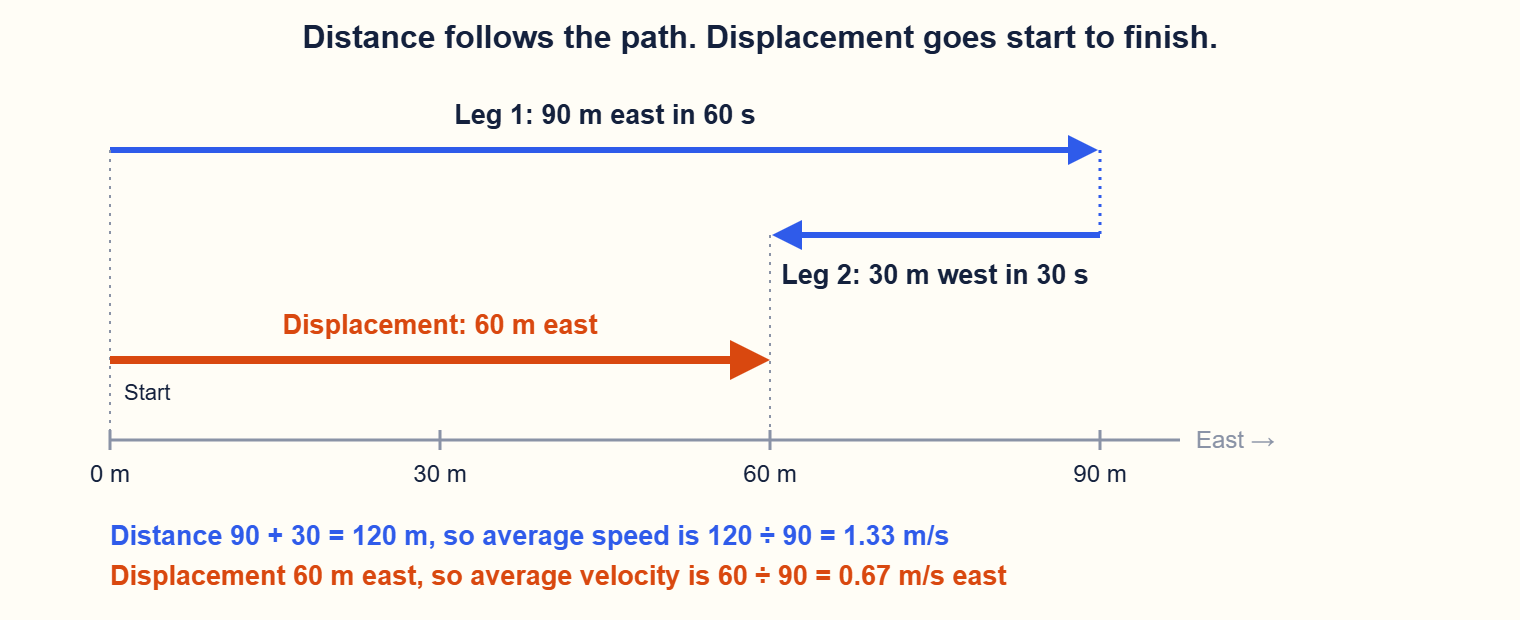
Step 1: Add up the distance. 90 m + 30 m = 120 m. Distance ignores direction, so the westward leg is added, not subtracted.
Step 2: Find the displacement. Final position minus starting position is 60 m minus 0 m, which is 60 m east. Equivalently, +90 m + (−30 m) = +60 m.
Step 3: Add up the time. 60 s + 30 s = 90 s.
Step 4: Compute the average speed. 120 m ÷ 90 s ≈ 1.33 m/s.
Step 5: Compute the average velocity. 60 m ÷ 90 s ≈ 0.67 m/s east.
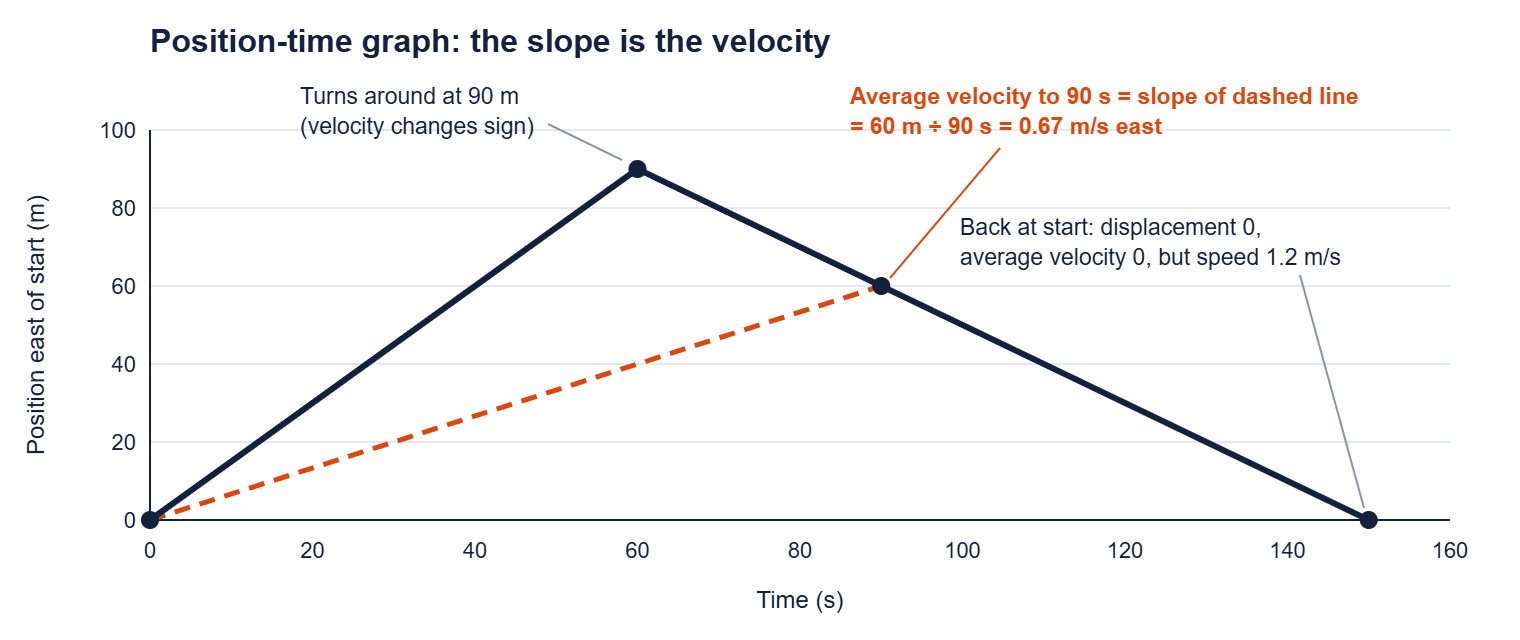
Notice that the speed is about twice the size of the velocity. Now finish the walk: you continue 60 m west in another 60 s and arrive back at the start. The total distance is 180 m in 150 s, so your average speed is 1.2 m/s. The total displacement is 0 m, so your average velocity is 0 m/s. You moved the whole time, yet your average velocity over the full trip is zero.
| Moment | Distance | Displacement | Time | Average speed | Average velocity |
|---|---|---|---|---|---|
| After leg 1 | 90 m | 90 m east | 60 s | 1.5 m/s | 1.5 m/s east |
| After leg 2 | 120 m | 60 m east | 90 s | 1.33 m/s | 0.67 m/s east |
| After leg 3 (back home) | 180 m | 0 m | 150 s | 1.2 m/s | 0 m/s |
What is the difference between average and instantaneous values?
Average speed and average velocity describe a whole trip. Instantaneous values describe one moment, like the reading on a car’s speedometer right now. Physics textbooks define instantaneous speed as the size, or magnitude, of the instantaneous velocity. So at any single moment, speed is just velocity with the direction stripped off.
Over a whole trip, though, average speed (total distance over time) can be much bigger than the size of the average velocity (net displacement over time). The only time they match is when you move in a straight line without ever turning back.
Reading velocity from a position-time graph
If you plot position against time, the slope of the line is the velocity. A line rising to the right means positive velocity. A line falling means negative velocity. Draw a straight line between any two points on the graph and its slope is the average velocity between them.
Can speed stay constant while velocity changes?
Yes, and this surprises many students. Velocity includes direction, so turning is enough to change it, even when the speedometer never moves. A car driving around a roundabout at a steady 40 km/h has constant speed but changing velocity, because its direction keeps rotating.
A real example: Earth around the Sun
NASA lists Earth’s mean orbital speed as 29.78 km/s, and a sidereal year as 365.256 days. Convert that and you get roughly 107,000 km/h. Over one full orbit, Earth travels about 940 million km, so the distance is enormous. But Earth ends the year back at the same point in its orbit, so its displacement over a full orbit is zero, and so is its average velocity. At every single moment, though, the instantaneous velocity points in a new direction along the orbit, which is exactly why Earth keeps curving instead of flying off in a straight line.
The average speed trap
A very common exam trick goes like this. A cyclist rides 24 km at 12 km/h, then another 24 km at 24 km/h. What is the average speed? Most people average the two numbers and say 18 km/h. That is wrong.
Step 1: Time for the first half: 24 km ÷ 12 km/h = 2 h.
Step 2: Time for the second half: 24 km ÷ 24 km/h = 1 h.
Step 3: Total distance is 48 km and total time is 3 h, so the average speed is 48 ÷ 3 = 16 km/h.
The slower leg takes more time, so it pulls the average down. Averaging two speeds only works when the two legs last equally long, not when they cover equal distances.
Common myths about speed and velocity
| Myth | Reality |
|---|---|
| Speed and velocity are the same thing. | Speed has no direction. Velocity does. |
| Distance and displacement are always equal. | They match only for straight-line motion that never reverses. |
| If your velocity is zero, you did not move. | Average velocity is zero for any round trip, however far you traveled. |
| A negative velocity means slowing down. | It only means moving in the direction you labeled negative. |
| Constant speed means constant velocity. | Velocity changes whenever direction changes. |
| Average speed is the mean of the speeds. | It is total distance divided by total time. |
Why does the difference matter in real life?
Direction is not a small detail once something has to arrive somewhere. A pilot cares about velocity, because a plane flying at 800 km/h in the wrong direction never reaches the airport, and a crosswind changes the plane’s velocity even when its airspeed reading stays the same. A delivery app, on the other hand, works with distance: your fuel use and the driver’s pay depend on the road length, not on the straight-line gap between the shop and your door.
Sports show the same split. A marathon runner covers 42.195 km, which is the distance, but on a point-to-point course the displacement is whatever the straight line from start to finish happens to be. On a lap-based track race the displacement can be zero while the distance is the full race length. When a question says “how far” it usually wants distance. When it says “how far from the start” or “where does it end up”, it wants displacement.
Units and quick conversions
Both speed and velocity use the same units: meters per second (m/s) in physics, and kilometers per hour (km/h) or miles per hour (mph) in daily life. To convert m/s to km/h, multiply by 3.6. For instance, 1.5 m/s is 5.4 km/h, and 60 km/h is about 16.67 m/s. If you want to practice moving between units without mistakes, see our guide on how unit conversions work.
Speed and velocity are the starting point for the rest of motion physics. Once you are comfortable with them, the next step is force and acceleration, which we cover in Newton’s three laws of motion with real examples. For the bigger picture of why these quantities are measured the way they are, read how math and physics describe our world. And since gravity is what changes the velocity of a falling object, how gravity works is a natural follow-up.
Frequently asked questions
Is speed always greater than velocity?
Not exactly, since one has a direction and the other does not. But the size of the average velocity is never larger than the average speed. They are equal only when you travel in a straight line without turning back.
Can velocity be negative?
Yes. You choose a positive direction, and motion the other way gets a minus sign. Speed cannot be negative because it is only a size.
Can displacement be zero if distance is not zero?
Yes. Walk once around a running track and you finish where you began. The distance is one full lap, but the displacement is zero.
Which one does a car’s speedometer show?
The speedometer shows instantaneous speed. It has no idea which way you are heading, so it cannot show velocity.
Is velocity just speed with a direction?
For a single moment, yes. For a whole trip, no: average velocity uses displacement, while average speed uses distance, so the two numbers can be quite different.
What is the SI unit of speed and velocity?
Meters per second (m/s). In everyday life you will often see km/h or mph instead.
The Short Version
Distance is the path length and speed is distance per time. Displacement is the straight-line change in position and velocity is displacement per time, with a direction attached. Walk a loop and your speed stays positive while your average velocity drops to zero. Keep these four ideas straight, check whether a question asks for a total or a net result, and most motion problems become much easier. Ready for the next step? Try Newton’s three laws of motion.
Disclaimer
This article is for general educational purposes. Worked examples use simplified, idealized motion, so check your course materials or ask your teacher for the exact conventions your exams require.


