

Kinetic and potential energy are the two basic ways a moving system stores energy: kinetic energy is the energy of motion, and potential energy is energy stored because of position. A rollercoaster swaps one for the other all ride long, and that swap is the same idea we use to describe our world with math and physics. Below you will see the formulas, a worked example with real numbers, and why a coaster can never climb higher than its first hill.
Quick answer
Kinetic energy is the energy an object has because it is moving: KE = ½ × mass × speed². Potential energy is stored energy, and for height it is PE = mass × g × height. On a rollercoaster, the lift hill loads the train with potential energy, the drop turns it into kinetic energy, and the total stays nearly constant.
Key takeaways
- Kinetic energy (KE): energy of motion. It depends on mass and on the square of speed.
- Potential energy (PE): stored energy. Gravitational PE depends on mass and height.
- Both are measured in joules (J). One joule is one kilogram meter squared per second squared.
- Total mechanical energy (KE + PE) stays the same when friction is ignored, which is why the first hill is the tallest.
- Double the speed and the kinetic energy quadruples. That is why fast rides are so much more intense.
What is kinetic energy?
Kinetic energy is the energy of anything that moves. A rolling ball has it, a flying baseball has it, and so does a rollercoaster train rushing through a valley. The more mass an object has and the faster it goes, the more kinetic energy it carries.
The formula is KE = ½ m v², where m is mass in kilograms and v is speed in meters per second. The result is in joules. Speed is squared, so it matters far more than mass: a car doing 20 m/s has four times the kinetic energy of the same car doing 10 m/s.
| Moving object | Mass | Speed | Kinetic energy |
|---|---|---|---|
| Rolling soccer ball | 0.43 kg | 10 m/s | about 22 J |
| Cyclist and bike | 80 kg | 8 m/s | about 2,560 J |
| Coaster train at the bottom of the example drop | 500 kg | 28 m/s | 196,000 J |
If you want a refresher on speed itself, including why it is not the same as velocity, see how speed differs from velocity.
What is potential energy?
Potential energy is energy stored in an object because of where it is or how it is arranged. It is “potential” because it can turn into motion later. A book on a high shelf, a stretched rubber band and a compressed spring all store it.
For rollercoasters, the type that matters is gravitational potential energy: PE = m g h. Here m is mass, g is 9.8 m/s² (the pull of Earth’s gravity near the surface) and h is height above a chosen zero level. If you want to see where g comes from, read how gravity works.
One detail trips students up: the zero level is your choice. OpenStax explains that potential energy needs a reference level where it is set to zero, and only the change in potential energy matters. On a coaster, the lowest point of the track is the easy choice.
OpenStax College Physics: 7.3 Gravitational Potential Energy.
| Type of potential energy | What stores it | Everyday example |
|---|---|---|
| Gravitational | Height above the ground | A coaster train at the top of the lift hill |
| Elastic | A stretched or squeezed object | A compressed spring in a pen |
| Chemical | Bonds between atoms | Food, fuel, batteries |
How does a rollercoaster turn potential energy into kinetic energy?
A coaster has no engine pushing it through the rest of the ride. A motor drags the train up the lift hill, and that work is stored as gravitational potential energy. After the train crests the top, gravity does the rest.
On the first drop, height falls and speed rises, so PE shrinks while KE grows. At the bottom of the valley the potential energy is at its smallest and the kinetic energy at its largest, which is why you feel the pull into your seat. Climbing the next hill reverses the trade: speed falls and height rises.
| Point on the ride | Height | Speed | Which energy is biggest? |
|---|---|---|---|
| Top of the lift hill | Highest | Slowest | Potential |
| Middle of the first drop | Medium | Medium | About equal |
| Bottom of the valley | Lowest | Fastest | Kinetic |
| Top of a smaller second hill | Lower than the first hill | Slower than at the bottom | Mixed, with some energy lost |
A worked example: a 40 m drop, step by step
This is an example scenario, not a real ride. Picture a 500 kg train (cars and riders together) resting at the top of a 40 m lift hill. Ignore friction and air for now, and use g = 9.8 m/s². How much energy does it have, and how fast does it go at the bottom?
Step 1: Find the potential energy at the top
PE = m g h = 500 × 9.8 × 40 = 196,000 J. The train is at rest, so its kinetic energy is 0 and the total mechanical energy is 196,000 J.
Step 2: Use conservation of energy
With no friction, the total stays 196,000 J everywhere. At the bottom the height is 0, so all of it has become kinetic energy: KE = 196,000 J.
Step 3: Solve for the speed at the bottom
Set ½ m v² = 196,000. Then v² = 2 × 196,000 ÷ 500 = 784, so v = 28 m/s. That is 100.8 km/h, or about 62.6 mph.
Step 4: Check a point halfway down
At 20 m the train has dropped 20 m, so KE = 500 × 9.8 × 20 = 98,000 J and PE is also 98,000 J. The speed there is √(2 × 9.8 × 20) = 19.8 m/s. The chart below shows all five heights.
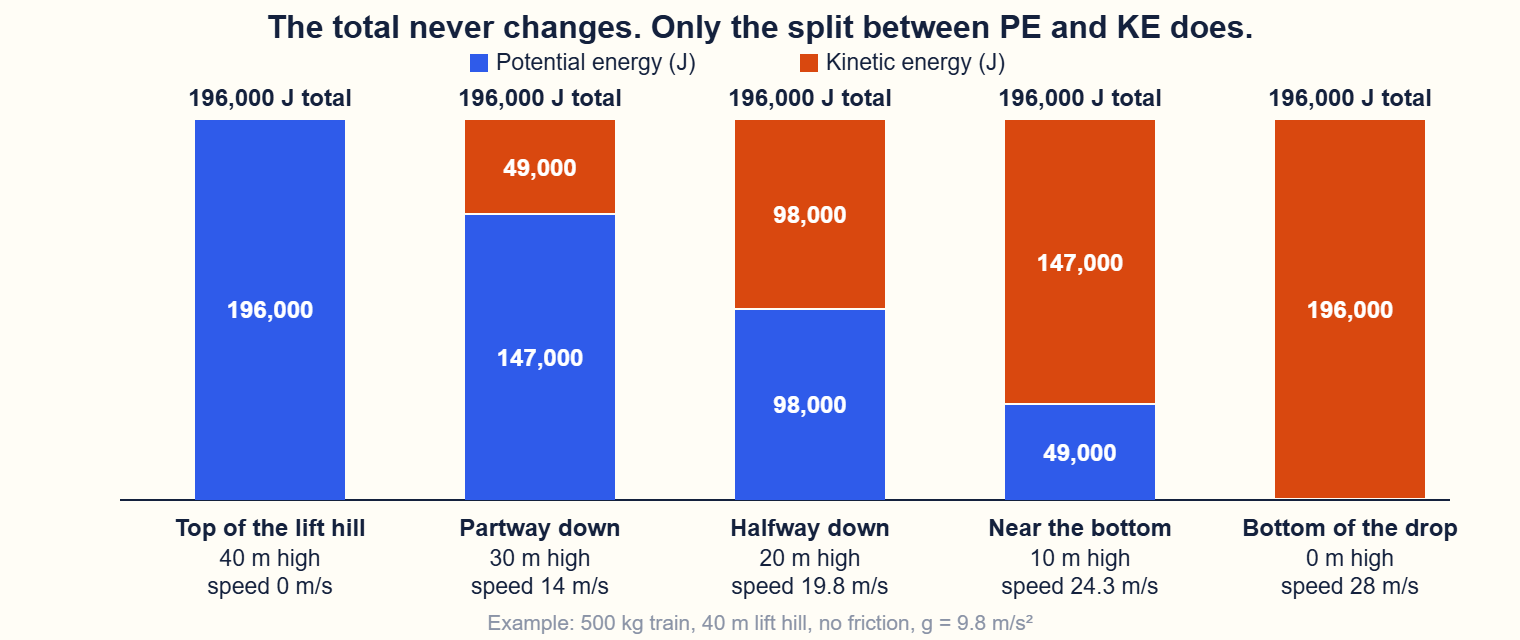
Look at the formula once more: the mass cancels out. Setting m g h equal to ½ m v² gives v = √(2 g h), so a heavier train does not reach a higher speed from the same drop. A full train and an empty one hit the bottom at the same speed in a frictionless world.
Why does doubling the speed quadruple the kinetic energy?
Because speed is squared in KE = ½ m v². Going from 10 m/s to 20 m/s is two times the speed but 2² = 4 times the energy. Going from 10 to 30 m/s is 9 times the energy.

This is why a drop that is twice as tall does not simply feel “twice as fast.” Speed at the bottom grows with the square root of the drop height, while the energy to be absorbed by the brakes grows with the square of speed. Designers have to plan for both.
Why can’t a coaster’s second hill be taller than the first?
Because the first hill sets the energy budget for the whole ride. The law of conservation of energy says total energy is constant in any process, so a train cannot gain mechanical energy from nowhere. To climb a hill of height h, it needs at least m g h of potential energy, and the only supply is what the lift hill gave it.
Friction makes the budget shrink. A nonconservative force such as friction turns some mechanical energy into thermal energy, which does not come back. Say 10% of the example’s 196,000 J is lost by the first valley. That leaves 176,400 J, enough to reach a height of 176,400 ÷ (500 × 9.8) = 36 m, not 40 m. Every hill after the first has to be lower than the one before it, or the train needs a second lift or a launch.
OpenStax: 7.5 Nonconservative Forces and Physics 9.2 Mechanical Energy and Conservation of Energy.
A real example: Fury 325 at Carowinds
Fury 325 opened in 2015 at Carowinds in North Carolina and was built by Bolliger & Mabillard. Its published figures are a 325 ft (99 m) height, a 320 ft (98 m) drop and a top speed of 95 mph (153 km/h).
Let’s test the energy idea on those numbers. With no losses, a 98 m drop gives v = √(2 × 9.8 × 98) ≈ 43.8 m/s, which is about 158 km/h or 98 mph. The published top speed is 153 km/h, or 42.5 m/s. Compare the energy per kilogram: the real speed carries ½ × 42.5² ≈ 902 J/kg, against 9.8 × 98 ≈ 960 J/kg available from the drop. So the train keeps roughly 94% of the energy as motion, and friction and air drag take the rest. Treat this as an estimate: the published figures are rounded, and the train starts the drop with a little speed over the crest.
Source for the ride’s figures: Wikipedia, Fury 325.
| Quantity | Value | How it was found |
|---|---|---|
| Drop height | 98 m | Published figure |
| Ideal top speed (no losses) | 43.8 m/s (158 km/h) | √(2 g h) |
| Published top speed | 42.5 m/s (153 km/h) | Published figure |
| Energy kept as motion | about 94% | 902 J/kg ÷ 960 J/kg |
What happens when the ride ends?
The train still has plenty of kinetic energy when it returns to the station, so brakes have to remove it. Brakes work through friction or magnetic effects, turning motion into heat. That is the same transformation as before, only on purpose: mechanical energy goes in, thermal energy comes out.
Common myths about kinetic and potential energy
| Myth | Reality |
|---|---|
| A heavier coaster train drops faster. | Mass cancels in v = √(2 g h), so the speed from a given drop is the same. |
| Potential energy only exists at the top of a hill. | It exists at every height above your zero level, and it drops steadily on the way down. |
| Energy is used up on a ride. | Energy is not destroyed. Friction turns part of the mechanical energy into heat. |
| Twice the speed means twice the kinetic energy. | It means four times the kinetic energy, because speed is squared. |
| Potential energy always means height. | Springs, stretched bands and chemical bonds store it too. |
The law of conservation of energy: OpenStax College Physics, 7.6 Conservation of Energy.
How are kinetic and potential energy connected to Newton’s laws?
Gravity pulls the train down the track, and that force does work on it, which is what changes its kinetic energy. The connection between force, mass and acceleration is the heart of Newton’s three laws of motion. Energy gives you a shortcut: you can find the speed at any point without tracking the force at every instant.
Units also matter. A joule equals a newton meter, so if your numbers look odd, check your conversions with this guide to how unit conversions work.
Frequently asked questions
What is the difference between kinetic and potential energy?
Kinetic energy belongs to motion, and potential energy is stored because of position or arrangement. A coaster at the top of a hill is full of potential energy. The same coaster at the bottom of the drop is full of kinetic energy.
What is the formula for kinetic energy?
KE = ½ m v², with mass in kilograms and speed in meters per second. The answer comes out in joules. Because speed is squared, small changes in speed change the energy a lot.
Does a rollercoaster have an engine?
Most classic coasters do not use an engine on the ride itself. A motor lifts the train up the first hill, and gravity then drives the train around the track. Some modern designs add launches or extra lifts.
Is the total energy of a rollercoaster always constant?
Only in the ideal case without friction and air drag. In real life, the total mechanical energy slowly drops, because some is turned into heat and sound. That is why later hills must be lower.
Can an object have both kinetic and potential energy at once?
Yes. A coaster halfway down a drop is both moving and elevated, so it has both. Their sum is the mechanical energy.
What unit is energy measured in?
Joules (J). One joule is the energy needed to push with a force of one newton over one meter.
The Short Version
- Kinetic energy is KE = ½ m v² and potential energy near Earth is PE = m g h.
- A coaster’s lift hill stores energy, and the drop converts it into speed.
- Total mechanical energy stays constant without friction, so each hill must be lower than the one before.
- Speed is squared in KE, so doubling speed quadruples the energy.
- Real rides lose a little energy as heat, as the Fury 325 estimate shows.
Want to go further? Read how speed differs from velocity, or review the idea behind falling objects in how gravity works. For the formulas used here, the OpenStax chapter on mechanical energy is a free, trusted reference.
Disclaimer
This article is for general educational purposes only. The worked examples use simplified physics that ignore friction and air resistance unless stated, and the Fury 325 comparison is a rough estimate from published figures. Check your course materials or ask a teacher for the exact methods your exams require.