
Your body holds about 30 trillion human cells, and roughly as many bacteria live on and in you. Every one of those cells needs oxygen, fuel and a steady temperature, and none of them can get any of it alone.
So how does the human body work? It works as a team of nested layers. Cells form tissues, tissues form organs, and organs cooperate in eleven organ systems that move blood, send signals, break down food and keep your inner conditions steady.
This guide walks through every system in plain English, follows a single sprint through the whole body, and puts real numbers on the page, including a chart of which organs use the most energy while you sit still. Every figure comes from a source linked at the end.
Quick answer
The human body works as layers of cooperating parts. Cells form tissues, tissues form organs, and organs team up in 11 organ systems. The nervous and endocrine systems send instructions, the cardiovascular system delivers supplies, and the respiratory, digestive and urinary systems bring materials in and remove waste. Feedback loops keep conditions such as temperature steady, a balance called homeostasis.
Key takeaways
- Layers: cells make tissues, tissues make organs, organs make organ systems, and the systems together make you.
- Eleven systems: this guide uses 11, although some sources count 10 to 12 depending on how they group them.
- Two messaging networks: the nervous system acts in seconds, while the endocrine system’s effects last minutes to weeks.
- Steady conditions: feedback loops hold things like temperature near a set range, which is homeostasis.
- An energy surprise: the brain, liver, heart and kidneys weigh under 5% of body mass but use more than half of your resting energy.
How Is the Human Body Built?
The body is built in layers: cells make tissues, tissues make organs, and organs work together as organ systems. Each layer can do something the layer below it cannot do alone.
| Level | What it is | Example |
|---|---|---|
| Cell | The smallest living unit of the body | A red blood cell, a nerve cell, a muscle cell |
| Tissue | A group of similar cells doing one job | Muscle tissue in the heart wall |
| Organ | Several tissue types working as one unit | The stomach, the heart, the skin |
| Organ system | Organs cooperating on a shared task | The digestive system |
| Organism | All the systems running together | You |
Every tissue falls into one of four basic types: epithelial (linings and coverings), connective (support and binding), muscle (movement) and nervous (signaling). The heart shows why layers matter. It is an organ built from muscle tissue plus connective and nervous tissue, so no single tissue could do its job.
Biology LibreTexts shows all four tissue types with diagrams in its chapter on the organization of the body.
How many cells are in the human body?
An average adult has about 30 trillion human cells. Adult men average about 36 trillion and women about 28 trillion. Those cells come in roughly 200 types, and about 330 billion of them die and are replaced every day, mostly blood cells and cells lining the gut.
The National Institute of General Medical Sciences gives these figures in its Biomedical Beat post on human cell numbers (September 25, 2024).
You may see 37 trillion quoted on other sites. The numbers differ because nobody can count cells one by one in a living person. Researchers estimate instead, and a 2023 PNAS study, The human cell count and size distribution, did this by compiling data on about 1,200 cell groups across 60 tissues. Different methods and different assumptions give different totals.
Bacteria add about one cell for every human cell, a ratio of roughly 1 to 1. They weigh very little, though. Human cells make up about 68% of your body mass, and all your bacterial cells together weigh only about 7 ounces.
What is the body made of?
At the chemical level, more than 90% of the body is carbon, oxygen, hydrogen and nitrogen. You can find all four on the periodic table, and our guide to how to read the periodic table explains what the symbols and numbers mean.
Cleveland Clinic lists the body’s composition in The Human Body: How Does It Work?
What Are the 11 Organ Systems of the Human Body?
The human body has 11 organ systems: integumentary, skeletal, muscular, nervous, endocrine, cardiovascular, lymphatic and immune, respiratory, digestive, urinary and reproductive. Here is each one at a glance.
| System | Main job | Key parts |
|---|---|---|
| Integumentary | Protects the body and helps control temperature | Skin, hair, nails, sweat glands |
| Skeletal | Supports and protects, stores calcium, makes blood cells | 206 bones in an adult, plus joints |
| Muscular | Produces movement, holds posture, makes heat | Skeletal muscles and tendons |
| Nervous | Fast control and communication | Brain, spinal cord, nerves |
| Endocrine | Slower chemical control through hormones | Ductless glands that release hormones into the blood |
| Cardiovascular | Moves blood to every cell | Heart, arteries, veins, capillaries |
| Lymphatic and immune | Returns fluid, absorbs fats, defends against germs | Lymph vessels, lymph nodes, spleen, thymus |
| Respiratory | Swaps oxygen and carbon dioxide | Airways and lungs |
| Digestive | Breaks down food and absorbs nutrients | Mouth to anus, plus the liver, gallbladder and pancreas |
| Urinary | Filters blood and balances water and salts | Kidneys, ureters, bladder, urethra |
| Reproductive | Makes egg and sperm cells and sex hormones | Ovaries or testes, plus ducts and glands |
Pages do not agree on the count. Cleveland Clinic says the body has 10 to 12 systems depending on how they are grouped, while Healthline says 11. This guide uses 11 and treats the lymphatic and immune systems as one.
Both counts appear in Cleveland Clinic’s overview of the human body and Healthline’s guide to the human body.
How Does Each Organ System Work?
Each system has a clear job, and almost every one depends on at least two others. Here they are in five groups.
Support and movement: skeletal, muscular and integumentary systems
An adult skeleton has 206 bones: 80 in the axial skeleton (skull, spine and rib cage) and 126 in the appendicular skeleton (the limbs and the girdles that attach them). Bones support the body against gravity, protect soft organs and act as levers when muscles pull on them. They also hold more calcium than any other organ, and the red marrow inside them makes blood cells. Newborns have about 300 bones, and many of them fuse as a child grows, which is why the adult count is lower.
Muscle fibers specialize in contracting, and nearly all body movement comes from that contraction. The body has three kinds of muscle: skeletal, cardiac and smooth. Skeletal muscle moves your bones, makes tiny posture adjustments all day and gives off heat. Nearly 85% of the heat your body produces comes from muscle contraction.
Skin is the largest organ. It covers about 2 square meters (21.5 square feet), makes up roughly 16% of body weight and is replaced about every 30 days. Between 2 and 5 million sweat glands release water that cools you as it evaporates.
The National Cancer Institute’s SEER training modules explain the skeletal and muscular systems. Newborn bone counts come from Healthline’s medically reviewed article on how many bones a baby has, and Britannica covers skin in 13 questions about how the human body works and on its page about sweat glands.
Control and communication: nervous and endocrine systems
The body runs on two messaging networks, and the biggest difference between them is speed.
| Feature | Nervous system | Endocrine system |
|---|---|---|
| Signal | Electrical nerve impulses and neurotransmitters | Hormones released into the blood |
| Speed | Effects measured in seconds | Effects last minutes, hours or weeks |
| Reach | Short-lived and local | Slower and more general |
| Targets | Muscles and glands | Only cells with the right receptors |
| Example | Telling a muscle to contract | Steering growth, development and metabolism |
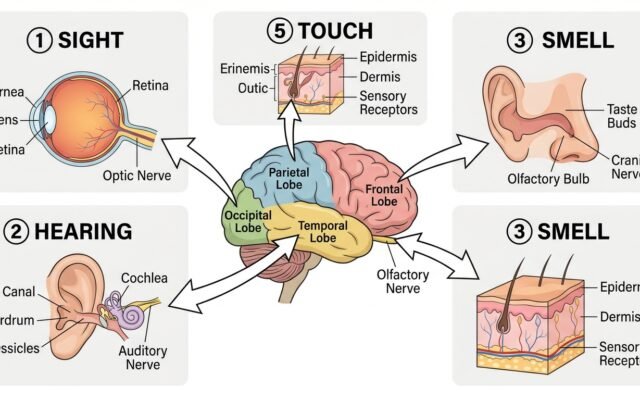
The nervous system has three overlapping jobs. Receptors sense changes such as temperature, light, pressure and carbon dioxide level. The brain combines those signals and decides what to do. Then muscles and glands, called effectors, carry out the response. The brain itself has three main parts, the cerebrum, cerebellum and brainstem, and the cerebrum makes up about 85% of its weight.
A hormone only affects cells that have a receptor for it. That is how one hormone traveling through the whole bloodstream can change some cells and ignore all the others.
SEER covers the nervous system and the endocrine system in detail, and the brain figures come from the same Britannica Q&A linked above.
Transport and defense: cardiovascular, lymphatic and immune systems
The cardiovascular system is a muscular pump, the heart, joined to a closed loop of arteries, veins and capillaries. In the capillaries, nutrients move from the blood into the fluid around cells while wastes move back the other way. An adult carries about 5 liters (1.3 gallons) of blood, and just over half of it is plasma, the liquid part. Red cells haul oxygen and carbon dioxide, white cells defend against germs, and platelets help a clot form. A pinhead-sized drop holds roughly 250,000 platelets, 10,000 white cells and 5 million red cells.
At rest, the heart beats about 70 times a minute in men and 75 in women on average. At 75 beats a minute, that adds up to about 108,000 beats a day.
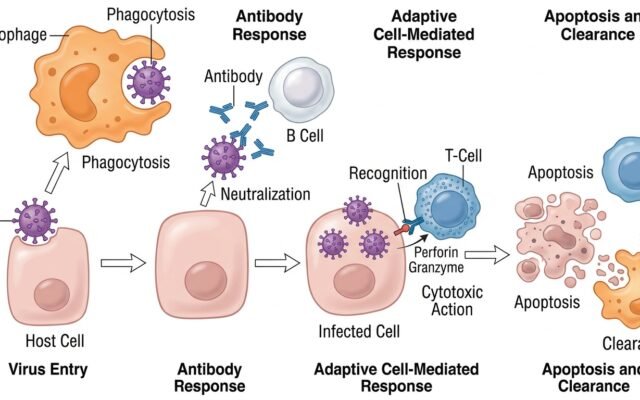
The lymphatic system cleans up after the blood vessels. About 90% of the fluid that leaks out of capillaries returns to the blood directly. The other 10% becomes the fluid between cells, and lymph vessels collect it and return it to the blood. Lymph nodes filter that fluid, and lymphocytes inside them destroy invading microbes. Lymph vessels in the gut also absorb fats and fat-soluble vitamins.
SEER explains the cardiovascular system and the lymphatic system. The blood volume of about 5 liters comes from Cleveland Clinic’s human body overview, and Britannica’s Q&A gives the blood cell counts and heart rates.
Energy in, waste out: respiratory, digestive and urinary systems
Breathing is only the first of five steps in respiration. They are ventilation (moving air in and out), external respiration (gas exchange between lungs and blood), transport (blood carries the gases), internal respiration (gas exchange between blood and tissue cells) and cellular respiration (cells use the oxygen). Nerve impulses trigger breathing about every 3 to 5 seconds, and the system also helps regulate blood pH. Cellular respiration is close to the reverse of what plants do, which you can read about in how photosynthesis works.
Food travels through the mouth, pharynx, esophagus, stomach, small intestine and large intestine. The liver, gallbladder and pancreas add fluids along the way. Mechanical digestion (chewing and churning) breaks food into smaller pieces, and chemical digestion uses water and enzymes to split carbohydrates, proteins and fats into molecules small enough to absorb. Most absorption happens in the small intestine, where those molecules pass into blood or lymph. Waves of muscle contraction called peristalsis push everything along.
The kidneys filter about 150 quarts of blood a day, roughly 140 liters. You can check that conversion with our Unit Converter. Only 1 to 2 quarts leave as urine, because the kidney tubules return most of the water and other useful substances to the blood. Each kidney is about the size of a fist and holds about a million filtering units called nephrons. The kidneys also remove acid made by cells, balance water and salts such as sodium and potassium, and make hormones that help control blood pressure and red blood cell production.
SEER has pages on the respiratory, digestive and urinary systems. The kidney figures come from the National Institute of Diabetes and Digestive and Kidney Diseases (NIDDK) page on how the kidneys work, last reviewed in June 2018.
Continuing the species: the reproductive system
The reproductive system makes egg and sperm cells (gametes), transports and sustains them, nurtures a developing offspring and produces sex hormones. The gonads, which are the ovaries and testes, are the primary organs because they make both the gametes and the hormones. Other organs, ducts and glands play supporting roles.
SEER’s page on the reproductive system lists the four functions.
How Do the Body’s Systems Work Together?
They work together by keeping the body’s inner conditions steady, a job called homeostasis. The physiologist Claude Bernard noticed that cells need stable surroundings, and Walter Cannon later named the idea from Greek words meaning “same” and “standing.” The name is a little misleading. Conditions do not stay perfectly fixed. They vary within a narrow range and get pulled back whenever they drift.
The tool for this job is the negative feedback loop. A sensor detects a change, a control center compares it with the target range, and an effector acts to reverse the change. Receptors play the sensor role, the brain is the control center, and muscles and glands are the effectors.
Body temperature is the easiest example. For people aged 11 to 65, Cleveland Clinic gives a normal range of 97.6°F to 99.6°F (36.4°C to 37.6°C), and a fever starts above 100.4°F (38°C). If you get too warm, sweat glands release water that cools your skin as it evaporates. Muscle contraction supplies nearly 85% of your body heat, so the muscular system also helps when you are cold.
SEER’s page on body functions and life processes tells the history of homeostasis. The temperature ranges come from Cleveland Clinic’s article on what is and isn’t a normal body temperature, reviewed by Donald Ford, MD, in February 2023.
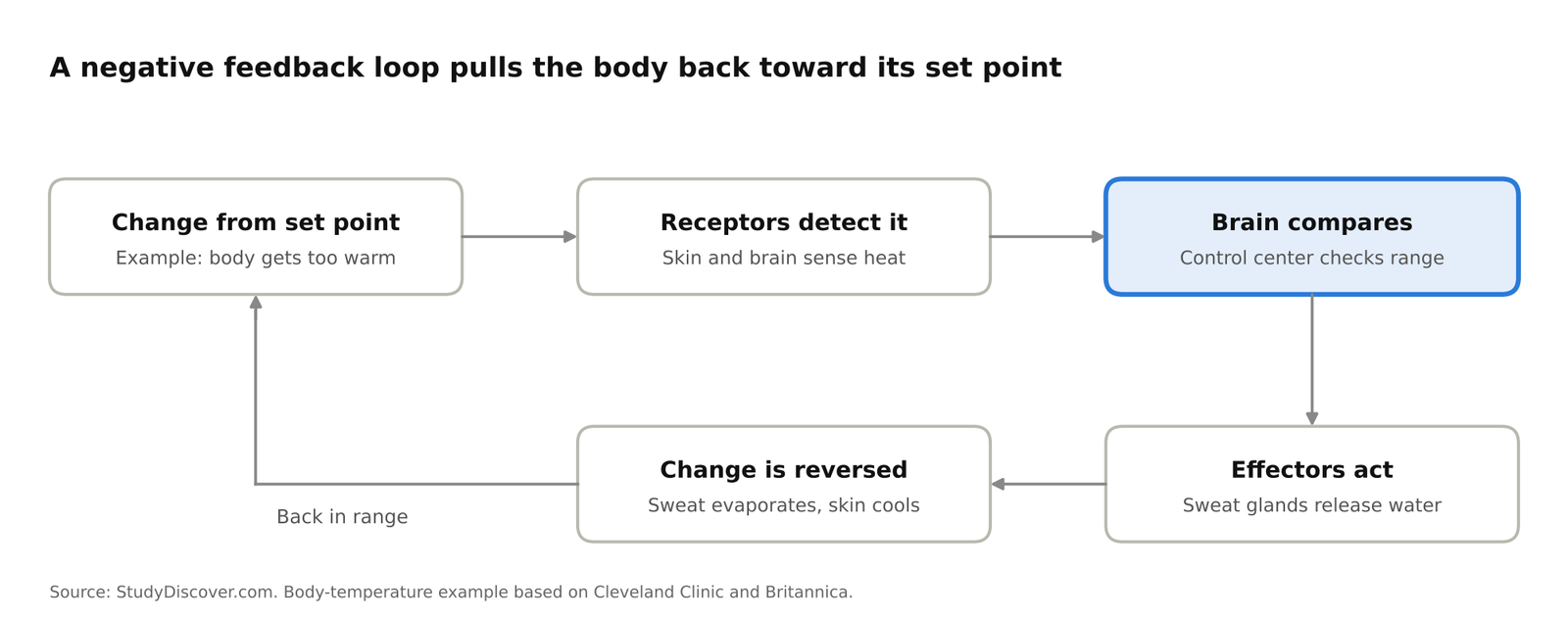
Read the loop clockwise: the brain is the only box that makes a decision, and the loop stops once the temperature is back in range.
What Happens in Your Body During a Sprint?
A sprint shows the systems at work better than any list can. Here is the chain of events in the order it unfolds.
Step 1: The nervous system sends the order
Your brain decides to run and sends electrical nerve impulses to your muscles, which act as the effectors that carry out the command. That takes seconds, not minutes.
Step 2: Muscles contract and burn fuel
Skeletal muscles pull on bones, and the bones work as levers. Muscle cells use oxygen to release energy from fuel, which is cellular respiration. The contraction also gives off heat, because nearly 85% of the body’s heat comes from muscle contraction.
Step 3: Carbon dioxide rises and breathing speeds up
Working muscles make more carbon dioxide. The brain controls breathing automatically in response to carbon dioxide levels, so your breathing quickens without any decision from you. Britannica puts the air you need at about 7.5 liters a minute lying down and 45 liters or more while running, about six times as much.
Step 4: The heart and blood deliver oxygen faster
The heart beats well above its resting rate of about 70 to 75 beats a minute and pushes more blood to the working muscles. Red cells carry oxygen to them and carry carbon dioxide away. In the capillaries, nutrients and wastes cross between the blood and the fluid around cells.
Step 5: Skin and sweat glands shed heat
Heat is the main trigger for sweating. The water evaporates from your skin and takes heat with it, which is the feedback loop you just saw.
Step 6: Hormones add a slower layer of control
The endocrine system releases hormones into the blood, and each one affects only cells with matching receptors. Their effects are slower than nerve signals but last minutes, hours or longer, so they add a longer-lasting layer to the body’s response.
Step 7: The kidneys and the rest of the body rebalance
After the sprint, the kidneys keep balancing water and salts and removing acid made by cells, so the blood returns to its normal chemistry. As you cool down and carbon dioxide falls, the loops switch off and your breathing and heart rate settle.
Seven steps, and eight of the eleven systems took part: nervous, muscular, skeletal, respiratory, cardiovascular, integumentary, endocrine and urinary. The digestive system supplied the fuel before you started.
Which Organs Burn the Most Energy at Rest?
Four organs, the brain, liver, heart and kidneys, use about 53% of the energy a man’s body burns at rest, yet together they make up only about 4.4% of his body mass. Skeletal muscle and fat are the reverse: they are most of the body by weight but a smaller share of its energy use.
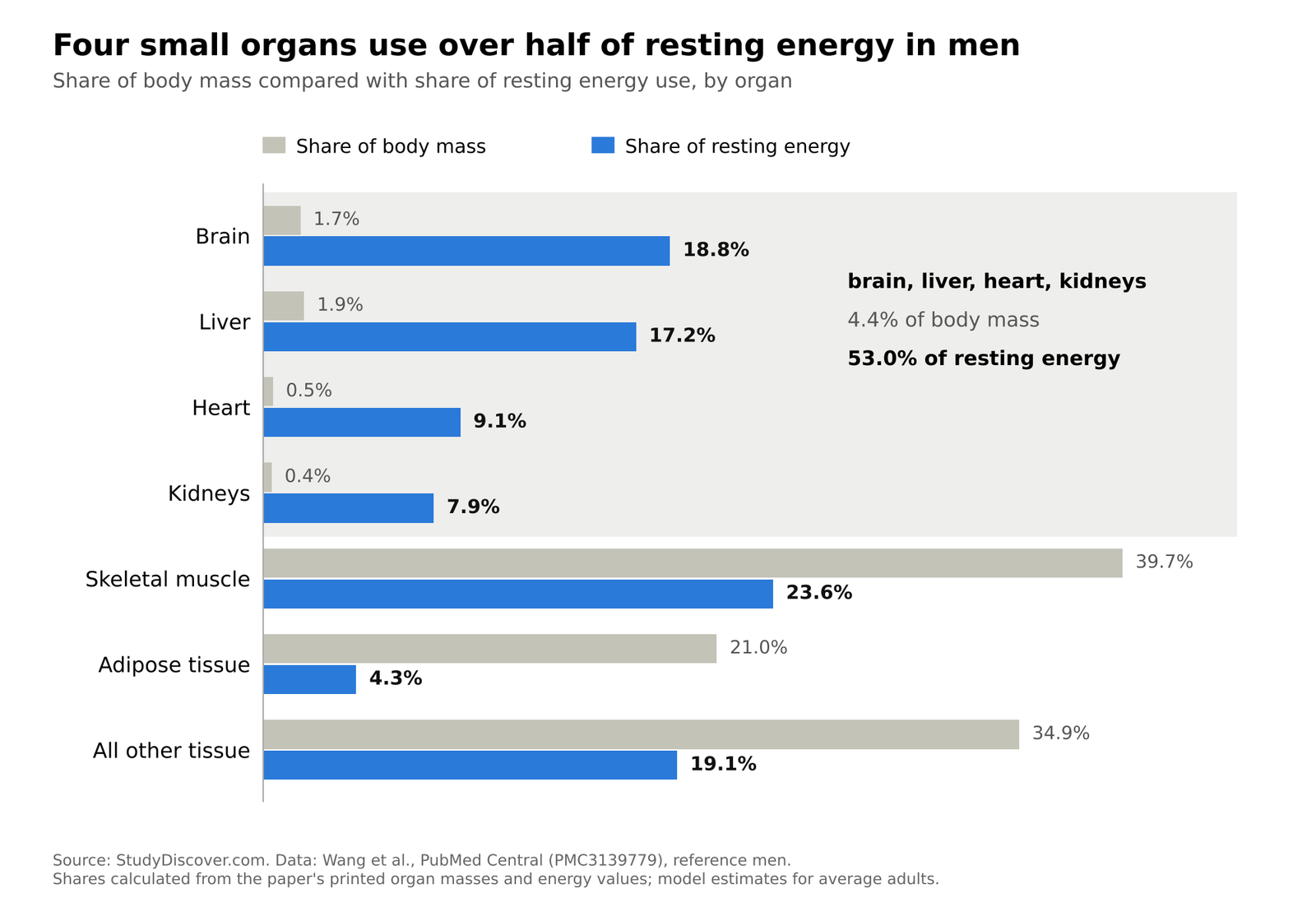
Kilogram for kilogram, the heart and kidneys are the hungriest organs. The model behind the chart assigns each of them about 440 kcal per kilogram per day, against 240 for the brain, 200 for the liver, 13 for skeletal muscle and 4.5 for fat. The brain still ranks first in total because it is far heavier than the heart or kidneys.
The pattern holds for women too. In the same study, the four organs use about 56% of resting energy and make up about 4.6% of body mass, with the brain alone at about 21.5%. As a check on the method, the model predicted 1,789 kcal a day for the men against 1,780 measured, and 1,409 against 1,407 for the women.
These are estimates for average adults, not measurements of your own organs. Body size, age and muscle mass will move the numbers.
The masses, energy values and model check come from the Wang et al. study on PubMed Central, and the percentage shares were calculated from its printed inputs.
Common Mix-Ups About the Human Body
Five popular ideas about the body sound reasonable but don’t hold up against the numbers.
| Myth | Reality |
|---|---|
| Bacteria in your body outnumber your own cells 10 to 1. | Newer estimates put the ratio at about 1 to 1, and bacteria add only about 7 ounces of body mass. |
| The brain is the only big energy user. | The brain uses about 19% of resting energy, but the liver uses about 17%, and kilogram for kilogram the heart and kidneys burn more. |
| Muscles exist only to move you. | Muscle contraction supplies nearly 85% of the body’s heat. |
| Blood in your veins is blue. | Blood is red. Veins look bluish because the blood in them has given up much of its oxygen. |
| You have the same bones you were born with. | Newborns have around 300 bones and adults have 206, because many bones fuse as a child grows. |
The cell ratio comes from the National Institute of General Medical Sciences, in a post that also puts the total at about 30 trillion human cells.
See the NIGMS Biomedical Beat post, published September 25, 2024.
The explanation of why veins look blue is in Britannica’s list of 13 questions about how the body works.
The bone counts are explained in Healthline’s article on how many bones a baby has, which was medically reviewed in 2019.
Frequently Asked Questions
How many organ systems does the human body have?
Most anatomy courses count 11: integumentary, skeletal, muscular, nervous, endocrine, cardiovascular, lymphatic, respiratory, digestive, urinary and reproductive. Some sources, including Cleveland Clinic, list 12 because they split a group in two, so published counts range from 10 to 12. The grouping changes, but the organs and their jobs stay the same.
What is the largest organ in the human body?
The skin. It covers about 2 square meters (21.5 square feet) in an adult, makes up roughly 16% of body weight and is replaced about every 30 days. It also holds between 2 and 5 million sweat glands, which cool you as the water they release evaporates.
How many human cells make up the body?
About 30 trillion human cells, according to the National Institute of General Medical Sciences. Men average roughly 36 trillion and women roughly 28 trillion. Bacteria add about as many cells again, but they weigh only about 7 ounces in total, so human cells still make up about 68% of your body mass.
How many bones are in the adult body?
An adult has 206 bones. A newborn has around 300, but many of them fuse as a child grows, which lowers the count. Textbooks use 206 as the standard adult figure.
What controls the human body?
The nervous system does, with the brain as the main control center. It reads signals from receptors and sends fast commands to muscles and glands. The endocrine system adds a slower layer: hormones travel in the blood and change what cells do over minutes, hours or longer.
What is a normal body temperature?
For people aged 11 to 65, Cleveland Clinic gives a normal range of 97.6°F to 99.6°F (36.4°C to 37.6°C). The familiar 98.6°F sits inside that range and is an average, not a fixed target. A fever begins above 100.4°F (38°C).
The Short Version
- The body is built in layers: cells, tissues, organs and 11 organ systems, all running on energy released from food and oxygen.
- Each system has a clear job, but none works alone. A single sprint draws on eight of them within seconds.
- Homeostasis keeps conditions steady through negative feedback loops: sense a change, compare it with a set point, act to reverse it.
- Size and energy use don’t match. Four small organs (brain, liver, heart, kidneys) use about 53% of a man’s resting energy while making up about 4.4% of his body mass.
- Several popular “facts” are off: the bacteria ratio is about 1 to 1, blood is never blue, and adults have 206 bones, not the roughly 300 they were born with.
To check what you remember, try the Science Quiz, then turn the 11 systems into a deck with the Flashcard Maker. If you are studying this for an exam, our guide on how to study effectively covers study methods you can apply to it, and the Science category has more guides like this one.
For the original anatomy material, the National Cancer Institute’s SEER training modules walk through each system in detail.
For quick answers to common body questions, see Britannica’s 13 questions about how the human body works.
Disclaimer
This article is for general educational purposes only. The energy shares in the chart are model estimates for average adults, not measurements of any one person. It is not medical advice, so for questions about your own health or symptoms, consult a doctor or another qualified healthcare professional.