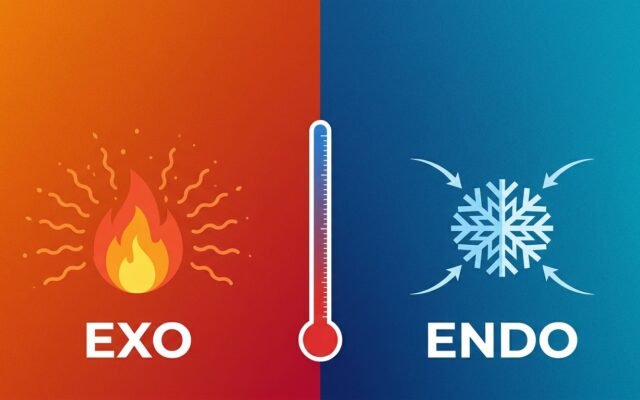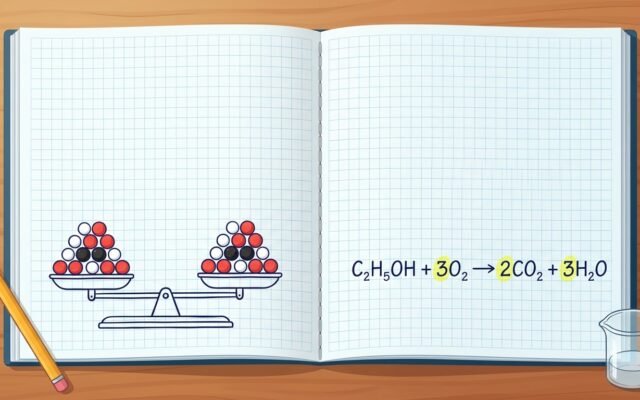

Most explanations stop at that definition and a list of examples. This guide goes further. You will get a clue check you can use on any change, a look at why some famous clues mislead, real energy numbers that explain why boiling water stays water, a table of tricky cases, and a practice set to test yourself.
Quick answer
A physical change alters form, shape or state, but the substance stays the same, so ice and liquid water are both H₂O. A chemical change forms one or more new substances with different properties, as when iron rusts or wood burns. The test is not how dramatic a change looks. It is whether new substances appear.
Key takeaways
- The deciding question: did a new substance form?
- Physical: same substance, new form. Melting, dissolving, cutting and crushing all count.
- Chemical: new substance. Burning, rusting, cooking and souring all count.
- Four clues hint at a reaction (color, gas, solid, light), but none of them proves it.
- Reversibility is not a reliable test, because some physical changes are hard to undo and some chemical ones can be reversed.
What Is a Physical Change?
A physical change is a change in which some properties of a material change, but the substance itself does not turn into anything new. LibreTexts Chemistry uses a melting ice cube as its opening example: the shape changes and the ice gains the ability to flow, yet the composition stays the same. Every molecule in the puddle is still H₂O.
Physical changes fall into three everyday groups:
| Type | Example | What stays the same |
|---|---|---|
| Change of state | Ice melting, water boiling, dry ice turning to gas | The same molecules, just arranged and moving differently |
| Change of shape or size | Crushing a can, cutting paper, breaking glass | The same material, in more or smaller pieces |
| Mixing or dissolving | Sugar in water, sand mixed with salt | Each substance is still there and can be separated again |
Notice that none of these needs a chemical reaction. The particles are rearranged in space, but the bonds inside each particle are left alone.
What Is a Chemical Change?
A chemical change, also called a chemical reaction, turns one or more substances into different ones. Bonds between atoms break and new bonds form, so the atoms end up in new partnerships. The atoms themselves are not created or destroyed. Our guide to atoms, elements, and molecules explains how those particles differ, which makes reactions easier to picture.
Rusting is a good case. Iron reacts with oxygen (and moisture) to form iron oxide, the flaky orange-brown material on an old bicycle. Rust is not shiny, does not conduct electricity like iron and crumbles in your hand, so it is clearly a different substance. Other chemical changes include:
- Burning wood, paper or gas
- Cooking an egg or baking bread
- Milk going sour
- Digesting a meal (see the stage-by-stage chemical digestion in your gut)
- Plants making glucose, as covered in how photosynthesis works
The One Question That Decides It
Ask whether a new substance formed. A “substance” here means something with its own properties, such as melting point, density, smell and how it reacts. If the properties of what you end up with match what you started with, you only changed the form. If they do not, you made something new.
You can usually answer this by watching for clues, then testing the result. Here is a worked example with two kitchen items: baking soda and vinegar.
Step 1: Record the starting substances
Baking soda is a white powder. Vinegar is a clear, sour-smelling liquid. Write down those properties so you have something to compare with later.
Step 2: Mix them and watch for clues
The mixture fizzes at once. Gas is forming, and nothing you added was a gas. That is a strong hint of a chemical change, but a hint is not yet proof.
Step 3: Test whether the product is new
The gas does not behave like air. Held over a small candle flame, it can snuff the flame out, which ordinary air does not do. The liquid left behind no longer smells like vinegar. These are new properties.
Step 4: Decide
New substances with new properties means a chemical change. The products are carbon dioxide gas, water and a dissolved salt called sodium acetate.
Four Clues of a Chemical Change (and How Each One Can Mislead You)
Chemistry courses list visual clues that a reaction is likely, though the same source stresses that they are not guaranteed: a color change, a gas, a solid product (called a precipitate) and light given off. Each clue has a physical look-alike that fools students every year.
| Clue | Chemical example | Physical look-alike |
|---|---|---|
| Color change | Iron turning orange-brown as it rusts | Food dye spreading through water |
| Gas bubbles | Baking soda and vinegar fizzing | Water boiling (the bubbles are steam, still H₂O) |
| New solid | A yellow solid forming when two clear solutions are mixed | Ice forming as water freezes |
| Light or heat | A log burning in a fire | An electric stove coil glowing red |
That is why the clue check below ends with a caution. Use the clues to form a guess, then ask whether the product really has new properties.

Why Boiling Water Is a Physical Change: The Energy Evidence
Bubbles and a big energy input make boiling look like a reaction, but the numbers show it is not. Boiling one mole of water takes the enthalpy of vaporization, about 40.67 kJ at 100 °C. Melting a mole of ice takes only about 6.01 kJ at 0 °C. Both changes loosen the attractions between water molecules. Neither one breaks the bonds inside them.
Breaking those inner bonds is a different scale of effort. OpenStax lists an average O–H bond energy of 464 kJ/mol, and a water molecule has two O–H bonds. That gives an estimate of about 928 kJ to split every molecule in a mole of water into pieces, roughly 23 times the energy of boiling and more than 150 times the energy of melting.
The chart makes the gap easy to see. The bond figure is an estimate built from an average value, so treat it as an order of magnitude and not an exact measurement.

This also answers a common worry: a change that absorbs or releases energy is not automatically chemical. Melting absorbs energy, and it is physical.
Is Reversibility a Good Test?
No. Many textbooks and websites offer “can you undo it?” as a shortcut, but it fails in both directions. Crushing a can or shredding paper is physical, yet you cannot realistically undo it. Going the other way, iron oxide can be turned back into iron, but that takes a new chemical reaction in a furnace and not simply cooling it down. The Science Notes guide to these changes makes the same point and calls reversibility unreliable.
A better version of the idea is this: if you can get the original substance back with a purely physical method, such as evaporating the water from sugar water, then the change was physical. If you would need another reaction to recover it, a chemical change took place.
Tricky Cases and Changes That Are Both
| Case | Verdict | Why |
|---|---|---|
| Dissolving sugar in water | Physical | The sugar is still sugar and returns when the water evaporates |
| Dissolving salt in water | Physical in most courses | The salt separates into ions but can be recovered by evaporation |
| Boiling water | Physical | Steam is still H₂O |
| Dry ice turning to gas | Physical | Solid carbon dioxide becomes carbon dioxide gas |
| Cooking an egg | Chemical | The egg proteins change, and you cannot uncook it |
| Burning a candle | Both | The wax melts (physical), then the wax vapor burns (chemical) |
| Chewing a cracker | Both | Teeth crush it (physical), then enzymes in saliva start breaking down starch (chemical) |
| Mixing sand and salt | Physical | Each keeps its own properties, so it is a mixture |
When a change is both, say so. Teachers usually accept “both” if you can name which part is physical and which is chemical.
What Happens to Mass and Atoms?
In every chemical or physical change, atoms are rearranged and none are lost, so the total mass stays the same in a closed system. Students often hit a snag with the baking soda and vinegar experiment. In an open cup, the scale reading can drop because the carbon dioxide gas floats away and carries its mass with it. Seal the reaction in a closed container and the total mass holds steady.
The same idea shows up in equations. When hydrogen and oxygen form water, 2H₂ + O₂ → 2H₂O has four hydrogen atoms and two oxygen atoms on each side. The partners changed, but the atoms did not.
Common Mix-Ups About Chemical and Physical Changes
| Myth | Reality |
|---|---|
| Physical changes are always reversible. | Crushing, cutting and breaking cannot realistically be undone, and they are still physical. |
| Chemical changes are always dramatic. | Rusting can take months. A slow change is still a new substance. |
| Bubbles mean a chemical change. | Boiling water makes bubbles of steam, which is still water. |
| Dissolving destroys the substance. | The dissolved substance is still present and can be recovered by evaporating the liquid. |
| Any energy change means a chemical change. | Melting ice absorbs about 6.01 kJ per mole and remains physical, as shown in the OpenStax phase-transition data. |
Quick Practice: Classify These Changes
Cover the right-hand column, decide on each one, then check.
| Change | Answer | Reason |
|---|---|---|
| Melting butter | Physical | Same fat molecules, now liquid |
| Toast browning | Chemical | Heat creates new brown compounds |
| Crushing ice | Physical | Only the size changes |
| An antacid tablet fizzing in water | Chemical | A reaction releases a new gas |
| Fog forming over a lake | Physical | Water vapor condenses to droplets of water |
| A bike chain rusting | Chemical | Iron reacts to form iron oxide |
| Milk souring | Chemical | New acids form and the taste and smell change |
| Mixing salt and pepper | Physical | A mixture whose parts keep their properties |
Frequently Asked Questions
Is melting a chemical or physical change?
Melting is a physical change. A solid turns into a liquid, but the substance stays the same, so melted ice is still H₂O. Only the arrangement and motion of the molecules change, not the molecules themselves.
Is burning a chemical or physical change?
Burning is a chemical change. Fuel reacts with oxygen to form new substances such as carbon dioxide and water vapor, and heat and light are released. You cannot turn the ash and gases back into the original wood.
Is dissolving sugar in water a chemical change?
No, it is physical. The sugar molecules spread out among the water molecules, but they are still sugar. If you let the water evaporate, the sugar crystals are left behind, which shows nothing new was made.
Is boiling water a chemical change?
No. Boiling is a physical change, because the gas in the bubbles is water vapor. The energy goes into separating molecules from each other, not into breaking the bonds inside them.
Is rusting a physical or chemical change?
Rusting is a chemical change. Iron reacts with oxygen and moisture to form iron oxide, a flaky orange-brown solid with different properties from the shiny metal it came from.
Can a change be both chemical and physical?
Yes. A burning candle is the classic case: the wax melts (physical) and then its vapor burns (chemical). When a process has both parts, identify which part is which instead of forcing one label.
The Short Version
- Ask one question first: did a new substance form?
- Physical changes alter form, shape or state. Chemical changes make new substances.
- Color change, gas, a new solid and light are clues, not proof.
- Reversibility and energy changes are unreliable shortcuts.
- Some processes, like a burning candle, are both.
Check what stuck with the science quiz, turn the vocabulary into cards with the Flashcard Maker, and keep reading in the chemistry category for related topics.
Sources
- LibreTexts Chemistry (Palomar College), “1.7: Physical and Chemical Changes”
- OpenStax Chemistry 2e via LibreTexts, “10.3: Phase Transitions”
- OpenStax, Chemistry 2e, “7.5 Strengths of Ionic and Covalent Bonds”
- Science Notes, “Chemical and Physical Changes of Matter”
Disclaimer
This article is for general educational purposes only. Energy values are rounded and the bond-energy figure is an estimate from an average, so use the data your textbook provides in tests. Never mix household chemicals or try experiments without adult supervision, and check with your teacher, tutor, or the official requirements for your course.