
So, how do our lungs breathe? They don’t pull air in by themselves. Your diaphragm and rib muscles make the chest bigger, the pressure inside drops below the pressure outside, and air flows in. When the muscles relax, the lungs spring back and the air flows out.
At a calm 15 breaths a minute, which sits inside the normal adult range of 12 to 18, you take about 21,600 breaths a day and move about 10,800 liters of air. You never decide to do any of it. Each breath travels down a branching tube to roughly 480 million tiny air sacs, where oxygen slips into the blood and carbon dioxide slips out.
This guide follows one breath from your nose to your blood. You’ll see the air path in a labeled drawing, learn the pressure trick that moves air, check the daily breathing math yourself, and clear up five common mix-ups.
Quick answer
Your lungs breathe through a pressure change. The diaphragm contracts and moves down while the rib muscles lift the ribs, so the chest expands and air rushes in through the airways to the alveoli. There, oxygen crosses into the blood and carbon dioxide crosses out. Relaxing the muscles pushes the air back out.
Key takeaways
- Air moves because chest volume changes pressure, not because the lungs pull.
- Inhaling takes muscle work; normal exhaling is passive.
- Gas exchange happens only in the alveoli, by simple diffusion with no energy cost.
- The urge to breathe is driven mainly by rising carbon dioxide, not falling oxygen.
- A resting adult takes roughly 17,000 to 26,000 breaths a day.
What Is the Respiratory System?
The respiratory system is the set of organs and muscles that bring oxygen into your body and send carbon dioxide out. It also traps dust and germs before they reach deep tissue, and it helps you smell and speak.
The tubes carry air, and the air sacs at the very end of the tubes do the actual swapping of gases. Here is the cast, in the order a breath meets them.
| Part | What it does |
|---|---|
| Nose and mouth | The two doors for incoming air. |
| Throat and voice box | A shared passage for air and food. A flap called the epiglottis keeps food out of the lungs. |
| Trachea (windpipe) | A single tube that carries air down toward the lungs. |
| Bronchi | Two tubes, one into each lung. |
| Bronchioles | Smaller and smaller branches that spread through the lung tissue. |
| Alveoli | Tiny air sacs at the branch tips where oxygen and carbon dioxide cross. |
| Diaphragm | A dome-shaped muscle under the lungs. It is the main breathing muscle. |
| Pleura | Two thin layers around each lung with a film of fluid between them, so the lungs follow the chest wall as it moves. |
The numbers are bigger than most people guess. An adult trachea runs about 10 to 12 cm long and 1.5 to 2 cm wide, held open by 16 to 20 C-shaped rings of cartilage. A typical adult lung weighs about 1 kg (2.2 lb) and stands roughly 24 cm tall at normal breathing.
The two lungs are not twins. The right lung has three lobes and the left has two, because the heart sits on the left side and takes up room.
Cleveland Clinic’s trachea page lists the windpipe length, width and cartilage rings.
Cleveland Clinic’s lungs page gives the lobe counts, lung weight and size.
The pleura wording follows OpenStax’s breathing chapter.
How Does Air Get From Your Nose to Your Blood?
Air passes six stops, and the last one is the only place where oxygen enters the blood. Picture an upside-down tree: the trunk is the trachea, the branches are the bronchi and bronchioles, and the leaves are the alveoli.
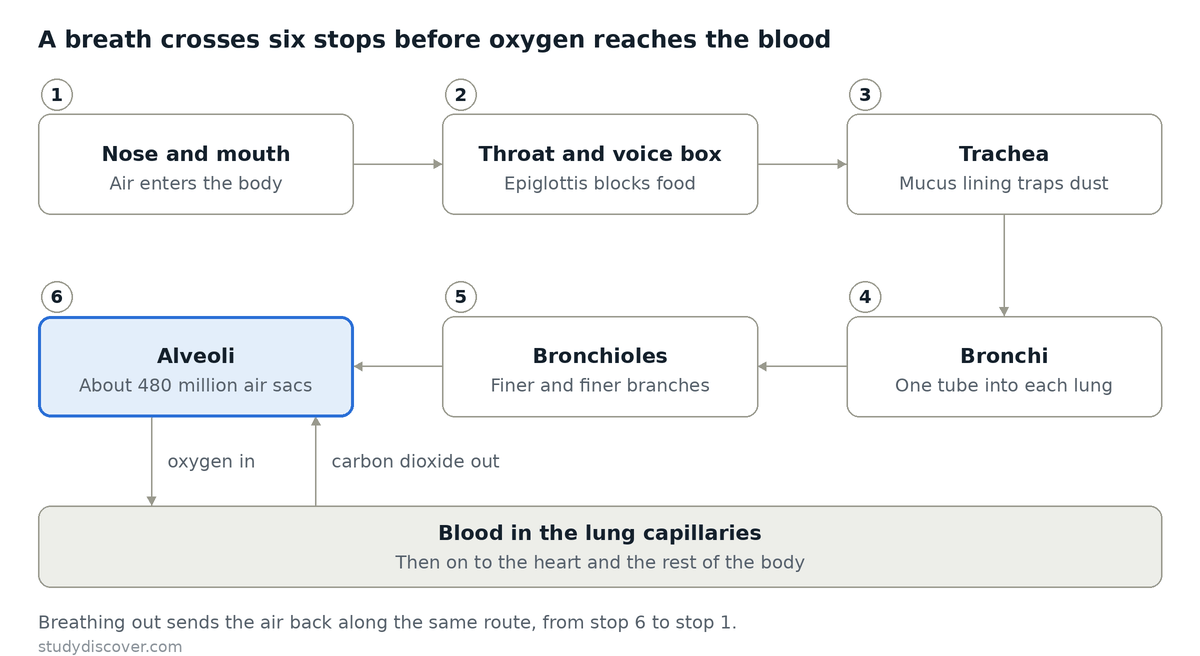
Follow the numbers: air goes in at 1, reaches the sacs at 6, and the blood does the rest.
- Nose and mouth. Air enters through either door.
- Throat and voice box. Air and food share the throat. When you swallow, the epiglottis covers the entrance to the windpipe so food stays out of the lungs.
- Trachea. The windpipe is lined with mucus that traps dust and germs. Hair-like cilia sweep that mucus upward so it can be cleared, and a cough forces air and mucus out with extra force.
- Bronchi. At a point called the carina, the trachea splits into a left and a right bronchus, one for each lung.
- Bronchioles. The tubes branch again and again and get narrower each time. Their width also adjusts to the carbon dioxide level in the alveoli, which helps send air where blood is flowing.
- Alveoli. Each air sac is about 200 micrometers wide, with a wall one cell thick, and the sacs cluster like grapes. A net of capillaries wraps around every one. The average person has about 480 million of them, with a combined surface area of about 130 square meters, roughly half a tennis court.
The tennis-court comparison is our own calculation: a standard court covers 23.77 m × 10.97 m, or about 261 square meters, so 130 square meters is about 50% of it.
Healthline’s alveoli page gives the alveoli count, width and surface area.
The NHLBI’s how the lungs work page confirms the air path from the nose or mouth to the alveoli.
OpenStax’s gas exchange chapter explains how bronchiole width follows carbon dioxide levels.
The cilia, mucus, carina and cough details come from Cleveland Clinic’s trachea page, and the epiglottis detail from KidsHealth.
How Do Your Lungs Pull Air In?
They don’t. Your muscles make the chest bigger, and the lungs are carried along with it. A bigger space means lower pressure, and air flows from the higher pressure outside to the lower pressure inside until the two match.
That is Boyle’s law: at a steady temperature, pressure and volume move in opposite directions. Here is the same rule with a syringe. This is an illustrative example, not a lung measurement.
P1V1 = P2V2
760 × 10 = P2 × 20
P2 = 380 mm Hg
Sea-level air presses at 760 mm Hg. Pull a sealed syringe from 10 mL to 20 mL and the pressure inside halves to 380 mm Hg. Your chest changes size by far less than that, so the pressure inside your lungs dips only slightly. Any dip below the outside pressure is enough to start the flow.
| Breathing in | Breathing out (quiet) | |
|---|---|---|
| Diaphragm | Contracts and moves down | Relaxes and moves back up |
| Rib muscles | External intercostals contract and lift the ribs up and out | Relax, so the ribs drop |
| Chest space | Gets bigger | Gets smaller |
| Pressure in the lungs | Falls below the outside air | Rises above the outside air |
| Air | Flows in | Flows out |
| Muscle effort | Active | None: elastic lung tissue springs back |
Two details keep this working. The pleural fluid between the lungs and the chest wall is sticky, so the lungs follow the chest as it moves, and the pressure in that gap stays about 4 mm Hg below atmospheric pressure. And a soapy coating called surfactant, made by type II alveolar cells, lowers surface tension inside the air sacs. Without it, the alveoli would collapse when you breathe out.
Quiet exhaling is passive, but it isn’t always. During hard exercise, neck muscles help lift the chest for a deeper breath in, and the abdominal muscles squeeze to push air out faster.
OpenStax’s process of breathing chapter supplies Boyle’s law, the 760 mm Hg figure, the muscle actions, surfactant and the pleural pressure.
The NHLBI’s breathing page confirms that exhaling is effortless at rest and that abdominal muscles help when you are active.
How Does Oxygen Get Into Your Blood?
Oxygen crosses into the blood by diffusion: each gas drifts from where its pressure is higher to where it is lower, and the body spends no energy on the move. The alveoli are built for exactly this, with walls one cell thick and a capillary pressed against every sac.
Every gas in a mixture pushes with its own share of the total pressure, called its partial pressure. Compare those shares at three places along the route.
| Where | Oxygen (mm Hg) | Carbon dioxide (mm Hg) |
|---|---|---|
| Air outside | 158.8 | 0.3 |
| Air in the alveoli | 104 | 40 |
| Blood arriving at the lungs | about 40 | about 45 |
Read across the last two rows. Oxygen is at 104 in the sac and about 40 in the arriving blood, a gap of 64 mm Hg, so oxygen flows into the blood. Carbon dioxide is at about 45 in the blood and 40 in the sac, a gap of only 5, yet it still flows out. That works because carbon dioxide dissolves about 20 times more easily than oxygen, so a small push moves a similar amount. By the time blood leaves the lungs through the pulmonary veins, its oxygen pressure is about 100 mm Hg.
The 158.8 in the first row is about 21% of the 760 mm Hg total, which matches the share of oxygen in air (our own division). Almost all of that oxygen was made by plants and algae through photosynthesis.
Once oxygen is in the blood, hardly any of it travels dissolved. Only about 1.5% rides in the plasma. The rest hitchhikes on hemoglobin in red blood cells, and each hemoglobin molecule can hold up to four oxygen molecules. Carbon dioxide takes three routes back: about 70% as bicarbonate, about 20% attached to hemoglobin, and about 7 to 10% dissolved.
The lungs also steer blood to where it is useful. If an alveolus gets too little fresh air, the tiny arteries serving it narrow, and blood is redirected to sacs that are well ventilated.
From here the oxygen-rich blood returns to the left side of the heart and is pumped around the body. Our guide to how the human heart works follows it from there, and the human body guide shows how the lungs fit with the other ten organ systems.
OpenStax’s gas exchange chapter gives every pressure in the table, the 64 and 5 mm Hg gaps, the 20-times solubility and the blood-flow steering.
OpenStax’s transport of gases chapter gives the 1.5% dissolved oxygen, the four oxygen molecules per hemoglobin and the carbon dioxide percentages.
What Controls Your Breathing?
Your brainstem does, automatically, and it reacts mostly to carbon dioxide, not oxygen. A cluster of cells in the medulla sets the basic rhythm: it fires to make the diaphragm and rib muscles contract, then goes quiet so they relax and you breathe out. A nearby area, the pons, fine-tunes the depth and speed. The brain guide shows where the brainstem sits and what else it runs.
Sensors do the checking. Chemoreceptors in the brain detect rising carbon dioxide, which makes the fluid around them more acidic, and they push the breathing rate up. Others in the aortic arch and the carotid arteries sense acidity in the blood. Oxygen sensors exist too, but they stay quiet until oxygen drops to about 60 mm Hg or lower.
Compare that with the table above: alveolar air sits at 104 mm Hg of oxygen, so ordinary breathing is never driven by an oxygen shortage. That is why holding your breath turns uncomfortable long before you run low on oxygen. Carbon dioxide piles up, the acidity signal grows, and the urge to breathe gets stronger.
Hard exercise adds a second push. Muscles make more carbon dioxide and lactic acid, both of which raise acidity and speed up breathing. At that point the accessory muscles join in, as described earlier.
OpenStax’s process of breathing chapter describes the medulla, pons, chemoreceptors, the 60 mm Hg threshold and the role of carbon dioxide.
How Much Air Do You Breathe in a Day?
A resting adult moves roughly 10,000 liters of air a day, and you can check that with three numbers. This is an example scenario with a typical adult, so your own figures will differ with age, size and activity.
Step 1: Pick a breathing rate
Adults at rest take 12 to 18 breaths a minute. Take the middle: 15 breaths a minute.
Step 2: Pick the air in one breath
A quiet breath moves about 500 mL, called the tidal volume.
Step 3: Multiply to get air per minute
15 breaths × 500 mL = 7,500 mL, or 7.5 liters a minute.
Step 4: Scale it to one day
There are 1,440 minutes in a day. 7.5 L × 1,440 = 10,800 liters, and 15 breaths × 1,440 = 21,600 breaths. At the ends of the normal range, 12 and 18 breaths a minute, the daily count runs from 17,280 to 25,920.
Step 5: Scale it to a lifetime
21,600 breaths × 365 days = 7,884,000 breaths a year. Over 70 years that is about 552 million breaths.
Breathing rate changes a lot with age. An infant under a year old may take 30 to 60 breaths a minute, which is 2.5 to 5 times the adult low end of 12.
| Age | Breaths per minute |
|---|---|
| Under 1 year | 30 to 60 |
| About 10 years | 18 to 30 |
| Teens and adults | 12 to 18 |
Your lungs also hold far more than one quiet breath. Here are the standard lung volume measurements.
| Measure | Plain meaning | Amount |
|---|---|---|
| Tidal volume | Air in one quiet breath | About 500 mL |
| Expiratory reserve volume | Extra air you can push out after a normal breath out | Up to 1,200 mL (males) |
| Vital capacity | Most air you can breathe out after a full breath in | 4,000 to 5,000 mL |
| Total lung capacity | All the air the lungs can hold | About 6,000 mL (males), 4,200 mL (females) |
A quiet breath uses only about 8% of a male’s total lung capacity, or about 12% of a female’s (our own division). The rest is reserve for exercise.
OpenStax’s process of breathing chapter supplies the breathing rates by age, the 500 mL tidal volume and the lung volumes. The daily, yearly and percentage figures are our own arithmetic from those inputs.
How Can You Keep Your Lungs Healthy?
A good first step is to keep harmful substances out of your airways. The NHLBI notes that cigarette smoke, air pollutants and other substances can damage the airways and make existing conditions worse. Cleveland Clinic also lists secondhand smoke, radon, vaping and dust or fumes at work as common irritants.
Damaged airways show up in a few familiar ways. Cleveland Clinic names cough, chest pain or tightness, shortness of breath and unusual tiredness as the main symptoms, and lists conditions such as asthma, bronchitis, COPD, pneumonia and cystic fibrosis. If you notice any of these, or they keep coming back, talk to a doctor. Sudden or severe trouble breathing, or chest pain, needs urgent medical care.
The NHLBI’s lungs page describes how smoke and pollutants harm the airways.
Cleveland Clinic’s lungs page lists the symptoms and conditions, and its respiratory system page lists the irritants.
Common Mix-Ups About Breathing and the Lungs
| Myth | Reality |
|---|---|
| The lungs suck air in like a vacuum. | The diaphragm and rib muscles enlarge the chest, the pressure inside falls, and outside air flows in. |
| Breathing out takes muscle work. | At rest it is passive. The muscles relax and elastic lung tissue springs back. Abdominal muscles help only when you are active. |
| You use up all the oxygen in a breath. | The air in the alveoli still holds about 104 mm Hg of oxygen, so the air you breathe out still contains plenty. |
| Low oxygen is what makes you gasp. | The strongest trigger is rising carbon dioxide. Oxygen sensors react only when oxygen falls to about 60 mm Hg or lower. |
| Breathing and respiration mean the same thing. | Breathing moves air. Respiration also includes gas exchange and the way cells use oxygen to release energy. |
OpenStax’s process of breathing chapter backs rows one, two and four.
OpenStax’s gas exchange chapter backs the 104 mm Hg figure in row three.
The NHLBI’s breathing page backs the point about abdominal muscles in row two.
Our human body guide lays out how breathing fits into the full chain of respiration, row five.
Frequently Asked Questions
How many breaths does a person take in a day?
A resting adult takes about 17,000 to 26,000 breaths a day. That comes from the normal rate of 12 to 18 breaths a minute multiplied by the 1,440 minutes in a day. At a middle rate of 15 a minute, the total is 21,600. Exercise, sleep, age and illness all shift the number.
Why is the left lung smaller than the right?
The heart sits slightly to the left, so the left lung gives up some room. It has two lobes, while the right lung has three. The size gap is small, and both lungs do the same job.
The lobe counts come from Cleveland Clinic’s lungs page, and the heart-position reason from the German-authored InformedHealth guide.
What is the difference between breathing and respiration?
Breathing is the movement of air in and out of the lungs. Respiration is wider: it includes the swap of gases in the lungs and blood, and the way cells use oxygen to release energy. Many textbooks use the word for both, so check which meaning your course uses.
Why do you breathe faster when you exercise?
Working muscles produce more carbon dioxide and lactic acid, which make the blood more acidic. Sensors in the brain and in large arteries detect that change and tell the breathing centers to speed up. Extra muscles in the neck and abdomen then help you take deeper breaths in and push more air out.
How much air can your lungs hold?
Total lung capacity is about 6,000 mL in an adult male and about 4,200 mL in an adult female. The most air you can breathe out after a full breath in, called vital capacity, runs from 4,000 to 5,000 mL. A quiet breath uses only about 500 mL of that.
The Short Version
- Air enters the nose or mouth, then passes the throat, trachea, bronchi and bronchioles before reaching the alveoli.
- Muscles enlarge the chest, pressure falls, and air flows in. Quiet breathing out needs no muscle work.
- Oxygen and carbon dioxide cross the alveolar wall by diffusion, driven by differences in partial pressure.
- Your brainstem sets the rhythm and responds most strongly to carbon dioxide.
- A resting adult breathes roughly 21,600 times and moves about 10,800 liters of air a day.
Test what you have learned with the Science Quiz, or turn the terms in this guide into cards with the Flashcard Maker. To see where the oxygen goes next, read how the human heart works, and for more explainers like this one, browse the Science category.
For the original textbook explanation, see OpenStax’s process of breathing chapter.
Disclaimer
This article is for general educational purposes only. It explains how healthy lungs work and does not diagnose or treat any condition. If you have trouble breathing, a lasting cough or chest pain, talk to a doctor, and get emergency care for sudden or severe symptoms.