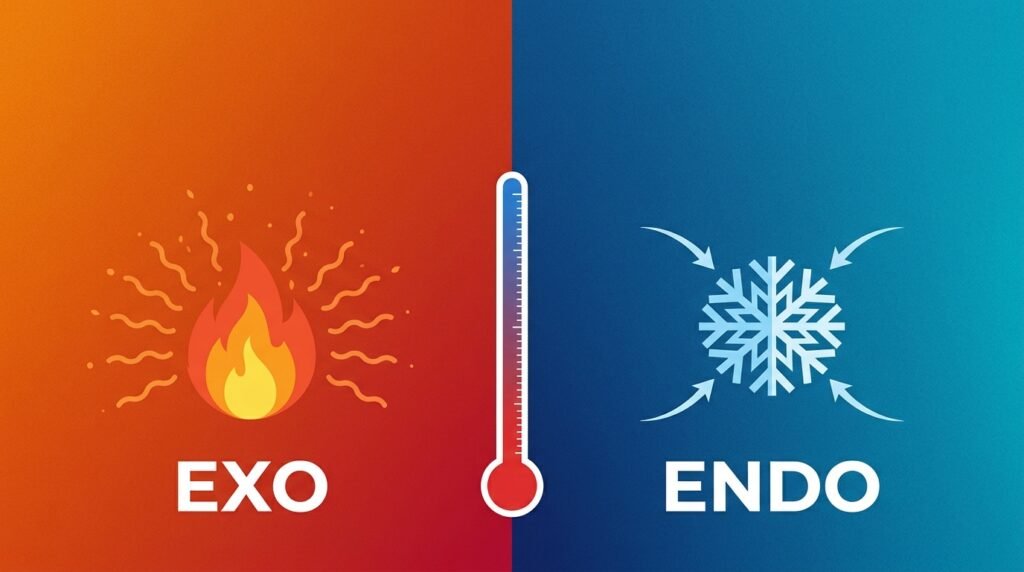
Endothermic vs. exothermic reactions comes down to which way heat flows. An exothermic reaction releases heat, so its surroundings get warmer; an endothermic reaction absorbs heat, so its surroundings get colder. Every chemical change does one or the other, from a gas flame to a plant leaf.
Grab an instant cold pack, squeeze it, and within seconds it feels icy. Strike a match and it gives off heat. Both are chemistry moving energy around, just in opposite directions.
This guide covers what each term means, the ΔH sign that tells them apart, why bonds decide the direction, how to read an energy diagram, a worked cold-pack calculation, everyday examples, common mix-ups and a quick practice set.
Quick answer
An exothermic reaction releases heat to its surroundings, which warm up, and has a negative enthalpy change (ΔH < 0). Burning methane is an example. An endothermic reaction absorbs heat from its surroundings, which cool down, and has a positive ΔH (ΔH > 0). Breaking down limestone and photosynthesis are examples.
Key takeaways
- Exo = heat out: surroundings warm up, ΔH is negative.
- Endo = heat in: surroundings cool down, ΔH is positive.
- Bonds decide it: breaking bonds takes energy, forming bonds releases it.
- Reverse it, flip it: if a reaction is exothermic one way, it is endothermic the other way.
- A spark is not a clue: many exothermic reactions still need energy to get started.
What Is an Exothermic Reaction?
An exothermic reaction gives off heat to its surroundings, so anything nearby, including the container and your hand, gets warmer. “Exo” means outward, and “thermic” refers to heat.
Burning natural gas on a stove is the classic case. One mole of methane burning in oxygen, CH4 + 2O2 → CO2 + 2H2O, releases 890.4 kJ of heat, according to Chemistry LibreTexts. That heat is what boils your pasta water.
Other common exothermic reactions include an acid neutralizing a base, iron slowly rusting, and your own cells breaking down glucose for energy. Fast or slow, the signature is the same: heat leaves the reaction.
What Is an Endothermic Reaction?
An endothermic reaction takes in heat from its surroundings, so the area around it gets colder, or the reaction needs a steady supply of heat to keep going. “Endo” means inward.
Heating limestone is a good example. Breaking calcium carbonate into lime and carbon dioxide, CaCO3 → CaO + CO2, absorbs 177.8 kJ per mole, which is why kilns have to keep firing to make it happen.
Photosynthesis is endothermic on a much bigger scale. Plants absorb energy from sunlight to turn carbon dioxide and water into sugar, as covered in our guide to how photosynthesis works. Turn the sun off and the reaction stops.
Endothermic vs. Exothermic: Side-by-Side
The two are mirror images. This table puts every difference in one place:
| Feature | Exothermic | Endothermic |
|---|---|---|
| Heat flow | From the reaction to the surroundings | From the surroundings into the reaction |
| Temperature of surroundings | Rises (feels warm) | Falls (feels cold) |
| Sign of ΔH | Negative (ΔH < 0) | Positive (ΔH > 0) |
| Energy of products vs. reactants | Products lower | Products higher |
| Bonds | More energy released forming bonds than used breaking them | More energy used breaking bonds than released forming them |
| Where “heat” sits in the equation | On the product side | On the reactant side |
| Everyday examples | Burning fuel, hand warmers, respiration | Cold packs, baking soda and vinegar, photosynthesis |
System and Surroundings: Where Does the Heat Go?
Chemists split the world into the system (the reacting chemicals) and the surroundings (everything else: the water they are dissolved in, the beaker, the air, your hand). Heat moves between the two.
This split clears up the most common confusion. A thermometer in the beaker measures the surroundings, not the reaction. When the beaker feels cold, it is because the reaction pulled heat out of the water around it. The system gained energy even though the beaker cooled.
Energy is never created or destroyed in either case; it only changes place, the same conservation rule that drives a rollercoaster in our article on kinetic and potential energy.
Why Do Some Reactions Release Heat and Others Absorb It?
It depends on the balance between breaking old bonds and forming new ones. Breaking bonds always costs energy, and forming bonds always releases it. Every reaction does both.
- If forming the new bonds releases more energy than breaking the old ones cost, the extra comes out as heat. The reaction is exothermic.
- If breaking the old bonds costs more than forming the new ones gives back, the reaction has to take in the difference. It is endothermic.
Think of it like a shop trade. You pay to break bonds and get paid to make bonds. Walk out with change in your pocket and the reaction was exothermic; owe money at the till and it was endothermic.
How to Read an Energy Profile Diagram
An energy profile diagram plots energy (up the side) against the progress of the reaction (along the bottom). Where the line ends compared with where it starts tells you the type.
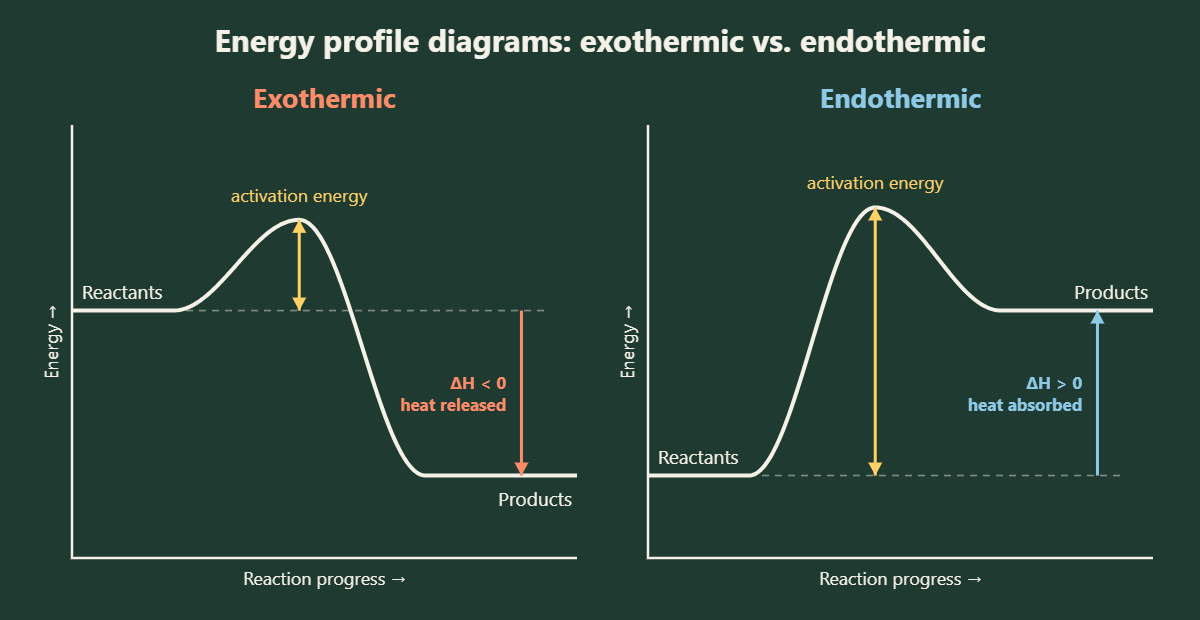
- Exothermic: products finish lower than reactants. The drop is the heat released.
- Endothermic: products finish higher than reactants. The rise is the heat absorbed.
- The hump: both curves climb first. That climb is the activation energy, the push needed to start breaking bonds.
That hump explains why a match is needed to light a gas stove even though burning gas releases heat. The spark supplies the activation energy; after that, the reaction releases enough heat to keep itself going. Needing a start-up push does not make a reaction endothermic.
What Does ΔH Mean? Reading Thermochemical Equations
ΔH (delta H) is the enthalpy change: the heat taken in or given out by a reaction at constant pressure. LibreTexts defines a positive ΔH as endothermic and a negative ΔH as exothermic, and a balanced equation that includes ΔH is called a thermochemical equation.
The sign is written from the reaction’s point of view. Negative means the reaction lost energy (to the surroundings); positive means it gained energy. Here is how real values compare:
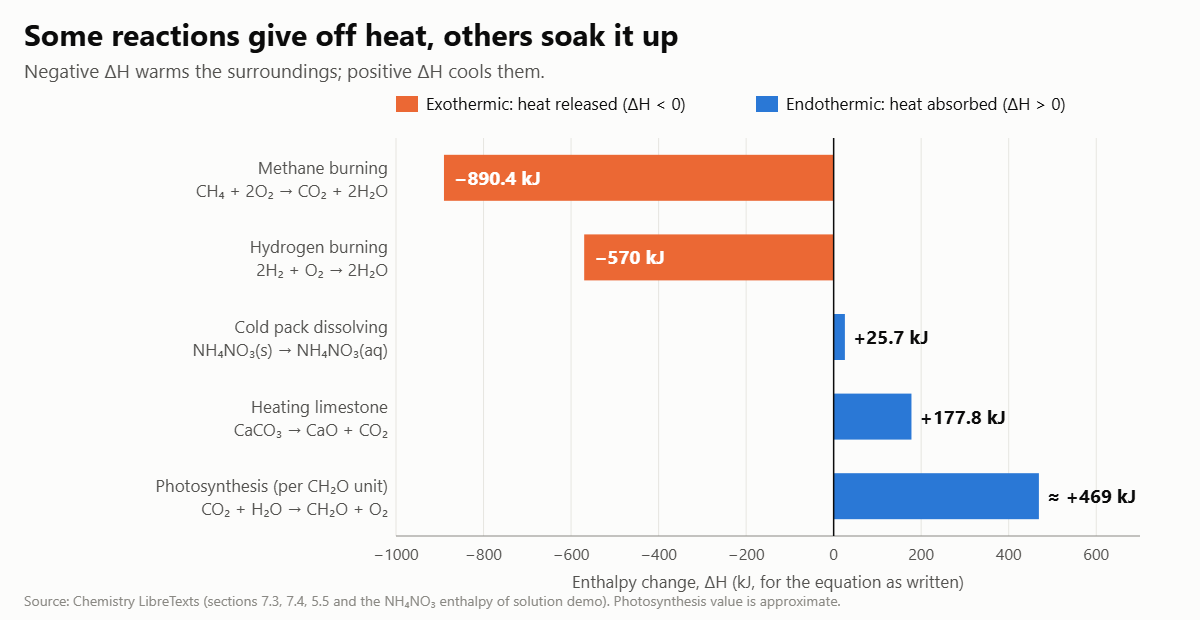
Three rules let you work with any thermochemical equation:
| Rule | Example |
|---|---|
| ΔH belongs to the equation exactly as written | 2H2 + O2 → 2H2O(l), ΔH = −570 kJ, is for 2 mol of water |
| Scale the equation, scale ΔH | Half the equation (1 mol of water): ΔH = −285 kJ |
| Reverse the equation, flip the sign | 2H2O(l) → 2H2 + O2: ΔH = +570 kJ (endothermic) |
The equation has to be balanced before ΔH means anything, so brush up on balancing chemical equations if the coefficients trip you up. Values are given per mole of reaction, which is why the mole shows up in every heat calculation.
Worked Example: How Cold Does an Instant Cold Pack Get?
A cold pack with 50.0 g of ammonium nitrate and 100 g of water would drop from 25.0 °C to roughly 0 °C. Dissolving ammonium nitrate is endothermic: its enthalpy of solution is +25.7 kJ/mol. Here is the calculation, as an example scenario.
Step 1: Find the moles of ammonium nitrate
The molar mass of NH4NO3 is (2 × 14.007) + (4 × 1.008) + (3 × 15.999) = 80.043 g/mol. So 50.0 g ÷ 80.043 g/mol = 0.6247 mol.
Step 2: Find the heat absorbed
0.6247 mol × 25.7 kJ/mol = 16.05 kJ, or 16,050 J. The dissolving salt pulls this much heat out of the water.
Step 3: Set up the temperature change
Use q = m × c × ΔT, assuming the 150 g of solution behaves like water (c = 4.18 J/g·°C) and no heat leaks in from outside. Rearranged: ΔT = q ÷ (m × c).
Step 4: Calculate the drop
ΔT = 16,050 J ÷ (150 g × 4.18 J/g·°C) = 25.6 °C. Starting from 25.0 °C, the pack ends near −0.6 °C, about freezing point.
Step 5: Compare with the real thing
Commercial packs use less water per gram of salt, 4.4 mol of water per mole of NH4NO3, and LibreTexts reports they can reach about −11 °C. Less water to cool means a bigger temperature drop from the same reaction.
The same method for an exothermic reaction
Run it the other way with a gas burner. Burning 4.00 g of methane is 4.00 ÷ 16.043 = 0.2493 mol, and 0.2493 × 890.4 kJ = 222 kJ released. Ignoring heat lost to the air, that could warm about 664 g of water from 20 °C to 100 °C (222,000 J ÷ (4.18 × 80)).
Everyday Examples of Endothermic and Exothermic Changes
You meet both types every day, often without noticing. The quickest test is what you would feel if you touched it.
| Example | Type | What you notice |
|---|---|---|
| Gas stove, campfire, candle | Exothermic | Heat and light given off |
| Disposable hand warmer (iron rusting quickly) | Exothermic | Packet warms up in your pocket |
| Acid neutralizing a base | Exothermic | Solution gets slightly warm |
| Cellular respiration | Exothermic | Helps keep your body warm |
| Instant cold pack | Endothermic | Pack turns icy cold |
| Baking soda and vinegar | Endothermic | Fizzing mixture feels cooler |
| Cooking an egg | Endothermic | Needs constant heat to set |
| Photosynthesis | Endothermic | Only runs while light is supplied |
The neutralization row links to our explainer on acids, bases and pH if you want the chemistry behind it.
Physical Changes Can Be Endothermic or Exothermic Too
The same words apply to changes of state, even though no new substance forms. Melting, boiling and evaporating are endothermic because they absorb heat; freezing and condensing are exothermic because they release it.
That is why sweating cools you down: evaporating sweat absorbs heat from your skin. It is also why the cold pack above is technically a physical change, since dissolving does not create a new substance. For the details of each state change, see states of matter.
Common Mix-Ups About Heat in Reactions
These five come up in almost every class.
| Mix-up | What is actually true |
|---|---|
| “If you have to heat it to start, it’s endothermic.” | Not necessarily. Burning needs a spark (activation energy) but releases far more heat overall. |
| “The beaker got cold, so the reaction lost heat.” | The reaction gained heat; it took it from the water and beaker. |
| “Endothermic reactions can’t happen on their own.” | Ammonium nitrate dissolves without any help and still absorbs heat. |
| “Exothermic reactions are always fast.” | Rusting is exothermic and can take years. Heat flow says nothing about speed. |
| “A negative ΔH means less energy in the universe.” | The energy moved to the surroundings. Total energy stays the same. |
Quick Practice: Exothermic or Endothermic?
Decide for each one, then check the answers below.
- A reaction with ΔH = −92 kJ.
- Water vapor condensing on a cold glass.
- The reverse of methane burning: CO2 + 2H2O → CH4 + 2O2.
- A test tube that feels cold after two solutions are mixed.
- Ice melting in a drink.
- Splitting water into hydrogen and oxygen using electricity.
| # | Answer | Why |
|---|---|---|
| 1 | Exothermic | Negative ΔH means heat released |
| 2 | Exothermic | Condensing releases heat (the glass warms slightly) |
| 3 | Endothermic | Reversing flips the sign: ΔH = +890.4 kJ |
| 4 | Endothermic | Heat was drawn out of the surroundings |
| 5 | Endothermic | Melting absorbs heat from the drink |
| 6 | Endothermic | The reverse of hydrogen burning (ΔH = +570 kJ for 2 mol of water) |
Frequently Asked Questions
Is burning exothermic or endothermic?
Burning is exothermic. Fuels such as wood, gas and candle wax release heat and light as they react with oxygen. The match or spark only supplies the activation energy to get started; once going, the reaction gives off far more heat than it took to light it.
Is melting ice endothermic or exothermic?
Melting ice is endothermic. The ice absorbs heat from its surroundings, which is why it cools your drink. Freezing is the reverse and releases heat, so it is exothermic. Both are physical changes, not chemical reactions.
Is photosynthesis endothermic?
Yes. Plants absorb light energy to build sugar from carbon dioxide and water, so the products store more energy than the reactants. Respiration runs the reverse direction and releases that stored energy, so it is exothermic.
Is ΔH positive or negative for an exothermic reaction?
Negative. ΔH describes the reaction’s own energy change, and an exothermic reaction loses energy to its surroundings. An endothermic reaction gains energy, so its ΔH is positive.
How can you tell if a reaction is exothermic or endothermic?
Measure the temperature of the surroundings. If a thermometer in the solution rises, the reaction is exothermic; if it falls, it is endothermic. On paper, look at the sign of ΔH or which side of the equation the heat term sits on.
Why does an exothermic reaction need energy to start?
Old bonds must start breaking before new ones can form, and that takes a small input called activation energy. It is the hump on an energy diagram. After the reaction starts, the heat it releases can supply the activation energy for the next molecules.
The Short Version
- Exothermic reactions release heat; surroundings warm up; ΔH is negative.
- Endothermic reactions absorb heat; surroundings cool down; ΔH is positive.
- The bond balance decides it: forming bonds releases energy, breaking them costs energy.
- Reversing a reaction flips the sign of ΔH; scaling it scales ΔH.
- Activation energy is a start-up cost, not a sign of an endothermic reaction.
To check whether a change counts as a reaction at all, read chemical vs. physical changes; the chemistry category has the rest of the series. LibreTexts’ chapter on enthalpy and chemical reactions has more thermochemical equations to practice with.
Disclaimer
This article is for general educational purposes only. Reactions described here are for understanding, not for home experiments; fuels are flammable and ammonium nitrate should only be handled under supervision in a school lab. Follow your teacher’s safety rules and check your exam board’s requirements for sign conventions and units.