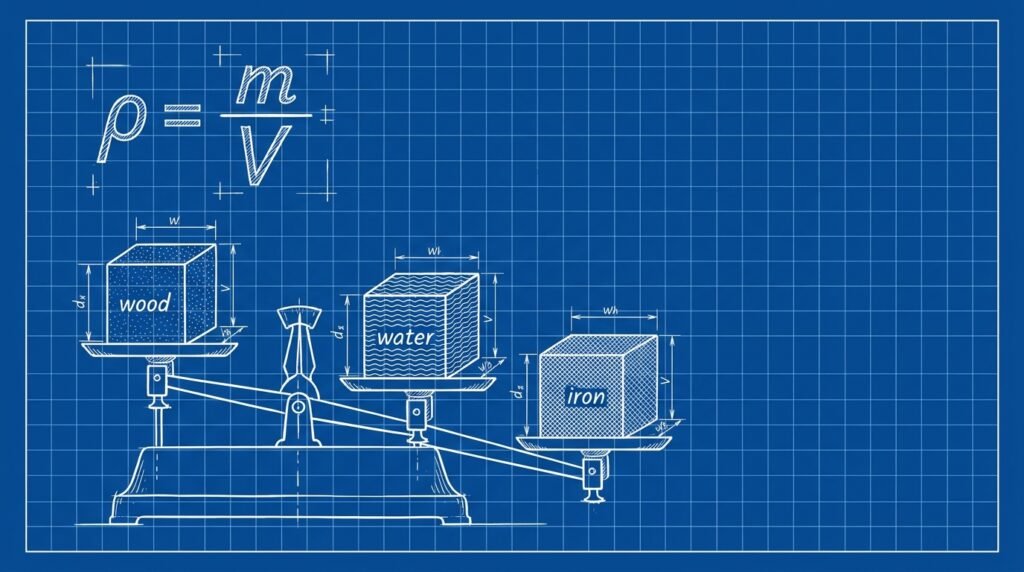
Density is how much mass is packed into a given volume, and you calculate it by dividing mass by volume: density = mass ÷ volume (ρ = m/V). A 1 cm3 cube of iron weighs 7.9 g, while the same cube of water weighs 1 g, so iron is 7.9 times denser. It is one of the simplest ways math and physics describe our world.
Density explains why ice floats in your drink, why a steel ship stays up while a steel bolt sinks, and why oil sits on top of vinegar in salad dressing.
This guide shows you the formula and its two rearranged forms, the units and how to convert them, how to measure odd-shaped objects, four worked examples, and a table of real densities you can use to identify a mystery material.
Quick answer
Density is the mass of a substance per unit of volume. To calculate it, measure the mass, measure the volume, and divide: ρ = m ÷ V. Common units are g/cm3 (or g/mL) and kg/m3. Water has a density of about 1 g/cm3, so anything denser sinks in water and anything less dense floats.
Key takeaways
- Formula: density = mass ÷ volume; mass = density × volume; volume = mass ÷ density.
- Units: 1 g/cm3 = 1 g/mL = 1,000 kg/m3.
- Odd shapes: find volume by water displacement, then divide as usual.
- Floating rule: an object floats if it is less dense than the liquid around it.
- Size does not matter: a nail and an iron beam have the same density.
What Is Density?
Density is the amount of mass in each unit of volume of a substance. OpenStax Chemistry 2e defines it as the ratio of a sample’s mass to its volume. In plain words, it tells you how tightly matter is packed.
Picture two identical shoeboxes. Fill one with popcorn and the other with sand. Same box, same volume, but the sand box is far heavier because sand packs much more mass into the space. The sand is denser.
Three ideas are easy to mix up here:
- Mass is how much matter something has (grams, kilograms).
- Volume is how much space it takes up (cm3, mL, m3).
- Density links the two: mass per volume.
Density is a physical property. Measuring it does not change the substance into anything new, which is why chemists use it to identify materials, alongside melting point and color. The difference between the two kinds of change is covered in chemical vs. physical changes.
The Density Formula (and How to Rearrange It)
The density formula is ρ = m / V, where ρ (the Greek letter rho) is density, m is mass and V is volume. Some textbooks write it as D = M/V or d = m/v. They all mean the same thing.
Because it is a simple division, you can rearrange it to find any one of the three values when you know the other two:
| You want to find | Formula | Example question |
|---|---|---|
| Density | ρ = m ÷ V | What is the density of a 40 cm3 block with a mass of 316 g? |
| Mass | m = ρ × V | How much does 250 mL of olive oil weigh? |
| Volume | V = m ÷ ρ | How much space does 1 kg of gold take up? |
A quick way to remember all three is the density triangle. Cover the value you want, and the other two show you whether to multiply or divide.
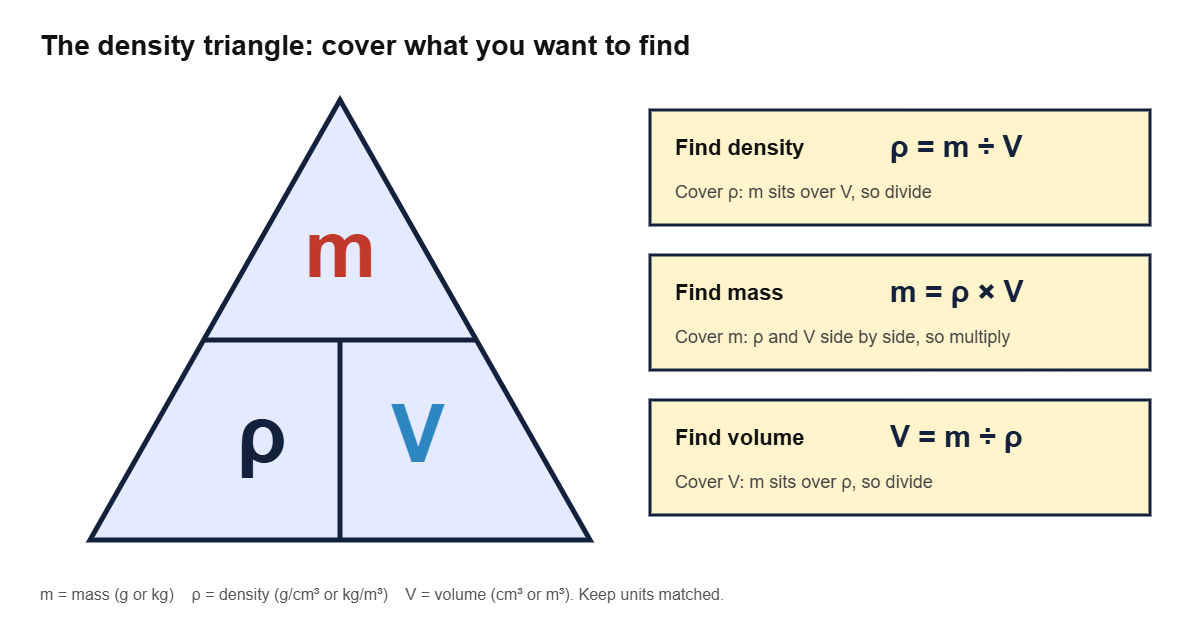
If rearranging feels shaky, it is the same skill as solving for x in basic algebra.
Units of Density and How to Convert Them
Density is always a mass unit divided by a volume unit. The SI unit is kilograms per cubic meter (kg/m3), but in school labs you will mostly use grams per cubic centimeter (g/cm3), according to OpenStax. For liquids, g/mL is common, and for gases, g/L.
The key fact: 1 cm3 is exactly the same volume as 1 mL. So g/cm3 and g/mL are interchangeable.
| Unit | Where you see it | Water in this unit |
|---|---|---|
| g/cm3 | Solids, school labs | 1 |
| g/mL | Liquids | 1 |
| kg/m3 | Physics, engineering (SI unit) | 1,000 |
| g/L | Gases | 1,000 |
To go from g/cm3 to kg/m3, multiply by 1,000. To go back, divide by 1,000. Here is why: 1 g/cm3 means 1 gram in each cubic centimeter. A cubic meter holds 1,000,000 cm3, so that is 1,000,000 grams, or 1,000 kg, per cubic meter.
So gold at 19.3 g/cm3 is 19,300 kg/m3. Air, by contrast, is about 1.2 kg/m3, as Britannica notes. For more practice moving between units, see how unit conversions work.
How to Calculate Density Step by Step
To calculate density, measure the mass, measure the volume, make sure the units match, then divide. Here is the method in order:
| Step | What to do | Tool |
|---|---|---|
| 1. Find the mass | Weigh the object; zero (tare) the scale first | Digital balance |
| 2. Find the volume | Measure with a ruler (regular shape) or by water displacement (irregular shape) | Ruler or graduated cylinder |
| 3. Match the units | Grams with cm3, or kilograms with m3 | Conversion factor |
| 4. Divide | Mass ÷ volume | Calculator |
| 5. Add units and check | Write g/cm3 or kg/m3; compare with a density table | Reference table |
Step 5 catches most mistakes. If your “wooden” block comes out at 12 g/cm3, something went wrong, because no wood is that dense.
How to Find the Volume of an Irregular Object
For an object with no neat shape, like a rock, a key or a ring, you find its volume by water displacement. Sink the object in water and measure how much the water level rises. That rise equals the object’s volume.
- Pour water into a graduated cylinder and read the level (for example, 50.0 mL).
- Gently slide the object in so no water splashes out.
- Read the new level (for example, 52.0 mL).
- Subtract: 52.0 − 50.0 = 2.0 mL, which is 2.0 cm3.
Read the bottom of the curved water surface (the meniscus) at eye level. Tilting your head can throw the reading off by a few tenths of a milliliter, and with small objects that is a big error. This trick only works for objects that sink and do not dissolve or soak up water.
Density Examples: Four Worked Problems
These example scenarios cover the four question types you are most likely to see on a test. Each answer is checked against real densities from OpenStax.
Step 1: Density of a regular block
A metal block measures 5 cm × 4 cm × 2 cm and has a mass of 316 g.
- Volume = 5 × 4 × 2 = 40 cm3
- Density = 316 g ÷ 40 cm3 = 7.9 g/cm3
That matches iron (7.9 g/cm3), so the block is very likely iron.
Step 2: Density of an irregular object
A ring has a mass of 21.0 g. Dropped into a cylinder, it raises the water from 50.0 mL to 52.0 mL.
- Volume = 52.0 − 50.0 = 2.0 mL = 2.0 cm3
- Density = 21.0 ÷ 2.0 = 10.5 g/cm3
Silver has a density of 10.5 g/cm3, so this ring is consistent with silver. Gold (19.3) would have raised the water only about 1.1 mL.
Step 3: Finding mass from density
How much does 250 mL of olive oil weigh? Olive oil’s density is 0.92 g/mL.
- Mass = density × volume = 0.92 × 250 = 230 g
That is 20 g less than the same cup of water would weigh, which is why oil floats on water.
Step 4: Finding volume from density
What volume does 1 kg of gold fill? Gold’s density is 19.3 g/cm3.
- Convert first: 1 kg = 1,000 g
- Volume = mass ÷ density = 1,000 ÷ 19.3 = about 51.8 cm3
That is roughly the size of a matchbox. A kilogram of water would fill 1,000 cm3, almost 20 times more space.
Densities of Common Substances
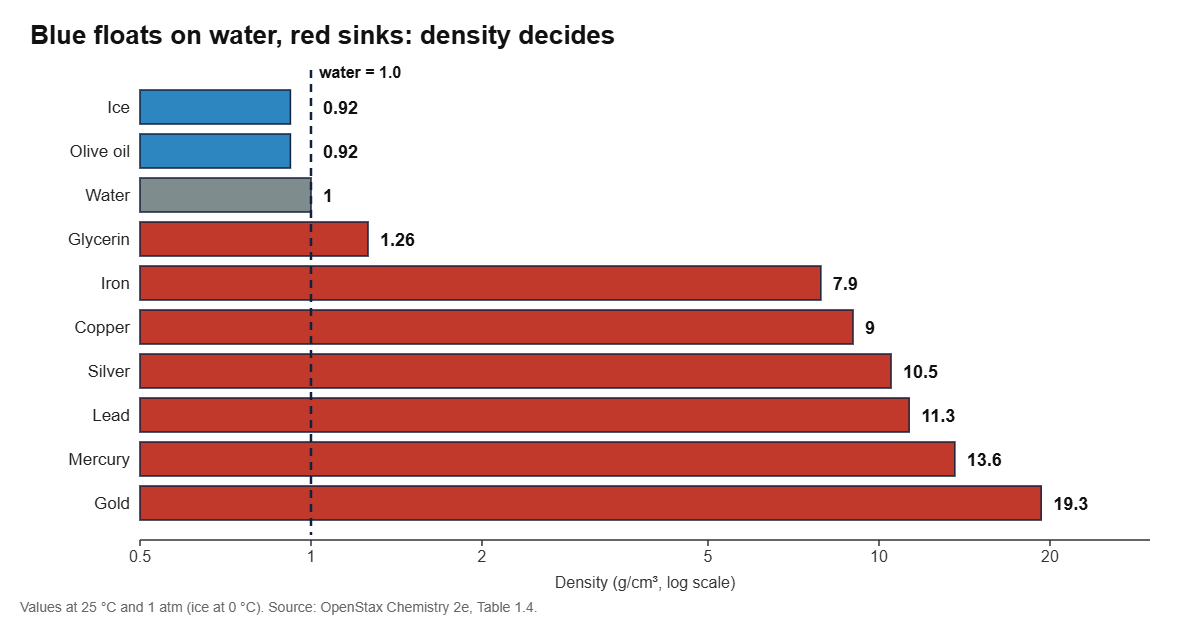
Most everyday solids and liquids fall between about 0.7 and 20 g/cm3. The table below uses values from OpenStax, measured at 25 °C and normal air pressure (ice at 0 °C).
| Substance | Density | Floats or sinks in water? |
|---|---|---|
| Gasoline | 0.70–0.77 g/cm3 | Floats |
| Ethanol | 0.79 g/cm3 | Mixes in (liquid) |
| Oak wood | 0.60–0.90 g/cm3 | Floats |
| Ice | 0.92 g/cm3 | Floats |
| Olive oil | 0.92 g/cm3 | Floats |
| Water | 1.0 g/cm3 | Reference |
| Glycerin | 1.26 g/cm3 | Sinks (mixes slowly) |
| Iron | 7.9 g/cm3 | Sinks |
| Copper | 9.0 g/cm3 | Sinks |
| Silver | 10.5 g/cm3 | Sinks |
| Lead | 11.3 g/cm3 | Sinks |
| Mercury | 13.6 g/cm3 | Sinks |
| Gold | 19.3 g/cm3 | Sinks |
Seeing them on one chart makes the water line stand out: everything left of it floats, everything right of it sinks.
Gases are far lighter. Dry air is about 1.20 g/L and helium only 0.16 g/L, which is why a helium balloon rises through air the way a cork rises through water. The densest natural element is osmium, with a specific gravity of 22.48, according to Britannica.
Why Some Things Float and Others Sink
An object floats when it is less dense than the fluid it sits in, and sinks when it is denser. The fluid pushes up with a buoyant force equal to the weight of fluid the object pushes aside, a rule known as Archimedes’ principle.
This is how a steel ship floats even though steel is about 8 times denser than water. The hull is mostly air inside, so the average density of the whole ship (steel plus air) is less than water’s. Fill it with water and that average jumps, which is exactly what happens when a ship sinks.
Density also tells you how much of a floating object sits underwater. Ice is 0.92 g/cm3 and fresh water is 1.0, so about 92% of a floating ice cube is below the surface. That is the real reason most of an iceberg is hidden.
You can watch this in a kitchen “density tower.” Pour honey, then water, then cooking oil into a glass, and they settle into layers from densest at the bottom to lightest on top.
Does Density Change With Temperature?
Yes. Most substances expand when heated, so the same mass takes up more volume and the density drops. That is why hot air rises: warm air is less dense than the cool air around it, and a hot air balloon uses exactly that effect.
Water is the famous exception. According to the USGS Water Science School, liquid water is densest at about 4 °C (39.2 °F), and when it freezes, its density drops by about 9%. So ice floats, and lakes freeze from the top down, leaving liquid water underneath where fish survive the winter.
Gases change density much more than liquids or solids, because their particles are far apart. Squeeze a gas or cool it and its density rises sharply. Our guide to states of matter shows how particle spacing changes from solid to gas.
Common Density Mistakes
These errors cost the most marks on density questions.
| Myth or mistake | Reality |
|---|---|
| A bigger object has a higher density. | Density does not depend on size. Cut an iron bar in half and each half is still 7.9 g/cm3. |
| Heavy things always sink. | Density decides floating, not weight. A huge log floats while a tiny pebble sinks. |
| A kilogram of feathers is lighter than a kilogram of iron. | They weigh the same. The feathers just take up far more volume because they are much less dense. |
| You can divide grams by m3. | Mixing units gives a wrong answer. Use grams with cm3, or kilograms with m3. |
| Density and weight are the same thing. | Weight is the pull of gravity on a mass. Density is mass per volume and would be the same on the Moon. |
That last row connects to how gravity works: your weight changes from planet to planet, but the density of the materials in your body does not.
Frequently Asked Questions
What are the three density formulas?
All three come from one equation. Density = mass ÷ volume finds density. Mass = density × volume finds mass. Volume = mass ÷ density finds volume. Pick the version that solves for the value the question asks for, and keep your units matched.
What is the density of water?
Water has a density of about 1 g/cm3, which is the same as 1 g/mL or 1,000 kg/m3. The exact value shifts slightly with temperature, and liquid water is densest at about 4 °C. Salt water is a little denser than fresh water, which is why swimming in the sea feels easier.
Does density change if you cut an object in half?
No. Cutting an object in half halves both its mass and its volume, so the ratio stays the same. A crumb of chocolate and a whole bar have the same density. That is what makes density useful for identifying materials, no matter the sample size.
What is the SI unit of density?
The SI unit is kilograms per cubic meter (kg/m3). In classrooms, grams per cubic centimeter (g/cm3) is more common because the numbers are smaller. To convert g/cm3 to kg/m3, multiply by 1,000.
Is density a physical or chemical property?
Density is a physical property. You can measure it without changing what the substance is made of. Scientists use it, along with melting point and boiling point, to identify unknown materials and check purity.
What is specific gravity?
Specific gravity is a substance’s density divided by the density of water, so it has no units. Gold’s specific gravity is 19.3, meaning it is 19.3 times denser than water. For quick work in g/cm3, specific gravity and density have the same number.
The Short Version
- Density is mass per unit volume: ρ = m ÷ V.
- Rearrange it to m = ρ × V or V = m ÷ ρ when you need mass or volume.
- 1 g/cm3 = 1 g/mL = 1,000 kg/m3; always match units before dividing.
- Use water displacement for irregular objects.
- Less dense than the fluid means it floats; denser means it sinks.
Try a few practice questions in the science quiz, and explore more topics in the physics section. For a longer table of densities and more practice problems, the OpenStax measurements chapter is free to read.
Sources
- OpenStax, Chemistry 2e, “1.4 Measurements” (density definition, units and Table 1.4). openstax.org
- Britannica, “Density.” britannica.com
- Britannica, “Archimedes’ principle.” britannica.com
- Britannica, “Osmium.” britannica.com
- USGS Water Science School, “Water Density.” usgs.gov
Disclaimer
This article is for general educational purposes only. Density values change slightly with temperature, pressure and purity, so use the figures your textbook or exam board provides. Handle liquids like mercury and gasoline only under a teacher’s supervision.