
Acids, bases, and the pH scale describe one simple idea: how many hydrogen ions a substance releases into water. Acids add hydrogen ions, bases soak them up (or add hydroxide ions), and the pH scale turns that amount into a number, usually from 0 to 14. If you already know how atoms and molecules differ, you have everything you need to follow along.
Lemon juice, baking soda, stomach acid, and drain cleaner all sit somewhere on that scale. Once you can place them, chemistry questions about neutralization, indicators, and acid rain stop feeling random.
This guide gives you clear definitions, real pH values for everyday things, the math behind the “10 times” rule, a worked example you can copy for homework, and the mix-ups that cost students marks.
Quick answer
An acid is a substance that releases hydrogen ions (H+) in water, and a base is a substance that accepts hydrogen ions or releases hydroxide ions (OH−). The pH scale measures hydrogen ion concentration. A pH below 7 is acidic, 7 is neutral, and above 7 is basic. Each whole step is a tenfold change.
Key takeaways
- Acids give away H+ ions; bases take them in or release OH− ions.
- pH 7 is neutral at 25 °C (77 °F), the pH of pure water.
- One pH unit equals a 10x change, so pH 3 is 100 times more acidic than pH 5.
- Strong and concentrated are different ideas: strength is about how fully an acid splits apart.
- Acid plus base gives water and a salt, a reaction called neutralization.
What Is an Acid?
An acid is any substance that releases hydrogen ions (H+) when it dissolves in water. A hydrogen ion is a hydrogen atom that has lost its only electron, which leaves a single proton. That is why chemists also call an acid a “proton donor.”
Take hydrochloric acid, the acid in your stomach. In water, each HCl unit splits into H+ and Cl−. The free H+ does not float around alone for long. It grabs onto a water molecule and forms hydronium (H3O+). Textbooks write H+ as a shortcut for this.
Acids you have met at home:
- Citric acid in lemons, limes, and oranges
- Acetic acid in vinegar
- Carbonic acid in fizzy drinks, formed when carbon dioxide dissolves in water
- Lactic acid in yogurt and sour milk
Food acids taste sour. Still, never taste anything in a lab to test it, because strong acids burn skin and eyes.
What Is a Base?
A base is a substance that accepts hydrogen ions or releases hydroxide ions (OH−) in water. Both descriptions point to the same result: a base lowers the number of free H+ ions in a solution.
Sodium hydroxide (NaOH), sold as lye, splits into Na+ and OH−. Those hydroxide ions pair up with any H+ nearby to make plain water. Ammonia (NH3) works the other way around: it has no OH to give, but it pulls an H+ off a water molecule, which leaves OH− behind.
A base that dissolves in water is called an alkali. So every alkali is a base, but not every base is an alkali (copper oxide, for example, is a base that barely dissolves).
Bases usually feel slippery and taste bitter. Soap, baking soda, antacid tablets, and oven cleaner are all basic. The slippery feeling on your fingers with strong bases is actually the base reacting with oils in your skin, which is a good reason to wear gloves.
What Does the pH Scale Actually Measure?
The pH scale measures the concentration of hydrogen ions in a water-based solution. The Danish biochemist S.P.L. Sørensen introduced it in 1909, and Britannica defines pH with the formula pH = −log[H+], where [H+] is the hydrogen ion concentration in moles per liter.
That minus sign explains the odd direction of the scale. More hydrogen ions mean a lower pH number. Here is how to read it:
| pH range | What it means | H+ compared with OH− |
|---|---|---|
| 0 to below 7 | Acidic | More H+ than OH− |
| 7 | Neutral (at 25 °C) | Equal amounts |
| Above 7 to 14 | Basic (alkaline) | More OH− than H+ |
Pure water is not empty of ions. A tiny fraction of water molecules split into H+ and OH− on their own, giving each a concentration of 10−7 mol/L. Take the negative log of 10−7 and you get 7. That is where “neutral = 7” comes from.
There is also a partner scale called pOH, which tracks hydroxide ions. At 25 °C, pH + pOH always adds up to 14, according to OpenStax Chemistry 2e. If a solution has a pH of 11, its pOH is 3.
Why Each Step on the pH Scale Is 10 Times Bigger
The pH scale is logarithmic, so each whole number is ten times more or less acidic than the next. The USGS Water Science School states that each number marks a 10-fold change. This is the single idea most students underestimate.
Moving from pH 6 to pH 5 does not make a liquid “a bit” more acidic. It multiplies the hydrogen ions by 10. Drop two units and you multiply by 100. Drop five units and it is 100,000 times.
The chart below shows how fast that grows when you compare common pH values with pure water.
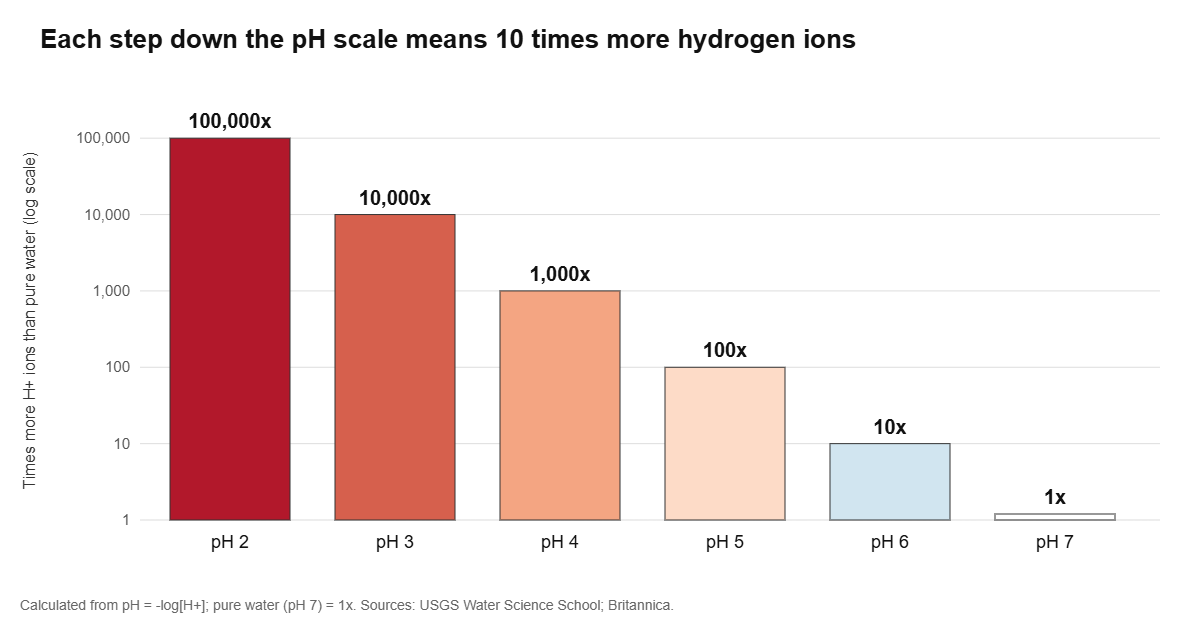
A useful shortcut: count the steps between two pH values, then write a 1 followed by that many zeros. Vinegar at about pH 2.4 and pure water at 7 are a bit more than 4 steps apart, so vinegar has tens of thousands of times more hydrogen ions than water.
pH of Everyday Substances (Real Values)
Most things in your kitchen and bathroom sit between pH 2 and pH 13. The table lists approximate values from science agencies and textbooks, so you can compare them with confidence.
| Substance | Approximate pH | Acidic, neutral or basic |
|---|---|---|
| 1 M hydrochloric acid (lab solution) | 0 | Strongly acidic |
| Gastric juice (stomach) | about 1.5 | Strongly acidic |
| Lime juice | about 2 | Acidic |
| Vinegar | about 2.4 | Acidic |
| Coffee | about 5 | Weakly acidic |
| Normal rain | about 5.6 | Weakly acidic |
| Pure water | 7 | Neutral |
| Human arterial blood | 7.38 to 7.42 | Slightly basic |
| Surface seawater | about 8.1 | Weakly basic |
| Milk of magnesia | about 10.5 | Basic |
| Household ammonia | about 12 | Strongly basic |
| Oven cleaner | about 13 | Strongly basic |
Values for food and cleaners vary by brand and recipe, so treat them as typical, not exact. Here is the same list placed on the scale.
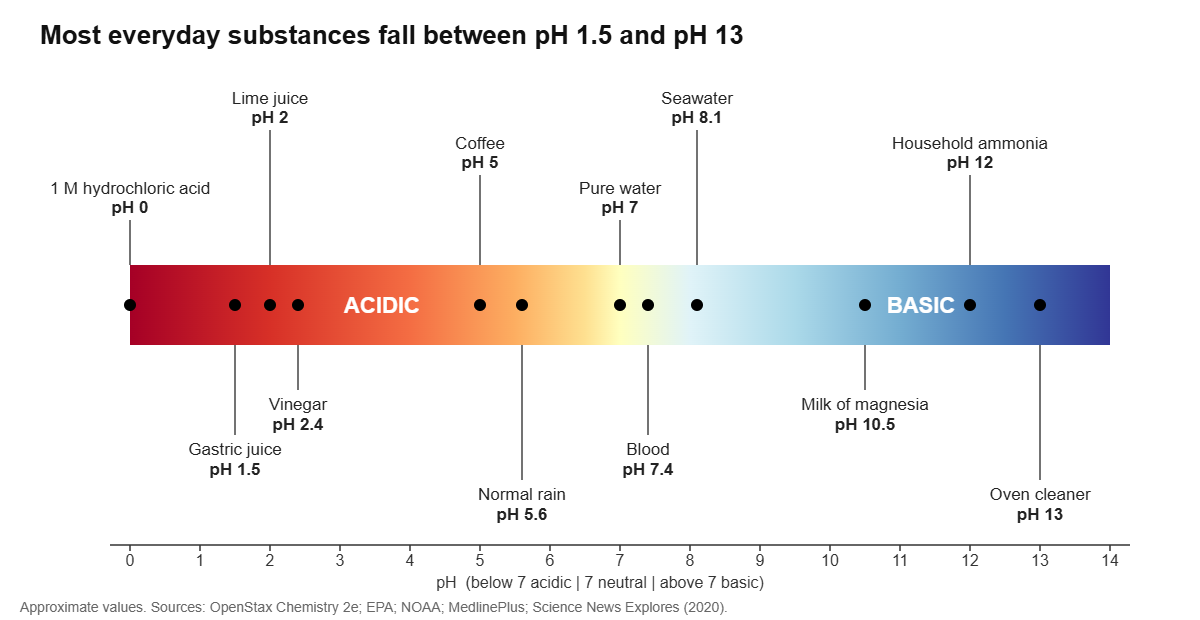
Notice that rain is already slightly acidic before any pollution touches it. Carbon dioxide from the air dissolves in raindrops and forms weak carbonic acid.
Strong vs. Weak Acids: Strength Is Not Concentration
A strong acid splits apart almost completely in water, while a weak acid only partly splits. That is what “strong” means in chemistry. It says nothing about how much acid is in the bottle.
Concentration is a separate idea: how much acid is dissolved per liter. You can have a dilute solution of a strong acid or a concentrated solution of a weak one. Mixing these two words up is one of the most common exam errors.
| Term | Question it answers | Example |
|---|---|---|
| Strong acid | Does almost every molecule release its H+? | Hydrochloric, sulfuric, nitric acid |
| Weak acid | Do only some molecules release H+? | Acetic acid (vinegar), citric acid |
| Concentrated | Is there a lot of acid per liter? | Glacial acetic acid (nearly pure, still weak) |
| Dilute | Is there only a little acid per liter? | A few drops of HCl in a beaker of water (still strong) |
The same rule works for bases. Sodium hydroxide is a strong base; ammonia is a weak base, even though household ammonia sits high on the pH scale because of how much is dissolved.
What Happens When an Acid Meets a Base?
When an acid and a base react, they cancel each other’s properties and form water plus a salt. This reaction is called neutralization, and it is a true chemical change because new substances form.
The classic textbook example:
HCl + NaOH → NaCl + H2O
The H+ from the acid joins the OH− from the base to make water. The leftover ions (Na+ and Cl−) form sodium chloride, ordinary table salt. In chemistry, “salt” means any compound built this way, not just the one on your dinner table.
You see neutralization in daily life more than you might expect:
- Antacid tablets are bases that react with extra stomach acid, which your digestive system uses to break down food.
- Farmers spread lime (a base) on fields when soil turns too acidic for crops.
- Baking soda and vinegar fizz because the reaction also releases carbon dioxide gas.
Neutralization does not always land exactly on pH 7. A strong acid with a weak base gives a slightly acidic result, and the reverse gives a slightly basic one.
How to Measure pH: Paper, Indicators and Meters
You can measure pH with indicator paper, liquid indicators, or an electronic pH meter. Each one suits a different job.
| Method | How it works | Best for |
|---|---|---|
| Litmus paper | Turns red in acid, blue in base | A quick acid-or-base check, no number |
| Universal indicator | Shows a range of colors, from red (acidic) through green (neutral) to purple (basic) | Estimating pH to about one unit in class |
| Phenolphthalein | Colorless in acid, pink in base | Spotting the end point in a titration |
| Red cabbage juice | Natural dye that changes color with pH | Safe home experiments |
| Digital pH meter | A glass probe measures voltage linked to H+ | Accurate readings to 0.1 or better |
For a school practical, universal indicator is usually enough. For pools, aquariums, and labs, a calibrated meter gives far more reliable numbers.
Worked Example: Comparing Two Solutions Step by Step
This example scenario shows how to answer the most common pH exam question. Solution A has a pH of 2. Solution B has a pH of 5. Which is more acidic, and by how much?
Step 1: Decide which is more acidic
The lower pH is more acidic. Solution A (pH 2) wins.
Step 2: Find the difference in pH
5 − 2 = 3 units.
Step 3: Turn the difference into a multiplier
103 = 1,000. Solution A has 1,000 times more hydrogen ions than Solution B.
Step 4: Check with real concentrations
pH 2 means [H+] = 10−2 = 0.01 mol/L. pH 5 means [H+] = 10−5 = 0.00001 mol/L. Divide 0.01 by 0.00001 and you get 1,000. The shortcut and the full math agree.
Step 5: Try a dilution
Now pour 10 mL of Solution A (a strong acid) into 90 mL of water. The volume goes up 10 times, so the H+ concentration drops 10 times, to 0.001 mol/L. The new pH is 3. Diluting an acid pushes its pH toward 7, but it never crosses to the basic side, no matter how much water you add.
If you want to check answers like these, the free scientific calculator handles logs and powers of ten.
Real-World pH: Your Blood, Rain and the Ocean
Small pH changes matter a lot in living things and the environment, because of that tenfold rule.
Your blood stays in a narrow window
Normal arterial blood sits between pH 7.38 and 7.42, according to MedlinePlus. Your body works hard to keep it there. One tool is breathing: when your lungs breathe out carbon dioxide, they remove a gas that would otherwise form carbonic acid in the blood.
Acid rain
Normal rain has a pH of about 5.6, while acid rain usually measures between 4.2 and 4.4, as the EPA explains. That gap of roughly 1.3 units means acid rain carries around 20 times more hydrogen ions than clean rain. Sulfur dioxide and nitrogen oxides from burning fuels are the main causes.
Ocean acidification
The ocean is still basic, averaging around pH 8.1, but it is moving toward the acidic side. NOAA reports that surface ocean pH has fallen by 0.1 units since the industrial era began, which is roughly a 30 percent increase in acidity. A 0.1 drop sounds tiny until you remember the scale is logarithmic. It makes it harder for oysters, corals, and some plankton to build their shells.
Common Mix-Ups About Acids and Bases
These five misunderstandings show up again and again in homework and tests.
| Myth | Reality |
|---|---|
| The pH scale stops at 0 and 14. | Those are common limits, not hard walls. Very concentrated strong acids can go below 0, and very concentrated strong bases can go above 14. |
| pH 7 is always neutral. | pH 7 is neutral at 25 °C. Water’s self-splitting changes with temperature, so the neutral point shifts slightly when it is hotter or colder. |
| Only acids are dangerous. | Strong bases such as lye and oven cleaner cause serious burns too, and can be harder to notice at first because they feel slippery, not stinging. |
| Strong acid means concentrated acid. | Strength is how completely the acid splits into ions. Concentration is how much is dissolved. They are independent. |
| pH 4 is twice as acidic as pH 8. | pH 4 has 10,000 times more hydrogen ions than pH 8, because the scale is logarithmic, not linear. |
If the symbols in these rows still feel shaky, it helps to review how to read the periodic table, where hydrogen, sodium, and chlorine all live.
Frequently Asked Questions
Is water an acid or a base?
Pure water is neither. It is neutral, with a pH of 7 at 25 °C, because it holds equal amounts of H+ and OH− ions. Water can act as an acid or a base depending on what it reacts with, which is why chemists call it amphoteric. Tap and bottled water often read a little above or below 7 because of dissolved minerals and gases.
Why does the pH scale go from 0 to 14?
The range comes from water itself. At 25 °C, the H+ and OH− concentrations in any water solution multiply to 10−14, so pH and pOH add up to 14. Most everyday solutions fall inside 0 to 14, which makes it a handy range. Extremely concentrated acids and bases can still fall outside it.
What is the difference between a base and an alkali?
An alkali is a base that dissolves in water. Sodium hydroxide and potassium hydroxide are alkalis because they dissolve and release OH− ions. Copper oxide is a base, since it neutralizes acids, but it is not an alkali because it hardly dissolves. In short, all alkalis are bases, but some bases are not alkalis.
Can pH be negative?
Yes. If the hydrogen ion concentration is above 1 mol/L, the formula pH = −log[H+] gives a number below zero. This only happens with very concentrated strong acids, such as concentrated hydrochloric acid. You will not meet negative pH values in normal food, cleaners, or school experiments.
Does a lower pH always mean more dangerous?
Not on its own. Lemon juice has a low pH and is safe to drink, while a strong base with a high pH can burn skin badly. Danger depends on how far a substance sits from 7 in either direction, how concentrated it is, and how long it touches your body. Treat both ends of the scale with care.
How do you remember which side is acidic?
Think “low pH, lots of H.” Acidic solutions have many hydrogen ions, and because of the minus sign in the pH formula, more H+ gives a smaller number. So low numbers are acidic, high numbers are basic, and 7 sits in the middle.
The Short Version
- Acids release H+ ions in water; bases accept them or release OH−.
- pH = −log[H+]: below 7 is acidic, 7 is neutral at 25 °C, above 7 is basic.
- Every pH unit is a tenfold change, so small differences add up fast.
- Strong vs. weak describes splitting; concentrated vs. dilute describes amount.
- Acid + base → salt + water, the neutralization reaction behind antacids and soil liming.
Ready to test yourself? Try the science quiz, or turn the pH table above into cards with the flashcard maker. You can find more topics like this in the chemistry section. For deeper reading, the OpenStax pH chapter covers pOH and calculations in more detail.
Disclaimer
This article is for general educational purposes only. pH values for foods and household products are approximate and vary by brand and conditions. Never taste, touch, or mix laboratory or cleaning chemicals; follow your teacher’s safety instructions and product labels, and ask a qualified teacher or professional before doing any experiment.