
The states of matter are the physical forms a substance can take, and the four you meet most often are solid, liquid, gas, and plasma. What separates them is how close the particles sit and how freely they move. Warm an ice cube and you get water, keep heating and you get steam, and push the energy high enough and the atoms themselves start losing electrons.
Most guides stop at four definitions and a picture. This one goes after the parts students tend to get stuck on: the difference between a state and a phase, why dry ice never melts, why water boils at 100 °C only at normal air pressure, and how much energy a state change really costs. You’ll also get a phase diagram you can read in under a minute.
We’ll start with the idea behind every state, then take each one in turn, then look at changes between them, the effect of pressure, and a short practice set.
Quick answer
The four states of matter are solid, liquid, gas, and plasma. A solid keeps its shape and volume, a liquid keeps its volume but flows into the shape of its container, a gas spreads to fill any container, and plasma is a gas so energetic that its atoms split into charged ions and free electrons.
Key takeaways
- A substance’s state is a balance between particle energy, which pulls things apart, and attraction, which holds them together.
- Solids and liquids barely compress, while gases squeeze easily because they are mostly empty space.
- Plasma conducts electricity, and estimates put it at over 99 percent of the matter in the universe.
- Temperature stays flat while ice melts or water boils, because the energy goes into changing the state.
- Pressure matters as much as temperature: dry ice skips the liquid stage at normal air pressure.
What Decides a Substance’s State of Matter?
A substance’s state comes from a contest between two things. The energy its particles carry pushes them apart, and the attraction between them pulls them together. Heating adds kinetic energy, so particles move faster and attraction loses ground. Cooling does the reverse. The particles involved can be atoms, molecules, or ions, a distinction we cover in our guide to atoms, elements, and molecules.
You’ll also see the word phase used as if it meant the same thing. A handy rule: the state is the broad category (solid, liquid, gas, plasma), while a phase is a region of matter with uniform properties. Oil floating on vinegar is two liquid phases inside one state. Iron can switch between different crystal arrangements and stay a solid the whole time.
| Property | Solid | Liquid | Gas | Plasma |
|---|---|---|---|---|
| Shape | Fixed | Takes the container’s shape | Fills the container | Fills the container |
| Volume | Fixed | Fixed | Changes easily | Changes easily |
| Particle spacing | Touching, locked in place | Touching, free to slide | Far apart | Far apart, electrically charged |
| Compressible? | Barely | Barely | Easily | Yes |
| Conducts electricity? | Metals and a few others | When free ions are present, like salt water | Normally no | Yes |
| Everyday example | Ice, a salt crystal, steel | Water, honey, mercury | Air, helium, water vapor | Lightning, a neon sign, the Sun |

Solids: Fixed Shape, Fixed Volume
In a solid, the attractions between particles are stronger than the energy the particles carry, so they stay stuck in place and only vibrate. Nothing flows, which is why a solid holds its shape without a container.
Solids come in two broad types. Crystalline solids such as salt, ice, and metals arrange their particles in a repeating pattern. Amorphous solids such as glass and many plastics lack that long-range pattern but still hold a fixed shape. If you ever wonder why a window pane doesn’t sag into a puddle, that is the answer: its particles can’t slide past one another at room temperature.
Liquids: Fixed Volume, Flexible Shape
Liquid particles still touch, but they carry enough energy to move around each other. That is why a liquid pours, spreads across a table, and takes the shape of any glass, while a liter of it stays a liter.
In most substances the solid is denser than the liquid. Carbon dioxide behaves that way, and so do most materials. Water is the famous exception. Frozen water takes up more room than liquid water, which is why ice cubes float and why a sealed bottle of water can crack in a freezer. Mercury and bromine are elements that are liquid at room temperature, and you can find them on the periodic table.
Gases: Mostly Empty Space
Gas particles move independently and stay far apart. Matter fills only about 1/1,000th of the volume of a gas, and the rest is empty space. That gap explains the biggest practical difference between states: you can squeeze a gas into a smaller volume, but a liquid or solid hardly budges.
Air, helium in a balloon, and the invisible water vapor above a pot are all gases. The white cloud you see over a kettle is not the gas itself. It is tiny droplets of liquid water that formed when the vapor cooled.
Plasma: The Fourth State of Matter
Plasma is a gas in which atoms have been broken into free electrons and positive ions. It forms when enough energy strips electrons from atoms, whether through extreme heat or through ultraviolet light and X-rays. Because plasma carries free charges, it conducts electricity and reacts strongly to magnetic fields, two things an ordinary gas does not do.
You’ve seen plasma more often than you might think. Lightning is plasma, and so is the glow inside a neon sign. A fluorescent lamp holds a thin gas that electricity turns into plasma, and the Sun’s outer atmosphere is plasma too. Scientists estimate that more than 99 percent of the matter in the universe is in this state, mostly because stars are made of it.
On Earth’s surface it needs help to survive. Free electrons keep trying to rejoin the ions and turn the plasma back into neutral gas, so it lasts only while energy keeps flowing in.
How Matter Changes From One State to Another
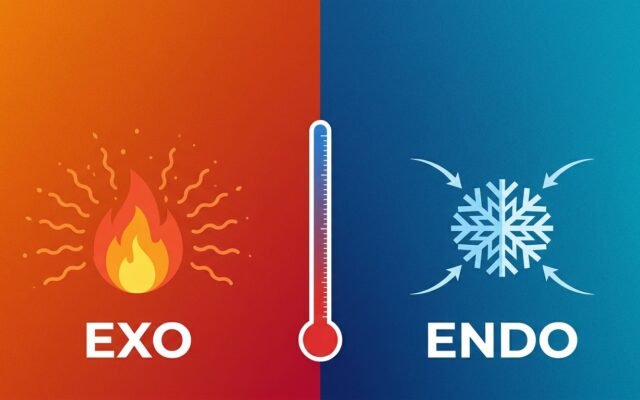
A change of state happens when energy is added to or removed from a substance. Each direction has its own name, and the table shows which ones absorb energy and which release it.
| Change | From → To | Energy | Everyday example |
|---|---|---|---|
| Melting | Solid → liquid | Absorbed | An ice cube in a drink |
| Freezing | Liquid → solid | Released | Water in the freezer |
| Vaporization | Liquid → gas | Absorbed | A kettle boiling |
| Condensation | Gas → liquid | Released | Droplets on a cold glass |
| Sublimation | Solid → gas | Absorbed | Dry ice shrinking, or freezer burn on frozen food |
| Deposition | Gas → solid | Released | Frost on a window |
| Ionization | Gas → plasma | Absorbed | A neon sign switching on |
| Recombination | Plasma → gas | Released | The glow of a lamp fading after power is cut |
Melting and boiling are physical changes. The molecules are still the same molecules, which is the key idea in our guide to chemical vs. physical changes.
Why Temperature Stays Flat During a Change of State
Put a thermometer in a glass of slush and it will sit at 0 °C until the last ice is gone. During a change of state, the added energy goes into loosening or breaking attractions between particles, not into making them move faster, so the substance stays at the same temperature until the change is complete.
That energy is not small. Melting one mole of ice (18.0 g) takes 6.01 kJ, while boiling one mole of water takes 40.68 kJ. Here is how to use those numbers.
Example scenario: 45.7 g of water
Say you have 45.7 g of water, roughly a fifth of a cup. How much energy does it take to melt it as ice, and how much to boil it?
Step 1: Convert grams to moles
Divide by the molar mass of water: 45.7 g ÷ 18.0 g/mol = 2.54 mol.
Step 2: Energy to melt it
Multiply by the energy per mole: 2.54 mol × 6.01 kJ/mol = 15.3 kJ.
Step 3: Energy to boil it
Use the vaporization value instead: 2.54 mol × 40.68 kJ/mol = 103.3 kJ.
Step 4: Compare
Boiling needs about 6.8 times more energy than melting (40.68 ÷ 6.01). That makes sense, because melting only lets molecules slide past each other, while boiling pulls them completely apart. These figures cover the state change only, not the energy needed to warm the water between 0 °C and 100 °C.
Why Pressure Matters: Reading a Phase Diagram
Temperature is only half the story. A phase diagram maps which state a substance takes at every combination of temperature and pressure. Each line marks where two states exist side by side, and crossing a line means a change of state. Two special points show up on almost every diagram.
The triple point is the single temperature and pressure where solid, liquid, and gas coexist. The critical point sits at the top end of the liquid-gas line. Above it, a gas cannot be liquefied by pressure alone, and the substance becomes a supercritical fluid with a liquid’s density but no clear boundary between liquid and gas.

| Substance | Triple point | Critical point | At 1 atm |
|---|---|---|---|
| Water | 0.01 °C and 0.006 atm | 374 °C and 218 atm | Melts at 0 °C, boils at 100 °C |
| Carbon dioxide | -56.6 °C and 5.1 atm | 31 °C and about 73 atm | Solid sublimes at -78.5 °C |
The table explains a classic puzzle. Normal air pressure is 1 atm, far below the 5.1 atm triple-point pressure of carbon dioxide, so liquid CO₂ cannot exist in open air. Dry ice therefore sublimes instead of melting. Water has the opposite situation: 1 atm sits comfortably above its triple-point pressure, so ice melts into a liquid first.
Two more facts from the water diagram are worth remembering. Water has no liquid phase at all below 0.006 atm, and its boiling point climbs as pressure rises, reaching 374 °C at 218 atm. And raising the pressure on ice lowers its melting temperature, which is why water’s solid-liquid line leans slightly to the left while the one for carbon dioxide leans right.
Beyond the Big Four: Other States of Matter
Four states cover everyday life, but they don’t cover everything. The cases below sit at the edges.
| State or material | What it is | Where you meet it |
|---|---|---|
| Amorphous solid | A solid with no repeating crystal pattern | Window glass, many plastics |
| Liquid crystal | A material with properties of both solids and liquids | Screens on phones and TVs |
| Supercritical fluid | A substance above its critical temperature and pressure | Supercritical CO₂ is used to decaffeinate coffee |
| Bose-Einstein condensate | A gas of atoms cooled so far that they all share the lowest energy state | Physics labs, first made in 1995 from about 2,000 rubidium atoms at 20 nanokelvin |
Common Mix-Ups About States of Matter
| Myth | Reality |
|---|---|
| Plasma is rare and exotic. | It is rare at Earth’s surface, but estimates put more than 99 percent of the universe’s matter in the plasma state. |
| A solid is always denser than its liquid. | Most materials follow that rule. Water breaks it, which is why ice floats. |
| Dry ice melts into a liquid. | At normal pressure it turns straight from solid to gas, so it leaves no puddle. |
| Temperature keeps rising while something melts or boils. | The temperature holds steady until the change is finished. |
| There are only four states of matter. | Four are common, but others such as the Bose-Einstein condensate have been made in laboratories. |
Quick Practice: Name the State or the Change
| Situation | Answer | Why |
|---|---|---|
| A salt crystal on a table | Crystalline solid | Particles sit in a fixed, repeating pattern |
| Honey poured into tea | Liquid | It flows, takes the cup’s shape, and keeps its volume |
| Helium in a balloon | Gas | It spreads out to fill the whole balloon |
| A lightning bolt | Plasma | Air is ionized and conducts electricity |
| Frost forming on a cold window | Deposition | Water vapor turns directly into solid ice |
| Dry ice shrinking on a counter | Sublimation | Solid CO₂ becomes gas with no liquid stage |
| Window glass | Amorphous solid | It holds its shape but has no crystal pattern |
Frequently Asked Questions
How many states of matter are there?
Four are taught most often: solid, liquid, gas, and plasma. Others exist under special conditions, including Bose-Einstein condensates and supercritical fluids, so the total depends on which ones a textbook chooses to count. For school exams, the four familiar states are the safe answer unless your course says otherwise.
What is the difference between a state and a phase of matter?
A state is the broad category, such as solid or liquid. A phase is a region with uniform properties inside it. Oil and vinegar form two separate liquid phases, and a solid can have more than one crystal form. Many textbooks use the words interchangeably, so check how yours does.
Is plasma just a very hot gas?
Plasma starts as a gas, but once enough atoms are ionized it acts differently. It carries free charges, so it conducts electricity and responds to magnetic fields. An ordinary gas does neither. That change in behavior is why plasma counts as its own state.
Why does dry ice not melt?
Dry ice is solid carbon dioxide, and normal air pressure is lower than the pressure at which CO₂ can exist as a liquid. Heat sends it from solid straight to gas, a change called sublimation. Raise the pressure above 5.1 atm at a suitable temperature, though, and carbon dioxide can form a liquid.
Does the temperature change while ice melts?
No. While ice and liquid water are both present, the temperature holds at 0 °C. The added energy goes into freeing molecules from the solid arrangement. Once all the ice is gone, extra energy raises the water’s temperature again.
What is the fifth state of matter?
The Bose-Einstein condensate is the one most often called the fifth state. The theory dates to 1924, when Satyendra Nath Bose and Albert Einstein worked it out, and experimenters made the first one in 1995 by cooling atoms to within a few billionths of a degree of absolute zero.
The Short Version
- A substance’s state depends on particle energy versus the attraction between particles.
- Solids hold shape and volume, liquids hold volume only, gases hold neither, and plasma is a charged gas.
- Melting and boiling need energy, and the temperature stays flat until the change is done.
- Boiling water takes about 6.8 times the energy per mole that melting ice does.
- Pressure shapes the outcome, which is why dry ice sublimes and water melts at normal air pressure.
Want to check what stuck? Take the Science Quiz, turn the tables above into revision cards with the Flashcard Maker, or browse more explainers in the Chemistry category. For a deeper look at how pressure and temperature set the state, the OpenStax chapter on phase changes is free to read.
Disclaimer
This article is for general educational purposes only. Temperatures and pressures are rounded values from the cited textbooks, and the curves in the phase diagram are sketches, so use the data your textbook or teacher provides in exams. Dry ice and liquid nitrogen can cause burns and should only be handled with adult supervision. Check with your teacher, tutor, or the official requirements for your course.