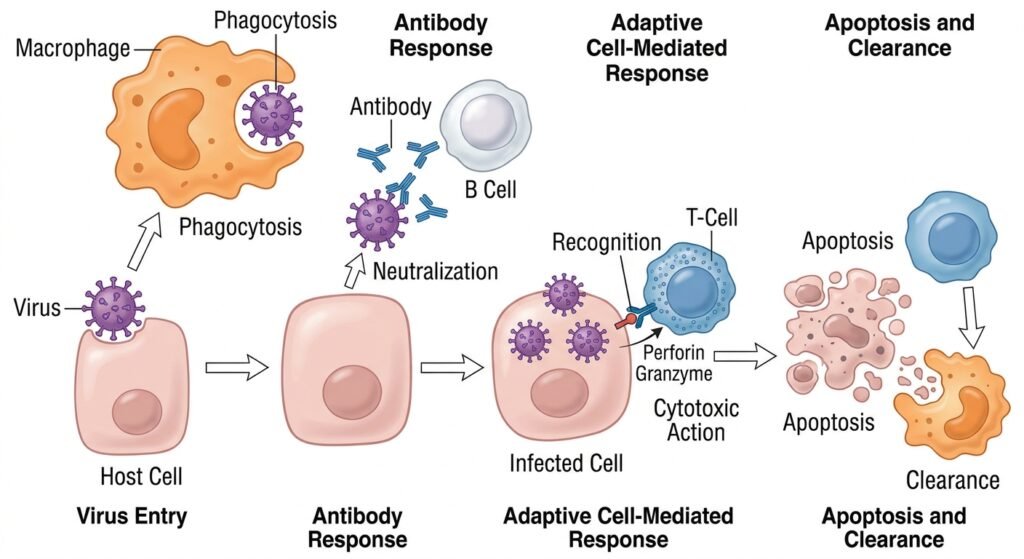
Your immune system fights viruses in two waves. Fast, general defenses (interferons, natural killer cells, fever) slow the virus within hours, and then, after several days, T cells destroy infected cells while B cells release antibodies that stop free virus particles from entering new cells.
That’s the short answer to how does the immune system fight viruses. The longer answer is more interesting, because viruses are a strange kind of enemy. A virus can’t grow or copy itself on its own. It has to slip inside one of your cells and use that cell’s machinery, which means your body must attack its own infected cells to win.
This guide follows a virus from the moment it lands on you to the day your body remembers it. You’ll learn which cells do what, why antibodies alone aren’t enough, how vaccines give you a head start, and why antibiotics do nothing against a cold. Each idea comes with a table or example you can use in a test answer.
We’ll start with what a virus does inside you, then cover the barriers, the first responders, the seven-step adaptive response, memory and vaccines, a worked example, common myths and FAQs.
Quick answer
The immune system fights viruses in layers. Skin and mucus block entry. Infected cells release interferons that warn neighbors, and natural killer cells destroy infected cells early. Within days, cytotoxic T cells kill infected cells and B cells make antibodies that neutralize free virus. Memory cells then guard against the same virus next time.
Key takeaways
- A virus hides inside your cells, so the body has two jobs: block free virus and kill infected cells.
- Innate defenses act within hours; the adaptive response needs several days to build.
- Cytotoxic T cells destroy infected cells, while antibodies from B cells stop virus particles from getting in.
- Memory T and B cells make a second encounter faster and stronger, which is how vaccines work.
- Antibiotics don’t work on viruses; they target bacteria.
What Does a Virus Do Once It’s Inside Your Body?
A virus breaks into one of your cells and forces it to build copies of the virus. On its own, a virus is just genetic material (DNA or RNA) wrapped in a protein coat, with no way to make energy or copy itself. Once it’s inside a host cell, the virus is hidden: immune cells moving through the bloodstream can’t see it there.
That hiding trick shapes the whole defense. Your immune system has to do two very different jobs at once:
- Catch virus particles while they’re outside cells, drifting in mucus, blood or the fluid between cells. Antibodies handle most of this.
- Find and destroy cells that already have a virus inside them, before those cells release a new batch. Natural killer cells and cytotoxic T cells handle this.
Think of a burglar who hides inside a house and starts building more burglars. Guards on the street can stop the ones walking between houses, but someone has to knock down the house that’s turned into a factory. Both jobs matter, and neither works alone.
What Are the Two Lines of Defense Against Viruses?
The body defends against viruses with innate immunity, which is fast and general, and adaptive immunity, which is slow to start but aimed at one specific virus. Innate defenses buy time; the adaptive side usually finishes the job and remembers.
| Feature | Innate immunity | Adaptive immunity |
|---|---|---|
| When it acts | Right away, from the first hours | After a delay of several days on first contact |
| What it recognizes | General features shared by many germs | One exact piece of one virus (an antigen) |
| Main players against viruses | Skin and mucus, interferons, natural killer cells, macrophages, neutrophils, fever | Helper T cells, cytotoxic T cells, B cells, antibodies |
| Memory | None | Yes: memory T and B cells |
| Present from birth? | Yes | Built up through infections and vaccines |
The two sides talk to each other constantly. Innate cells such as dendritic cells pick up pieces of the virus and carry them to the adaptive cells, which is how the specific attack gets started.
How Does Your Body Keep Viruses Out in the First Place?
Physical and chemical barriers stop many viruses before they reach a living cell. The outer layer of your skin is made of dead, tough cells that are constantly shed, and viruses need living cells to infect.
Weak points are the openings: your eyes, nose, mouth and gut. Each has its own guard:
- Mucus in the nose and airways traps particles, and tiny hairs called cilia move it out. Our guide on how the lungs breathe shows where this lining sits.
- Saliva and tears wash surfaces and carry IgA antibodies, a type made for mucous membranes.
- Stomach acid destroys many germs that get swallowed; you can see where it fits in how the digestive system breaks down food.
Barriers aren’t perfect. Respiratory viruses, for example, can land directly on the cells lining your nose and throat, which is why the next layer of defense matters.
What Happens in the First Hours After a Virus Gets In?
In the first hours, infected cells sound an alarm, and general-purpose defenders attack anything that looks infected or foreign. None of these defenders recognize the specific virus. They respond to warning signs shared by many germs, using a limited set of sensors called pattern recognition receptors.
| First responder | What it does against a virus |
|---|---|
| Interferons | Proteins released by an infected cell. They travel to nearby cells and make them produce antiviral proteins, so the virus has a harder time spreading. The first cell is lost, but its neighbors are protected. |
| Natural killer (NK) cells | Lymphocytes that trigger infected cells to self-destruct (apoptosis). They punch pores in the target cell with perforins, then send in granzymes through those pores. |
| Macrophages and neutrophils | Eating cells (phagocytes) that swallow virus particles and debris and break them down inside. |
| Inflammation | Heat, redness, swelling and pain at the infected spot as blood flow rises and defenders pour in. |
| Fever | Immune signals reset the brain’s thermostat (the hypothalamus) to a higher setting. |
Fever feels awful, but it has a job. According to OpenStax Microbiology, a higher body temperature stimulates white blood cells to kill pathogens, and many human pathogens grow best near 35°C (95°F), so extra heat may slow them down. The human brain guide explains more about the brain regions that keep your body running automatically.
OpenStax Anatomy and Physiology 2e: 21.2 Barrier Defenses and the Innate Immune Response
How Do T Cells and B Cells Destroy a Virus? (7 Steps)
T cells and B cells destroy a virus by first learning its exact shape, then multiplying into an army that kills infected cells and floods the body with matching antibodies. Here’s the sequence most biology courses expect you to know.
- A dendritic cell collects the evidence. This sentinel cell picks up pieces of the virus at the infection site and carries them to the nearest lymph node.
- The matching helper T cell is found. In the lymph node, the dendritic cell displays the viral pieces on a molecule called MHC class II. Out of a huge variety of helper T cells (also called CD4 cells), only those whose receptors fit that exact piece are selected. They then copy themselves many times, a process called clonal selection and expansion.
- Helper T cells give orders. They release chemical signals (cytokines) that switch on other immune cells, including cytotoxic T cells and B cells.
- Cytotoxic T cells kill infected cells. Most cells in your body show small samples of the proteins inside them on MHC class I molecules. When a cell is infected, viral pieces appear there too. Cytotoxic T cells (CD8 cells) spot them and make the infected cell self-destruct using perforins and granzymes. A single cytotoxic T cell can destroy several infected cells in a row.
- B cells turn into antibody factories. A B cell whose receptor matches the virus, with help from a helper T cell, multiplies and becomes a plasma cell that pours out antibodies.
- Antibodies neutralize the virus. They latch onto virus particles so they can no longer infect a cell. They also clump particles together, tag them so phagocytes eat them faster, and trigger a group of blood proteins called complement.
- Memory cells stay behind. Once the virus is cleared, most of the army dies off, but long-lived memory T cells and memory B cells remain, ready for the next encounter.
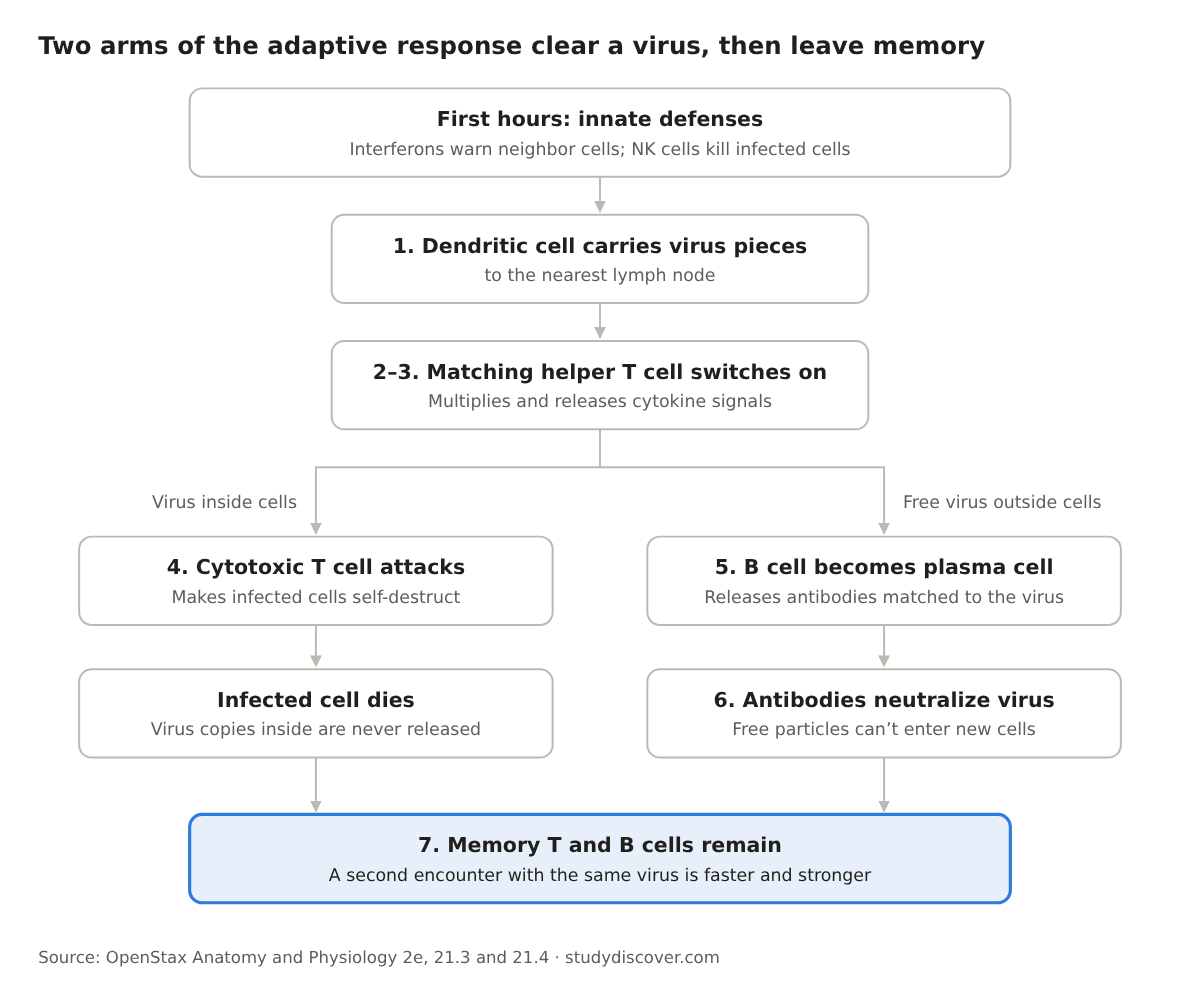
Picture of how the immune system fights viruses, from innate defenses to T cells, antibodies and memory cells.
The split between steps 4 and 6 is the part students mix up. Antibodies mostly deal with virus that’s outside cells. Killing an infected cell is the job of cytotoxic T cells (and, earlier on, NK cells).
Which Antibodies Fight Viruses?
Your body makes five classes of antibody, and three of them do most of the work against viruses: IgM early on, IgG in the blood, and IgA on mucous surfaces. Every antibody has the same basic Y shape (two heavy chains and two light chains), with two tips that grab the target.
| Antibody class | Where you find it | Role against viruses |
|---|---|---|
| IgM | Blood | Usually the first antibody made in a new infection; it has 10 binding sites |
| IgG | Blood and tissue fluid | Main antibody of a repeat (secondary) response; crosses the placenta to protect a baby |
| IgA | Tears, saliva, mucus and breast milk | Guards the surfaces where many viruses enter |
| IgE | Low levels in blood | Linked mainly to allergies |
| IgD | On the surface of young B cells | Acts as a receptor, not a released antibody |
OpenStax Anatomy and Physiology 2e: 21.4 The Adaptive Immune Response: B-lymphocytes and Antibodies
How Does the Immune System Remember a Virus?
The immune system remembers a virus through memory T cells and memory B cells, which can last for many years and sometimes a lifetime. On a second encounter, these cells recognize the virus at once, so there’s no waiting period.
| Feature | First (primary) response | Second (secondary) response |
|---|---|---|
| Starting point | Only a few matching cells | Many ready-made memory cells |
| Speed | Antibody levels rise after a delay of several days | Little or no delay |
| Amount of antibody | Lower | Much higher |
| Main antibody | IgM first | IgG |
| What you notice | Usually symptoms while the response builds | Often cleared before symptoms appear |
Chickenpox is the classic example. After recovering, the body keeps a memory of the varicella-zoster virus that protects against it on later exposure.
How Do Vaccines Train the Immune System to Fight Viruses?
Vaccines train the immune system by showing it a killed or weakened virus, or just a piece of one, so it builds memory cells without you having to get sick first. This is called artificial active immunity.
Two real cases show how powerful that memory can be:
- Smallpox: Edward Jenner developed the first successful vaccine in 1796. Smallpox killed up to 30% of the people it infected. After a worldwide vaccination and surveillance campaign, the World Health Organization declared it eradicated in 1980.
- Measles: The CDC puts the MMR vaccine’s effectiveness against measles at 93% after one dose and 97% after two, with protection lasting for life in most people.
Protection can also be borrowed. In passive immunity, antibodies come from someone else: IgG crossing the placenta from mother to baby, IgA in breast milk, or antibody injections. It works right away but fades, because no memory cells are made.
How Do Viruses Try to Escape the Immune System?
Viruses survive by hiding from the cells that hunt them. Because cytotoxic T cells find infected cells by checking the viral pieces shown on MHC class I molecules, some viruses block those molecules from reaching the cell surface. With nothing on display, the T cell walks past.
The immune system has a backup for that trick. NK cells kill cells that show fewer MHC class I molecules than normal, so a cell that hides its “ID card” becomes a target anyway. It’s a good example of how the innate and adaptive sides cover each other’s blind spots.
British Society for Immunology: Immune responses to viruses
Worked Example: How Your Body Beats a Common Cold
Here’s an example scenario that follows one cold virus through the whole defense. The timing is simplified for learning.
Step 1: The virus lands
A classmate sneezes, and droplets carrying a cold virus land in your nose. Mucus traps most of them, but a few particles reach the cells lining your nasal passage and get inside.
Step 2: The alarm goes off
Infected nasal cells release interferons, and nearby cells switch on their antiviral defenses. NK cells arrive and destroy some infected cells. Your nose gets inflamed and runny as blood flow and fluid increase.
Step 3: The specific attack builds
Dendritic cells carry viral pieces to lymph nodes in your neck, which may feel slightly swollen. Matching helper T cells, cytotoxic T cells and B cells multiply over the next several days.
Step 4: The virus is cleared
Cytotoxic T cells kill the remaining infected cells, and antibodies neutralize free virus in your nose and throat. Symptoms fade as the virus runs out of cells to use.
Step 5: Memory is stored
Memory T and B cells remain. If this exact virus returns, they respond quickly. You can still catch other colds, though, because many different viruses cause them and each needs its own memory.
Common Mix-Ups About Viruses and Immunity
| Myth | Reality |
|---|---|
| Antibiotics help you get over a cold or flu faster. | Antibiotics don’t work on viruses, including the ones that cause colds and flu. |
| A fever is just a harmful side effect. | Fever is an immune response that stimulates white blood cells and may slow pathogen growth. |
| Antibodies kill infected cells. | Antibodies mainly neutralize virus outside cells; cytotoxic T cells and NK cells kill infected cells. |
| Getting over one virus protects you from all viruses. | Adaptive immunity is specific: memory cells recognize the exact virus they met. |
| Vaccines give you the disease. | Vaccines use killed or weakened viruses, or parts of them, to build memory with few symptoms. |
Source for the antibiotics row:
CDC: Healthy Habits: Antibiotic Do’s and Don’ts
Source for the fever row:
OpenStax Microbiology: 17.5 Inflammation and Fever
Frequently Asked Questions
How long does it take the immune system to fight off a virus?
The first defenses start within hours, but the targeted response takes several days to build on a first infection, because only a few matching T and B cells exist at the start and they need time to multiply. On a repeat encounter, memory cells cut that delay sharply, which is why the second infection is often milder or goes unnoticed.
Do antibiotics work against viruses?
No. Antibiotics target structures and processes found in bacteria, which viruses don’t have. The CDC states plainly that antibiotics don’t treat infections caused by viruses such as colds and flu. Doctors sometimes prescribe antiviral medicines for specific viruses, but most mild viral infections are cleared by the immune system itself.
Why do you get a fever when you have a virus?
You get a fever because immune cells release signaling molecules that reset the hypothalamus, the brain’s thermostat, to a higher temperature. Your body then shivers and narrows blood vessels in your skin to reach the new setting. The extra heat helps white blood cells work and may slow germs that prefer normal body temperature.
Which white blood cells fight viruses?
Several types share the work. Natural killer cells and cytotoxic T cells destroy infected cells. Helper T cells coordinate the response. B cells become plasma cells that make antibodies. Macrophages, neutrophils and dendritic cells swallow virus particles, and dendritic cells also carry viral pieces to the lymph nodes to start the adaptive response.
What is the difference between an antigen and an antibody?
An antigen is the thing being recognized, such as a protein on a virus’s surface. By contrast, an antibody is the Y-shaped protein your B cells make to grab that antigen. Each antibody fits only a small region of one antigen, called an epitope, much like a key cut for one lock.
Can a baby get antibodies from its mother?
Yes. IgG antibodies cross the placenta before birth, and IgA antibodies pass to the baby in breast milk. This is passive immunity: it protects the baby right away, but it fades over time because the baby’s own memory cells weren’t involved in making those antibodies.
The Short Version
- A virus hides inside your cells, so your body must both block free virus and destroy infected cells.
- Barriers, interferons, NK cells, inflammation and fever act fast but aren’t specific.
- After several days, cytotoxic T cells kill infected cells and B cells release antibodies that neutralize the virus.
- Memory T and B cells make the next response faster and stronger, the same principle vaccines use.
- Antibiotics don’t work on viruses.
Want to test yourself? Take the science quiz, or turn the seven adaptive steps into cards with the Flashcard Maker. For how the immune system fits alongside the other organ systems, read how the human body works, and find more guides in Biology.
OpenStax Microbiology has a free, college-level chapter on adaptive immunity if you want to go further:
OpenStax Microbiology: 18.1 Overview of Specific Adaptive Immunity
Disclaimer
This article is for general educational purposes only. It explains how a healthy immune system responds to viruses and is not medical advice for diagnosing or treating any infection. If you or your child has a high or lasting fever, trouble breathing or other worrying symptoms, contact a doctor or qualified health professional, and check vaccine questions with your healthcare provider.