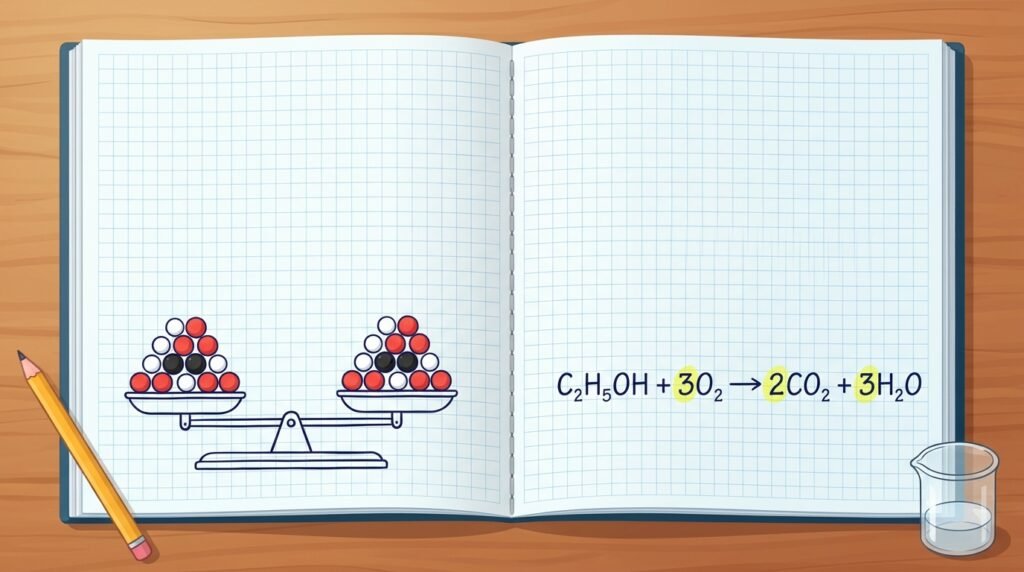
Balancing chemical equations means adding numbers in front of each formula until every element has the same number of atoms on both sides of the arrow. You never change the formulas themselves, only those front numbers, called coefficients. It works because a reaction only rearranges atoms and molecules; it never creates or destroys a single atom.
Three slip-ups cost the most marks: changing a subscript, forgetting the atoms hiding inside brackets, and freezing when a fraction appears. This guide fixes all three.
You will get a six-step method you can use on any equation, a tally table that keeps your counting honest, full worked examples (simple, combustion, fractions, polyatomic ions and a tough one solved with algebra), the odd-even trick, and a practice set with answers.
Quick answer
To balance a chemical equation, write the correct formulas, count the atoms of each element on both sides, then add whole-number coefficients in front of formulas one element at a time. Balance metals and carbon first, hydrogen next, oxygen last. Recount, clear any fractions, and reduce to the lowest whole-number ratio. Never change subscripts.
Key takeaways
- Only coefficients change: altering a subscript turns one substance into a different one.
- Order matters: balance “loner” elements first, then hydrogen, and leave oxygen or any free element for last.
- Fractions are allowed mid-way: just multiply every coefficient by the same number at the end.
- Brackets multiply: in Ca(OH)2, the 2 applies to both O and H.
- Always recount: a tally table catches nearly every mistake before your teacher does.
What Does It Mean to Balance a Chemical Equation?
A balanced chemical equation has exactly the same number of atoms of each element on the reactant side (left of the arrow) and the product side (right of the arrow). Take hydrogen burning in oxygen. Written as H2 + O2 → H2O, the left has two oxygen atoms and the right has one. One oxygen atom has apparently vanished, which is impossible.
The fix is 2H2 + O2 → 2H2O. Now there are 4 hydrogen and 2 oxygen atoms on each side. Read it as a recipe: two molecules of hydrogen react with one molecule of oxygen to make two molecules of water.
The rule behind this is the law of conservation of mass. Antoine Lavoisier weighed every substance in the reactions he studied and pushed chemists to treat “matter is neither created nor destroyed” as a law; French students still learn it as Lavoisier’s law. Every chemical change keeps the same atoms; it only connects them differently.
Coefficients vs. Subscripts: The One Rule You Cannot Break
Coefficients are the full-size numbers in front of a formula, and they are the only numbers you are allowed to change. Subscripts are the small numbers inside a formula, and they define what the substance is.
Change H2O to H2O2 and you no longer have water; you have hydrogen peroxide, a bleach. The equation would “balance” on paper and describe a reaction that does not happen.
| Number | Where it sits | What it multiplies | Can you change it? |
|---|---|---|---|
| Coefficient (the 3 in 3H2O) | In front of the formula | Every atom in that formula | Yes, this is how you balance |
| Subscript (the 2 in H2O) | After an element symbol | Only the element just before it | No |
| Subscript after brackets (the 2 in Ca(OH)2) | After a closing bracket | Every atom inside the brackets | No |
| Invisible 1 (O2 with no coefficient) | Not written | Means one unit of that formula | Yes, you can replace it |
How to count atoms correctly
Multiply the coefficient by each subscript. In 3Ca(OH)2, calcium is 3 × 1 = 3, oxygen is 3 × 2 = 6 and hydrogen is 3 × 2 = 6. For 2C2H5OH, count every H, including the one in OH: 2 × 6 = 12 hydrogen atoms. Ethanol’s hidden sixth hydrogen trips up a lot of students.
Element symbols come straight from the periodic table, so if you are unsure whether “Co” is cobalt or carbon plus oxygen, check the capital letters: a new capital always starts a new element.
How to Balance Chemical Equations: The 6-Step Method
The fastest reliable method is to balance one element at a time in a fixed order, then recount. Chemists call this balancing by inspection, and it handles nearly every equation you will see in a school course.
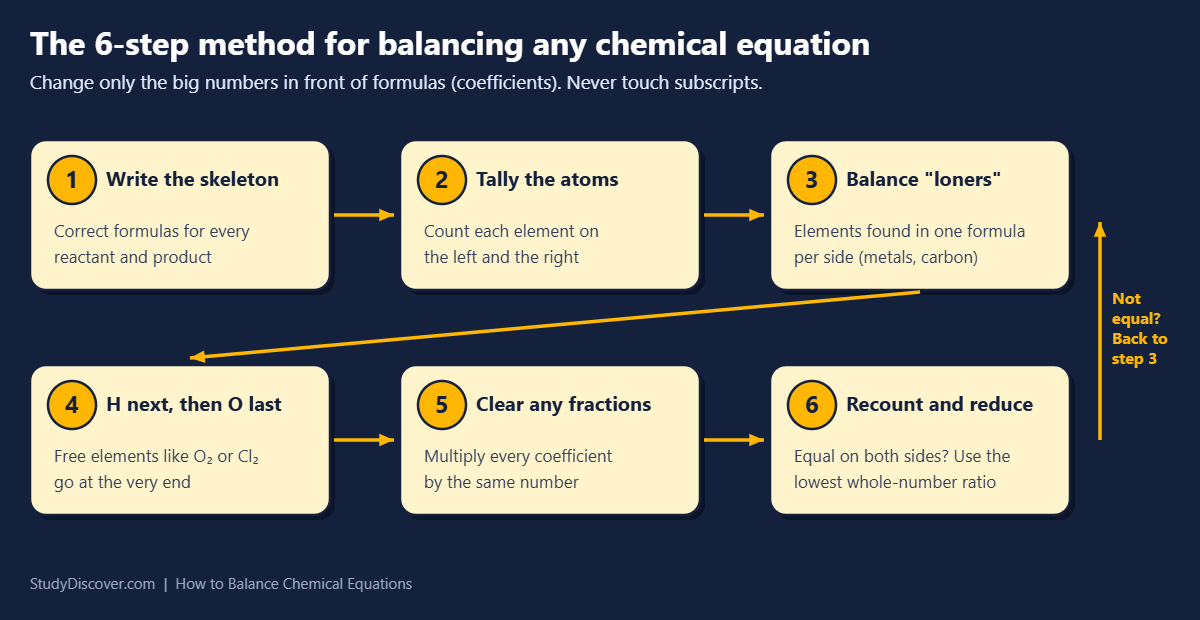
- Write the skeleton equation. Put the correct formula for every reactant and product. If a word equation is given, convert names to formulas first.
- Make a tally table. List each element and count its atoms on the left and right.
- Balance the “loners” first. Start with elements that appear in only one formula on each side, usually metals or carbon.
- Balance hydrogen next, then oxygen. Leave any element that stands alone (like O2, Cl2 or Fe) for last, because changing its coefficient affects nothing else.
- Clear fractions. If the last element needs a half, multiply every coefficient by 2.
- Recount and reduce. Check the tally again. If every coefficient shares a factor (like 4, 2, 4), divide down to the lowest whole numbers (2, 1, 2).
That last step matters for marks. The smallest whole-number coefficients are the expected final answer, so 4H2 + 2O2 → 4H2O is correct in ratio but would usually lose a point.
Worked Example: Burning Ethanol, Step by Step
Ethanol (C2H5OH) is the alcohol blended into many gasoline fuels, and it burns in oxygen to make carbon dioxide and water. It is a good first example because the fuel itself contains oxygen, which is exactly where students slip.
Step 1: Write the skeleton equation
C2H5OH + O2 → CO2 + H2O
Step 2: Tally the atoms
| Element | Left (reactants) | Right (products) | Balanced? |
|---|---|---|---|
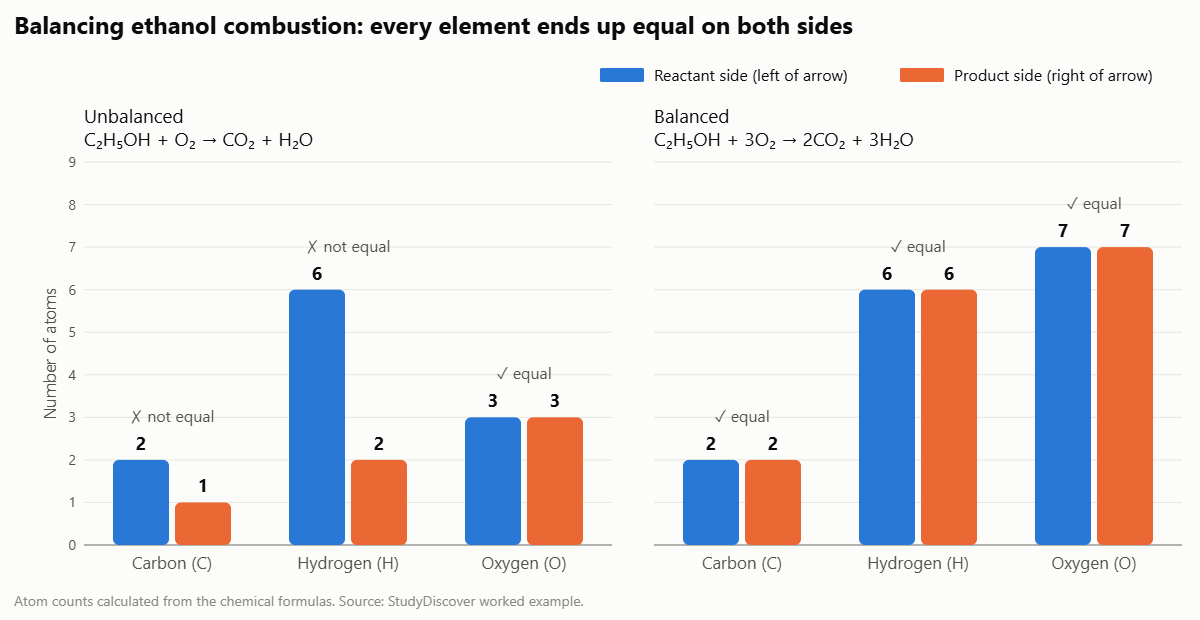
| C | 2 | 1 | No |
| H | 6 (5 + 1) | 2 | No |
| O | 3 (1 in ethanol + 2 in O2) | 3 (2 in CO2 + 1 in H2O) | Yes, for now |
Oxygen looks balanced, but ignore that. It will change as soon as you fix carbon and hydrogen.
Step 3: Balance carbon
Two carbons on the left, so put a 2 in front of CO2: C2H5OH + O2 → 2CO2 + H2O. Carbon is now 2 and 2. Oxygen on the right has jumped to 5.
Step 4: Balance hydrogen
Six hydrogens on the left, and each water holds 2, so you need 3 waters: C2H5OH + O2 → 2CO2 + 3H2O. Hydrogen is 6 and 6. Oxygen on the right is now 4 + 3 = 7.
Step 5: Balance oxygen last
The left needs 7 oxygen atoms. Ethanol already supplies 1, so O2 must supply 6, which means 3 molecules of O2:
C2H5OH + 3O2 → 2CO2 + 3H2O
Step 6: Recount
C: 2 = 2. H: 6 = 6. O: 1 + 6 = 7 on the left, 4 + 3 = 7 on the right. Coefficients 1, 3, 2, 3 share no common factor, so you are done.
The chart below shows the same tally before and after. Notice how oxygen started equal by coincidence and still had to change.
Why Does Balancing Matter? A Mass Check You Can Do
A balanced equation lets you predict masses, and the masses always add up. Using rounded atomic masses (C = 12, H = 1, O = 16), one molecule-recipe of the ethanol equation gives:
| Substance | Coefficient | Mass of one unit (g/mol) | Total mass (g) |
|---|---|---|---|
| C2H5OH | 1 | 46 | 46 |
| O2 | 3 | 32 | 96 |
| Reactants total | 142 | ||
| CO2 | 2 | 44 | 88 |
| H2O | 3 | 18 | 54 |
| Products total | 142 |
So burning 46 g of ethanol uses 96 g of oxygen and produces 142 g of products. Try that with the unbalanced version and the numbers refuse to match. The coefficients are really a ratio of particles, which is why every later calculation in chemistry (moles, yields, limiting reagents) starts from a balanced equation.
Combustion Shortcut: The C, H, O Order
For any fuel made of carbon and hydrogen (with or without oxygen) burning in O2, balance in this order every time: carbon, then hydrogen, then oxygen. The products are always CO2 and H2O, so the pattern never changes.
- C: the coefficient of CO2 equals the number of carbons in the fuel.
- H: the coefficient of H2O equals half the hydrogens in the fuel.
- O: add up oxygen on the right, subtract any oxygen already in the fuel, and divide by 2 for O2.
When the oxygen count on the right comes out odd, you get a fraction. That is the next example.
What to Do When You Get a Fraction
A fraction mid-way is fine; just multiply every coefficient by the denominator at the end. Here is hexane (C6H14), a component of gasoline, burning in oxygen.
Step 1: Carbon and hydrogen
Six carbons gives 6CO2. Fourteen hydrogens gives 7H2O: C6H14 + O2 → 6CO2 + 7H2O.
Step 2: Oxygen gives a half
Right-side oxygen is 12 + 7 = 19. You would need 19 ÷ 2 = 9½ molecules of O2. Write it as a fraction for now: C6H14 + 19/2 O2 → 6CO2 + 7H2O.
Step 3: Double everything
Multiply all four coefficients by 2:
2C6H14 + 19O2 → 12CO2 + 14H2O
Check: C is 12 = 12, H is 28 = 28, O is 38 = 24 + 14 = 38. The fraction only exists in your rough work; a final answer should never contain one.
How to Balance Equations With Polyatomic Ions
If a polyatomic ion such as phosphate (PO4), sulfate (SO4) or nitrate (NO3) appears unchanged on both sides, treat it as one block. That way you count one unit instead of four or five separate atoms.
These formulas come from the charges of ionic compounds, so you cannot rewrite them to make balancing easier. Calcium phosphate is always Ca3(PO4)2.
Example: calcium hydroxide reacting with phosphoric acid, a neutralization reaction.
Ca(OH)2 + H3PO4 → Ca3(PO4)2 + H2O
Step 1: Balance calcium
Three Ca on the right, so 3Ca(OH)2 on the left.
Step 2: Balance the phosphate block
Two PO4 blocks on the right, so 2H3PO4 on the left.
Step 3: Balance hydrogen with water
Left hydrogen is 6 (from 3Ca(OH)2) + 6 (from 2H3PO4) = 12. Water carries 2 each, so 6H2O:
3Ca(OH)2 + 2H3PO4 → Ca3(PO4)2 + 6H2O
Step 4: Check oxygen
Left: 6 from hydroxide + 8 from phosphate = 14. Right: 8 in phosphate + 6 in water = 14. Balanced, and you never had to juggle oxygen directly.
The Odd-Even Trick for Stubborn Equations
When an element is odd on one side and even on the other, put a 2 in front of the odd one first. Diatomic gases always hold an even number of atoms, so any product formula with an odd count of that element needs an even coefficient.
Example: ammonia burning to nitrogen monoxide, NH3 + O2 → NO + H2O.
- Hydrogen is 3 on the left and 2 on the right. The lowest common multiple is 6, so use 2NH3 and 3H2O.
- Nitrogen is now 2 on the left, so 2NO.
- Oxygen on the right is 2 + 3 = 5, which is odd against the even O2. Double everything you have so far: 4NH3, 4NO, 6H2O, giving 4 + 6 = 10 oxygen atoms on the right.
- That needs 5 molecules of O2.
4NH3 + 5O2 → 4NO + 6H2O
The seven elements that exist as two-atom molecules are hydrogen, nitrogen, oxygen, fluorine, chlorine, bromine and iodine (H2, N2, O2, F2, Cl2, Br2, I2). Writing them as single atoms in a skeleton equation is one of the most common errors.
The Algebra Method for Really Hard Equations
When inspection keeps going in circles, give each coefficient a letter and write one equation per element. Inspection works for most simple equations, but complex reactions often need a mathematical approach, and this is the easiest one to do by hand with basic algebra.
Example: potassium permanganate with hydrochloric acid.
a KMnO4 + b HCl → c KCl + d MnCl2 + e Cl2 + f H2O
| Element | Equation | Result (set a = 1) |
|---|---|---|
| K | a = c | c = 1 |
| Mn | a = d | d = 1 |
| O | 4a = f | f = 4 |
| H | b = 2f | b = 8 |
| Cl | b = c + 2d + 2e | 8 = 1 + 2 + 2e, so e = 5/2 |
Multiply everything by 2 to remove the half:
2KMnO4 + 16HCl → 2KCl + 2MnCl2 + 5Cl2 + 8H2O
Chlorine is the element that appears in four different substances here. That is precisely why trial and error struggles and algebra does not.
Which Method Should You Use?
Use inspection for almost everything, and switch methods only when a specific pattern shows up.
| If the equation… | Use | Why |
|---|---|---|
| Has 2 to 4 substances | Inspection (6 steps) | Fastest, and usually solved in under a minute |
| Is a fuel burning in O2 | C, H, O order | The products never change |
| Keeps the same ion on both sides | Polyatomic block | Fewer things to count |
| Has an odd-even clash | Odd-even trick | Removes fractions early |
| Has one element in 3 or more substances | Algebra method | Trial and error goes in circles |
Common Mistakes When Balancing Equations
Almost every wrong answer comes from one of these, so check for them before you hand anything in.
| Mistake | What it looks like | The fix |
|---|---|---|
| Changing a subscript | Writing H2O2 to get more oxygen | Add a coefficient in front instead |
| Forgetting brackets | Counting 1 O in Ca(OH)2 | Multiply everything in the brackets |
| Missing a hidden atom | Counting 5 H in C2H5OH | Scan the whole formula, OH included |
| Coefficient applied to one atom only | Reading 2H2O as 4 H but 1 O | A coefficient multiplies every atom |
| Single-atom diatomics | Writing O instead of O2 | Remember the seven diatomic elements |
| Leaving a fraction or a common factor | Final answer 4, 2, 4 | Reduce to 2, 1, 2 |
Count, change one coefficient, count again: that three-move loop is the habit that prevents most of these.
Practice Problems (Try First, Then Check)
Cover the answers below, balance each equation on paper, then compare. They get harder as you go down.
| # | Unbalanced | Hint |
|---|---|---|
| 1 | K + Br2 → KBr | Bromine is diatomic |
| 2 | Fe + Cl2 → FeCl3 | Odd-even on chlorine |
| 3 | KClO3 → KCl + O2 | Odd-even on oxygen |
| 4 | C2H4 + O2 → CO2 + H2O | C, H, O order |
| 5 | AgNO3 + CaCl2 → AgCl + Ca(NO3)2 | Treat NO3 as a block |
| 6 | Al + HCl → AlCl3 + H2 | Balance Cl, then H |
| 7 | Fe2O3 + CO → Fe + CO2 | Iron first, then oxygen |
Answers:
- 2K + Br2 → 2KBr
- 2Fe + 3Cl2 → 2FeCl3
- 2KClO3 → 2KCl + 3O2
- C2H4 + 3O2 → 2CO2 + 2H2O
- 2AgNO3 + CaCl2 → 2AgCl + Ca(NO3)2
- 2Al + 6HCl → 2AlCl3 + 3H2
- Fe2O3 + 3CO → 2Fe + 3CO2
Got four or more right? Come back to the ones you missed in two days rather than redoing them now. Spaced practice sticks far better than ten in a row.
Frequently Asked Questions
What are the steps to balance a chemical equation?
Write the correct formulas, count the atoms of each element on both sides, and add coefficients one element at a time. Start with metals or carbon, then hydrogen, and finish with oxygen or any element standing alone. Clear fractions by multiplying everything, reduce to the smallest whole numbers, and recount to confirm each side matches.
What is the easiest way to balance chemical equations?
Use a tally table and a fixed order. Writing the atom counts for each side in two columns turns balancing into simple bookkeeping. Pairing that with the order “loners, hydrogen, oxygen last” means you rarely undo earlier work, which is what makes balancing feel slow.
Can you change subscripts to balance an equation?
No. A subscript is part of a substance’s identity, so changing it creates a different chemical. CO is carbon monoxide and CO2 is carbon dioxide; they are not interchangeable. Only coefficients, the numbers in front of formulas, can be adjusted.
Why do chemical equations have to be balanced?
Atoms are not created or destroyed in a chemical reaction, so the equation has to show the same atoms before and after. A balanced equation also gives the exact particle ratio, which you need to calculate masses, moles and yields.
Should you balance oxygen first or last?
Last, in most equations. Oxygen usually appears in several substances, so every change to carbon or hydrogen shifts its count. If oxygen stands alone as O2, adjusting it at the end does not disturb anything else you have already balanced.
How do you know if an equation is already balanced?
Count every element on both sides, multiplying coefficients by subscripts. If each element matches and the coefficients cannot be divided by a common number, it is balanced. Some equations, like HCl + NaOH → NaCl + H2O, are balanced from the start with all coefficients equal to 1.
The Short Version
- Balancing means equal atoms of each element on both sides, because atoms are conserved.
- Change coefficients only, never subscripts.
- Go in order: loner elements, hydrogen, then oxygen or free elements last.
- Fractions are fine mid-way; double everything to clear them.
- Recount with a tally table and reduce to the lowest whole numbers.
Next, make sure you can tell a reaction from a simple change of state with our guide to chemical vs. physical changes, or browse more chemistry explainers. For extra worked problems, the Physics Classroom balancing lesson has seven more examples to try.
Disclaimer
This article is for general educational purposes only. Chemical equations here are for learning to balance on paper, not instructions for carrying out reactions; several of the substances mentioned are flammable or corrosive. Always follow your teacher’s lab safety rules and check your exam board or school’s requirements for how answers should be written.