
Ionic vs. covalent bonds come down to one difference: in an ionic bond, one atom gives electrons to another and the two charged ions attract, while in a covalent bond, two atoms share a pair of electrons. Which one forms depends on how hard each atom pulls on electrons, a pattern that follows where each element sits on the periodic table.
That single difference explains a lot. It is why salt cracks when you hit it, why sugar melts in a pan but salt does not, and why salty water can carry an electric current while sugary water cannot.
Below you will find clear definitions, a number-based test for predicting bond type, real melting point data, a worked example, and the exceptions that trip students up on exams.
Quick answer
An ionic bond forms when one atom transfers electrons to another, creating positive and negative ions that attract, usually between a metal and a nonmetal (like NaCl). A covalent bond forms when two atoms share electrons, usually between nonmetals (like H2O). The bigger the electronegativity difference, the more ionic the bond.
Key takeaways
- Ionic: electrons move from one atom to another; opposite charges hold the ions together.
- Covalent: electrons are shared between atoms, forming molecules.
- Quick rule: metal + nonmetal is usually ionic; nonmetal + nonmetal is usually covalent.
- Number test: an electronegativity difference above about 1.8 points to ionic, below 0.4 to nonpolar covalent.
- Properties give it away: ionic solids melt hot and conduct when dissolved; most covalent substances do neither.
What Is an Ionic Bond?
An ionic bond is the attraction between oppositely charged ions. Britannica describes it as a linkage formed by electrostatic attraction, the same kind of pull that makes a balloon cling to your hair after you rub it.
Here is how it happens with sodium and chlorine. A sodium atom has one lonely electron in its outer shell. Chlorine needs just one more to fill its outer shell. So sodium hands its electron over:
- Sodium loses an electron and becomes Na+ (a positive ion, or cation).
- Chlorine gains that electron and becomes Cl− (a negative ion, or anion).
- The + and − charges attract, and that attraction is the bond.
Ionic compounds do not form single, separate pairs. Billions of Na+ and Cl− ions stack into a repeating 3D grid called a crystal lattice, with each ion surrounded by ions of the opposite charge. That is why a grain of table salt is a tiny cube, and why we write NaCl as a ratio (one sodium for every chlorine) instead of a molecule.
Charge size matters too. Magnesium oxide is built from Mg2+ and O2− ions. Doubling both charges makes the attraction much stronger, which shows up clearly in melting points later in this guide.
What Is a Covalent Bond?
A covalent bond is a pair of electrons shared between two atoms. Britannica’s definition is exactly that: the sharing of an electron pair. Neither atom wins the electrons outright, so no ions form. Instead, both nuclei are attracted to the shared pair sitting between them, and that holds the atoms together.
Think of two hydrogen atoms. Each has one electron, and each would be more stable with two. By sharing, both get to “count” two electrons. The result is an H2 molecule.
Atoms can share more than one pair:
| Bond type | Pairs shared | Electrons shared | Example |
|---|---|---|---|
| Single bond | 1 | 2 | H–H in hydrogen gas |
| Double bond | 2 | 4 | O=O in oxygen gas |
| Triple bond | 3 | 6 | N≡N in nitrogen gas |
Covalent bonds build discrete molecules such as water, methane (CH4) and carbon dioxide. If the difference between a molecule and a compound still feels fuzzy, that is worth sorting out first, because ionic compounds are compounds but not molecules.
Ionic vs. Covalent Bonds: Side-by-Side Comparison
The fastest way to see the difference is to line up both bond types against the same questions.
| Feature | Ionic bond | Covalent bond |
|---|---|---|
| What happens to electrons | Transferred from one atom to another | Shared between atoms |
| Usual partners | Metal + nonmetal | Nonmetal + nonmetal |
| Particles formed | Ions in a crystal lattice | Separate molecules (mostly) |
| Electronegativity difference | Large (above about 1.8) | Small to medium (below about 1.8) |
| State at room temperature | Solid | Solid, liquid or gas |
| Melting point | High | Usually low (network solids are the exception) |
| Conducts electricity? | Yes when melted or dissolved, not as a solid | Usually no |
| Hardness | Hard but brittle | Often soft (wax, sugar), with exceptions |
| Examples | NaCl, MgO, KBr, CaF2 | H2O, CO2, CH4, C12H22O11 (sugar) |
Use the “usual partners” row as your first guess, then confirm it with electronegativity when a question asks for a reason.
How to Predict the Bond Type Using Electronegativity
You can predict bond type by subtracting the electronegativity values of the two atoms. Electronegativity is a number that measures how strongly an atom pulls shared electrons toward itself. Fluorine is the greediest element, with a value of 4.0 on the Pauling scale.
When two atoms pull equally, they share evenly. When one pulls much harder, it drags the electrons most of the way over, and the bond becomes ionic. OpenStax Chemistry 2e gives this general guide:
| Electronegativity difference (ΔEN) | Bond type | What the electrons do |
|---|---|---|
| Less than 0.4 | Nonpolar covalent | Shared almost equally |
| 0.4 to 1.8 | Polar covalent | Shared unequally, pulled toward one atom |
| Greater than 1.8 | Ionic | Transferred, ions form |
Real bonds sit on a sliding scale rather than in three neat boxes. The chart below places common bonds on that scale using OpenStax values.
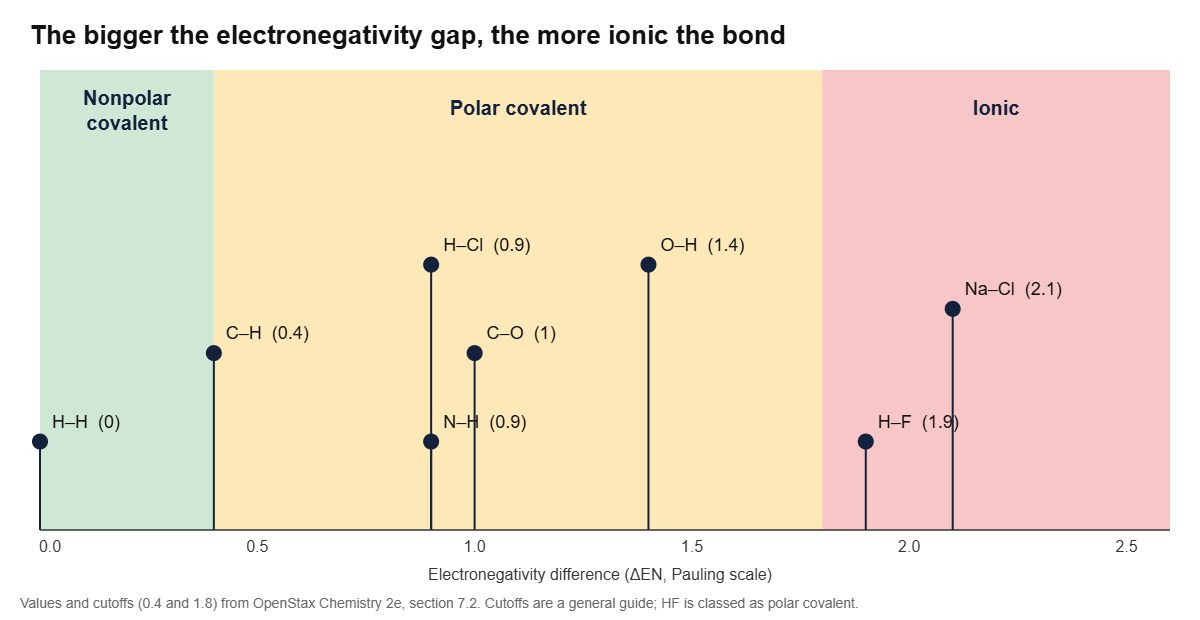
Different textbooks draw the line at 1.7 or 1.8, and OpenStax itself calls the cutoff a rough guide with many exceptions. If your class uses 1.7, use 1.7 on the test.
What Is a Polar Covalent Bond?
A polar covalent bond is a shared bond where one atom holds the electrons closer than the other. Nobody fully gives up an electron, but the sharing is lopsided, so one end of the bond carries a slight negative charge (written δ−) and the other a slight positive charge (δ+).
Water is the classic case. Oxygen pulls harder than hydrogen (ΔEN = 1.4), so each O–H bond has a slightly negative oxygen end. Those partial charges are why water dissolves salt so well and why water molecules cling to each other.
Polar covalent bonds are the middle ground between perfect sharing and full transfer. Hydrogen chloride (HCl) is a good example: as a gas it is a polar covalent molecule, but in water it splits into H+ and Cl− ions and becomes hydrochloric acid, a story covered in our guide to acids, bases and pH.
Why Ionic and Covalent Compounds Behave So Differently
Their properties differ because of what you have to pull apart. To melt an ionic solid, you must break the attraction between every ion and all its neighbors in the lattice. To melt most covalent substances, you only need to separate whole molecules from each other, which takes far less energy. The covalent bonds inside each molecule stay intact.
Melting and boiling points
The gap is huge. Table salt melts at 800.7 °C and magnesium oxide at 2,825 °C, according to PubChem (citing the CRC Handbook). Sugar melts and starts to break down at about 185.5 °C, and ice melts at 0 °C.
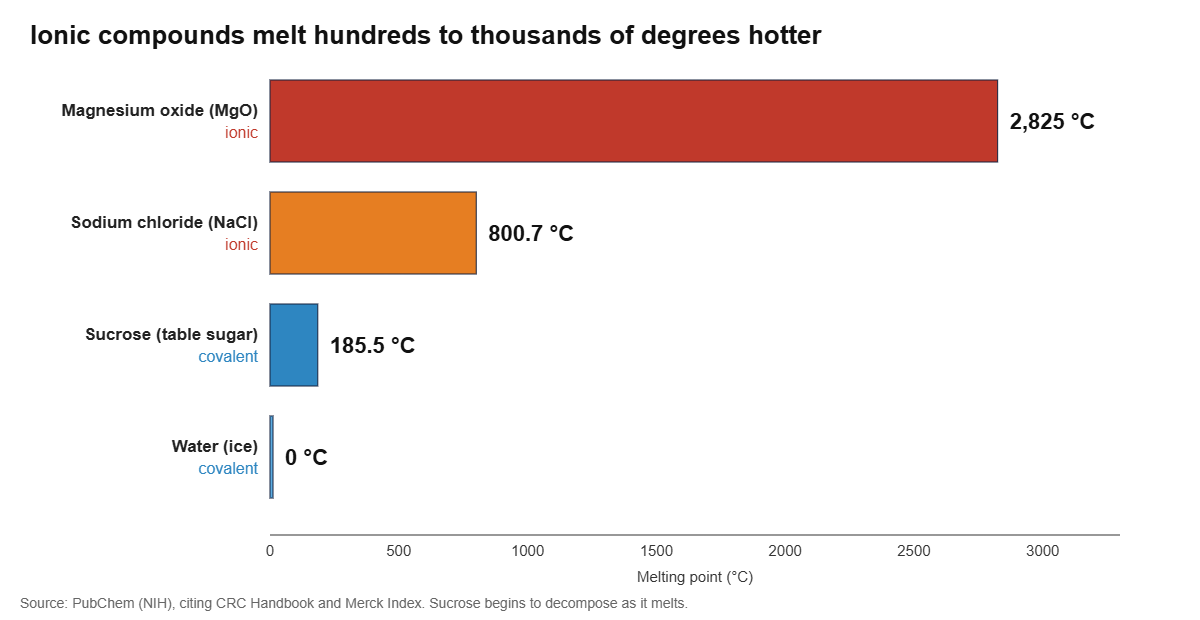
Notice that MgO melts more than 2,000 degrees hotter than NaCl. Its ions carry double charges (2+ and 2−), so they grip each other far more tightly. This is a direct way to see that charge size matters. If you want to picture what happens to particles during melting, our guide to the states of matter shows it step by step.
Electrical conductivity
Ionic compounds conduct electricity only when their ions can move. OpenStax notes that ionic solids are poor conductors, but once dissolved or melted they become excellent conductors. In the solid, the ions are locked in place. Dissolve salt in water and the freed Na+ and Cl− ions carry the current. Sugar water does not conduct, because sugar dissolves as whole, uncharged molecules.
Hardness and brittleness
Ionic crystals are hard but shatter easily. A sharp tap shifts one layer of ions so that like charges line up next to each other (+ beside +, − beside −). They repel, and the crystal splits along a clean plane. Covalent molecular solids like wax and sugar are usually softer because the forces between molecules are weak.
Worked Example: Is the Bond Ionic or Covalent?
This example scenario walks through a typical homework question: classify the bonds in NaCl, HCl and H2, and explain your answer.
Step 1: Check whether metals are involved
Sodium is a metal; chlorine and hydrogen are nonmetals. So NaCl is likely ionic, while HCl and H2 are likely covalent. This is your first guess, not your proof.
Step 2: Find the electronegativity values
Using the Pauling values in OpenStax: Na = 0.9, H = 2.1, Cl = 3.0.
Step 3: Subtract the smaller value from the larger
| Bond | Calculation | ΔEN |
|---|---|---|
| Na–Cl | 3.0 − 0.9 | 2.1 |
| H–Cl | 3.0 − 2.1 | 0.9 |
| H–H | 2.1 − 2.1 | 0 |
Step 4: Compare with the cutoffs
2.1 is above 1.8, so Na–Cl is ionic. 0.9 falls between 0.4 and 1.8, so H–Cl is polar covalent. 0 is below 0.4, so H–H is nonpolar covalent.
Step 5: Write the full-mark answer
“NaCl is ionic because the electronegativity difference (2.1) is large enough for sodium to transfer an electron to chlorine, forming Na+ and Cl− ions. HCl is polar covalent (ΔEN 0.9): the atoms share electrons unequally. H2 is nonpolar covalent (ΔEN 0): identical atoms share equally.” Naming the number and the electron behavior is what earns the marks.
How to Tell Them Apart in the Lab
You can identify an unknown solid by testing its properties. Each test alone can mislead, but two or three together give a reliable answer.
| Test | Likely ionic if… | Likely covalent if… |
|---|---|---|
| Heat gently in a test tube | Nothing melts | It melts or changes quickly |
| Dissolve in water, test with a conductivity probe | The bulb lights or the meter reads high | Little or no current flows |
| Tap a crystal | It shatters into smaller crystals | It squashes or crumbles softly |
| Look at the formula | Metal or NH4+ with a nonmetal | Only nonmetals |
Salt and sugar look almost identical in a dish, which makes them the perfect pair for this test. Only one of them lights the bulb. Dissolving either one is a physical change, so you can get the solid back by evaporating the water.
Exceptions and Tricky Cases
The metal-plus-nonmetal shortcut works most of the time, but a few cases break it, and teachers love them.
- Compounds with both bond types. Ammonium nitrate (NH4NO3), common in fertilizers, contains no metal, yet it is ionic. The NH4+ and NO3− ions attract each other, while the atoms inside each ion are held by covalent bonds.
- Borderline numbers. OpenStax points out that hydrogen fluoride has a ΔEN of 1.9 but is still classed as polar covalent. The cutoff is a guide, not a law.
- Covalent network solids. Diamond and quartz (SiO2) are covalent, yet they are extremely hard and melt at very high temperatures. Here every atom is bonded to its neighbors in one giant network, so melting means breaking real covalent bonds.
- Metallic bonding. Metal atoms bonded to each other (as in copper wire) form a third type, where outer electrons flow freely through the whole piece. It is neither ionic nor covalent.
Common Mix-Ups About Ionic and Covalent Bonds
These are the errors that show up most often in tests.
| Myth | Reality |
|---|---|
| Ionic bonds are always stronger than covalent bonds. | Not always. The covalent bonds in diamond are extremely strong. Covalent substances melt easily because the forces between molecules are weak, not the bonds inside them. |
| NaCl is a molecule. | NaCl is a formula unit showing a 1:1 ratio of ions in a lattice. There are no separate NaCl molecules in a salt crystal. |
| Solid salt conducts electricity. | Solid ionic compounds are poor conductors. The ions must be free to move, which happens only when the compound is melted or dissolved. |
| Melting sugar breaks its covalent bonds. | Melting separates sugar molecules from each other. Browning and caramelizing at higher heat is when the molecules start breaking down. |
| Bonds are either 100% ionic or 100% covalent. | Bonding is a spectrum. Most bonds between different atoms are partly polar, with ionic and nonpolar covalent at the two ends. |
Frequently Asked Questions
How do you know if a compound is ionic or covalent?
Start with the formula. A metal joined to a nonmetal usually means ionic, and only nonmetals usually means covalent. For a firmer answer, subtract the electronegativity values: above about 1.8 is ionic, below that is covalent. In the lab, high melting points and conductivity in water point to ionic.
Is water ionic or covalent?
Water is covalent. Hydrogen and oxygen are both nonmetals and share electrons. The O–H bonds are polar covalent because oxygen pulls the shared electrons closer (ΔEN 1.4), giving water its slightly negative oxygen end and slightly positive hydrogen ends.
Which is stronger, ionic or covalent bonds?
There is no single winner. Individual covalent bonds can be very strong, as in diamond. Ionic compounds usually have higher melting points than covalent molecular substances, but that is because melting a molecular substance only separates molecules, not because each covalent bond is weak.
Can a compound have both ionic and covalent bonds?
Yes. Compounds built from polyatomic ions have both. In sodium hydroxide (NaOH), the O–H inside the hydroxide ion is covalent, while the attraction between Na+ and OH− is ionic. Ammonium nitrate and calcium carbonate work the same way.
Why do ionic compounds conduct electricity in water?
When an ionic compound dissolves, its lattice breaks up and the ions spread through the water. Those charged particles can move toward electrodes, carrying an electric current. Covalent compounds like sugar dissolve as neutral molecules, so there is nothing charged to carry the current.
Is CO2 ionic or covalent?
Carbon dioxide is covalent. Carbon and oxygen are both nonmetals, and the carbon atom forms a double bond with each oxygen. Each C=O bond is polar, but the molecule is straight, so the pulls cancel out and CO2 as a whole is nonpolar.
The Short Version
- Ionic bonds come from electron transfer and charged ions; covalent bonds come from shared electron pairs.
- Metal + nonmetal is usually ionic; nonmetal + nonmetal is usually covalent.
- Electronegativity difference decides it: above about 1.8 ionic, 0.4 to 1.8 polar covalent, below 0.4 nonpolar covalent.
- Ionic solids melt hot (NaCl at 800.7 °C) and conduct when dissolved; most covalent substances melt low and do not conduct.
- Watch for exceptions: polyatomic ions, borderline numbers like HF, and network solids like diamond.
Test what you learned with the science quiz, then browse more topics in the chemistry section. For a deeper look at bond polarity, read the OpenStax chapter on ionic bonding.
Disclaimer
This article is for general educational purposes only. Electronegativity cutoffs vary slightly between textbooks and exam boards, so follow the values your course uses. Do lab tests only under a teacher’s supervision with proper safety equipment.