A ratio compares two amounts by showing how many of one there are for every one (or every few) of the other, like 3 cups of flour for every 2 cups of milk. A proportion says two ratios are equal, so 3:2 and 6:4 describe the same mix at different sizes. Ratios sit underneath much of the math that explains everyday life, which is the big idea in our pillar guide on how math and physics describe our world.
The “magic” is that one small comparison lets you scale anything up or down without losing its shape. Here are ratios and proportions explained simply: what each one means, how to simplify and solve them, and how to use them for the problems you’ll actually meet, from splitting money to reading a hiking map.
You’ll get a step-by-step method for missing values, a real map-scale example, a bar-model picture for sharing amounts, a quick way to find the better deal at the store, and the six mistakes that cost students the most marks.
Quick answer
A ratio compares two quantities, written as 3:2, 3 to 2 or 3/2, and shows how many of one there are for each part of the other. A proportion is an equation stating two ratios are equal, such as 3/2 = 12/8. To find a missing value in a proportion, cross-multiply and divide.
Key takeaways
- Order matters: boys to girls 2:3 is not the same as girls to boys 2:3.
- Simplify like a fraction: divide both parts by their greatest common factor.
- A proportion is two equal ratios: check it by cross-multiplying.
- To share in a ratio, add the parts first: 4:5 means 9 equal parts.
- Unit rates settle price comparisons: divide price by quantity for each option.
What Is a Ratio, in Plain Words?
A ratio is a comparison that tells you how much of one thing there is for each amount of another. If a class has 12 boys and 18 girls, the ratio of boys to girls is 12:18, read “12 to 18”.
You can write the same ratio three ways, and all mean the same thing:
| Written as | Read as | Where you’ll see it |
|---|---|---|
| 12:18 | 12 to 18 | Maps, recipes, test questions |
| 12 to 18 | 12 to 18 | Word problems |
| 12/18 | 12 over 18 (or 12 to 18) | Setting up a proportion |
The order is part of the meaning. Boys to girls is 12:18, while girls to boys is 18:12. Swap them by accident and every later step comes out wrong, so label each number before you start.
Ratios also come in two flavors. Part-to-part compares one group with another (boys to girls, 12:18). Part-to-whole compares one group with the total (girls to all students, 18:30). That second kind is a fraction of the whole, which is exactly what a percentage is: 18 out of 30 is 60%. Our guide on calculating percentages in real life picks up from there.
How to Simplify a Ratio
To simplify a ratio, divide both parts by the largest number that goes into both of them, called the greatest common factor (GCF). The ratio keeps its meaning but gets easier to read.
For 12:18, list the factors. Twelve splits evenly by 1, 2, 3, 4, 6 and 12; eighteen by 1, 2, 3, 6, 9 and 18. The biggest one they share is 6, so 12 ÷ 6 = 2 and 18 ÷ 6 = 3. The simplified ratio is 2:3: two boys for every three girls.
If you don’t spot the GCF right away, divide by any common factor and repeat. 12:18 ÷ 2 gives 6:9, then ÷ 3 gives 2:3. You land in the same place, just in two moves.
One rule before simplifying: both amounts must be in the same unit. A 50 cm board next to a 2 m board isn’t 50:2. Convert first (2 m = 200 cm), then simplify 50:200 to 1:4. The same reasoning is behind every unit conversion, where a factor like 100 cm : 1 m is a ratio equal to one.
Ratio, Fraction or Rate: What’s the Difference?
A ratio, a fraction and a rate all use division, but they answer different questions. A fraction always compares a part with its whole; a ratio can compare any two amounts; a rate compares two different units.
| Idea | Compares | Example | Same units? |
|---|---|---|---|
| Ratio (part-to-part) | One part with another part | 2 boys : 3 girls | Yes |
| Fraction | A part with the whole | 3/5 of the class are girls | Yes |
| Rate | Two different kinds of quantity | 65 miles per hour | No |
| Unit rate | A rate per single unit | $0.25 per ounce | No |
Some famous numbers are really ratios in disguise. Pi is the ratio of any circle’s circumference to its diameter, which is why our article on why pi never ends can call it the same number for a coin and for a planet’s orbit.
What Is a Proportion?
A proportion is a statement that two ratios are equal. Divide both parts of 8:12 by 4 and you’re back at 2:3, so you can write 2/3 = 8/12, and that equation is a proportion.
You can make as many equivalent ratios as you like by multiplying (or dividing) both parts by the same number: 2:3 = 4:6 = 6:9 = 8:12. Each one describes the same mix, just at a bigger size. Change only one part and the mix changes, which is why a cake tastes wrong when you double the flour but not the sugar.
Shape works the same way. A right triangle with sides 3, 4 and 5 can be scaled to 6, 8, 10 or 9, 12, 15, and it stays a right triangle, a shortcut covered in our guide to the Pythagorean theorem.
How to Solve a Proportion With Cross-Multiplication
To find a missing number in a proportion, multiply across the equals sign diagonally, then divide. This works because it’s the same as multiplying both sides of the equation by both denominators, a move you’ll recognize from solving equations in algebra.
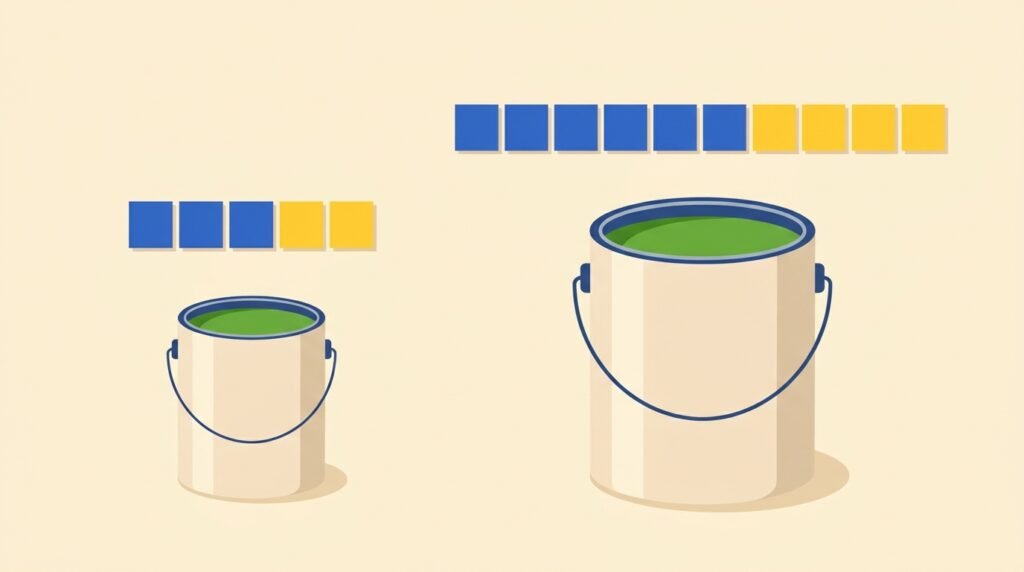
Here’s an example scenario. A shade of green uses 3 parts blue paint to 2 parts yellow. You have 12 liters of blue. How much yellow do you need?
- Set up matching ratios. Blue on top both times: 3/2 = 12/x.
- Cross-multiply. 3 × x = 2 × 12, so 3x = 24.
- Divide. x = 24 ÷ 3 = 8 liters of yellow.
- Check. 12:8 simplifies to 3:2 (divide by 4), so the mix matches.
The only trap is the setup. Keep the same quantity on top on both sides (blue over yellow, then blue over yellow). Mix them and the arithmetic still works, but the answer is wrong.
Worked Example: Reading a Real Map Scale With a Proportion
Map scales are ratios you can test on a real map. The US Geological Survey’s classic topographic maps use a scale of 1:24,000, which means 1 inch on the map stands for 24,000 inches (2,000 feet) on the ground.
The USGS explains that scale in its booklet on topographic mapping.
Say you’re planning a hike, and the trail measures 3.5 inches on one of these maps. How long is it on the ground?
Step 1: Write the scale as a ratio with units
The map says 1 inch represents 2,000 feet, so map : ground = 1 in : 2,000 ft.
Step 2: Set up the proportion
Keep map distance on top on both sides: 1/2,000 = 3.5/x, where x is the ground distance in feet.
Step 3: Cross-multiply and solve
1 × x = 2,000 × 3.5, so x = 7,000 feet.
Step 4: Turn it into something useful
A mile is 5,280 feet, so 7,000 ÷ 5,280 ≈ 1.33 miles. A one-and-a-third-mile trail is a short walk, which matches a 3.5-inch line on a detailed map. Good sense-check.
How to Share an Amount in a Given Ratio
To split a total in a ratio, add the parts to find how many equal shares there are, find the size of one share, then multiply. Most guides skip this, yet it’s one of the most common test questions.
Here’s an example scenario. Two siblings split $90 of birthday money in the ratio 4:5 (the older one gets 4 parts).
- Total parts: 4 + 5 = 9
- One part: $90 ÷ 9 = $10
- Older sibling: 4 × $10 = $40; younger sibling: 5 × $10 = $50
- Check: $40 + $50 = $90, and 40:50 simplifies to 4:5
The bar model below shows why adding the parts comes first: the $90 is cut into 9 equal blocks before anyone gets a share.

The method stretches to three parts. A garden soil mix calls for compost, sand and topsoil in the ratio 1:2:3, and you need 12 buckets in total. That’s 6 parts, so each part is 2 buckets: 2 of compost, 4 of sand and 6 of topsoil.
Unit Rates: Finding the Better Deal
A unit rate tells you how much one single unit costs, and it’s the fastest fair way to compare two sizes of the same product. Divide the price by the quantity for each option, then compare.
Here’s an example scenario with two cereal boxes:
| Box | Price | Size | Price per ounce |
|---|---|---|---|
| Regular | $4.50 | 18 oz | $4.50 ÷ 18 = $0.25 |
| Family | $5.76 | 24 oz | $5.76 ÷ 24 = $0.24 |
The family box wins by a penny an ounce, which adds up to 24 cents on the full box. Bigger isn’t always cheaper, though, so run the numbers every time; shelf labels sometimes use different units for neighboring products.
The same habit explains scaling recipes, mixing fuel for a lawn mower or adjusting a screen’s size while keeping its shape: find the rate for one unit, then multiply up.
Common Ratio and Proportion Mistakes
Most lost marks on ratio questions come from six habits, and each has a quick fix.
| Mistake | Why it’s wrong | The fix |
|---|---|---|
| Writing the parts in the wrong order | 2:3 boys to girls is a different class from 2:3 girls to boys | Label each number before you write the ratio |
| Mixing units | 50 cm : 2 m is not 50:2 | Convert to one unit first, then simplify |
| Dividing the total by one part | $90 ÷ 4 doesn’t give anyone’s share | Add the parts (4 + 5 = 9) and divide by that |
| Flipping one side of a proportion | 3/2 = x/12 gives 18, not 8 | Keep the same quantity on top on both sides |
| Adding instead of multiplying to scale | 2:3 plus 2 each becomes 4:5, a new mix | Multiply both parts by the same number |
| Calling a ratio a fraction of the whole | 2:3 boys to girls doesn’t mean 2/3 are boys | For part-to-whole, divide by the total parts (2/5) |
If an answer looks off, simplify your result and compare it with the ratio you started from. When they match, the setup was right.
Frequently Asked Questions
Is a ratio the same as a fraction?
Not quite. A fraction always compares a part with its whole, while a ratio can compare any two amounts, including two separate parts. In a class with 2 boys for every 3 girls, the ratio is 2:3, but the fraction of students who are boys is 2/5, because the whole is 5 parts. Every fraction can be read as a ratio, but not every ratio is a fraction of something.
How do you know if two ratios are proportional?
Simplify both, or cross-multiply. If 4:10 and 6:15 both reduce to 2:5, they’re proportional. Cross-multiplying gives the same verdict faster: 4 × 15 = 60 and 10 × 6 = 60, so the products match. If the two products differ, the ratios aren’t equal and the quantities don’t scale together.
Can a ratio have decimals or fractions in it?
Yes, though it’s usually tidied into whole numbers. A ratio of 1.5:2 means the same as 3:4, because you can multiply both parts by 2 without changing the comparison. With fractions, multiply both parts by the common denominator: ½ : ¾ becomes 2:3 after multiplying by 4.
What is the difference between direct and inverse proportion?
In direct proportion, both amounts rise together: twice the ingredients make twice the batches. In inverse proportion, one goes up as the other goes down, so their product stays fixed. If 4 painters take 6 days to paint a fence (24 painter-days), 6 painters at the same pace need 24 ÷ 6 = 4 days.
What grade do you learn ratios and proportions?
In most US schools, ratios start in sixth grade. Under the Common Core standards, sixth graders learn ratio language, unit rates and ratio reasoning for real problems, and later grades build proportional relationships on top of that. Other countries teach them at similar ages, so check your own syllabus.
Does the order of numbers in a ratio matter?
Yes, always. The first number matches the first thing named. “Cats to dogs is 3:1” means three cats for each dog, while 1:3 would mean three dogs for each cat. In word problems, underline the words before and after “to” and write the numbers in that order.
The Short Version
- A ratio compares two amounts in a set order; a proportion says two ratios are equal.
- Simplify a ratio by dividing both parts by their greatest common factor, after matching units.
- Solve a proportion by cross-multiplying and dividing, then check by simplifying.
- To share an amount, add the parts first, find one part, then multiply.
- Unit rates (price ÷ quantity) show which size is really cheaper.
Review the terms with the Flashcard Maker, test your speed on the Math Quiz, and check messy divisions on the Scientific Calculator or the Fraction Calculator. More guides like this sit in our mathematics articles.
The Common Core’s sixth-grade ratio standards show exactly what US students are expected to do with ratios and unit rates.
Sources
- US Geological Survey, “Topographic Mapping”: pubs.usgs.gov
- Common Core State Standards Initiative, “Grade 6, Ratios and Proportional Relationships”: thecorestandards.org
Disclaimer
This article is for general educational purposes only. Grade levels and course content vary by country, state and school, so check your own syllabus or exam board. For help with a specific class, talk to your math teacher or a qualified tutor.