

A unit conversion works by multiplying a measurement by a fraction that equals 1, such as 2.54 cm over 1 in. Because you’re multiplying by one, the amount itself never changes; only the label and the number in front of it do.
That single idea explains how unit conversions work for everything from recipe cups to rocket fuel. Once you see it, you stop memorizing “multiply here, divide there” rules and start setting up conversions that check themselves, since the units you don’t want cancel out on paper.
You’ll learn the multiply-by-one method in four steps, how to chain several factors, why square and cubic units trip people up, and why temperature refuses to follow the usual rule. There’s also a real spacecraft that was lost over a units mix-up, and a table of the mistakes that cost students marks.
Quick answer
To convert units, write the conversion fact as a fraction equal to 1, with the unit you want on top and the unit you’re leaving on the bottom. Multiply your measurement by it, cancel the matching units, and calculate. For multi-step conversions, chain several such fractions. Temperature is the main exception, because its scales have different zero points.
Key takeaways
- A conversion factor equals 1: 12 in ÷ 1 ft is just a fancy way of writing one.
- Units cancel like numbers: if the old unit isn’t gone, the fraction is upside down.
- Smaller unit, bigger number: 1.8 m becomes about 71 in, because inches are tiny.
- Squared units need squared factors: 1 ft² is 0.3048² m², not 0.3048 m².
- Round once, at the end: early rounding is where small errors grow.
Why Multiplying by a Conversion Factor Doesn’t Change the Amount
A conversion factor is a fraction whose top and bottom describe the same length, mass or time, so its value is exactly 1. Multiplying anything by 1 leaves it unchanged, which is why the measurement survives the trip into new units.
Take the fact 1 ft = 12 in. Divide both sides by 1 ft and you get 12 in ÷ 1 ft = 1. Flip it and 1 ft ÷ 12 in = 1 as well. Both fractions are “one” dressed up in units, and you pick whichever version cancels the unit you’re trying to get rid of.
The units behave like algebra symbols. Just as 3x ÷ x leaves 3, writing ft on the top and ft on the bottom leaves no ft at all. That’s the same balancing logic you use to solve equations in algebra, applied to labels instead of unknown numbers.
Science teachers call this setup dimensional analysis or the factor-label method. The names sound technical, but the move is the same every time: multiply by one, cancel, calculate.
Where Conversion Factors Come From: Exact vs Approximate
Conversion factors come from definitions, and some are exact while others are rounded. Knowing which is which tells you how much to trust your final digits.
The inch is a good example of an exact factor. Since July 1, 1959, the US inch has been defined as exactly 25.4 millimeters (2.54 cm), after English-speaking countries agreed to tie their length and mass units to the metric system. That’s why 2.54 never needs rounding.
The National Institute of Standards and Technology explains that agreement on its page about SI units of length and the 1959 yard.
| Conversion | Factor | Exact or rounded? |
|---|---|---|
| Inches to centimeters | 1 in = 2.54 cm | Exact (by definition) |
| Feet to meters | 1 ft = 0.3048 m | Exact (12 × 2.54 cm) |
| Miles to meters | 1 mi = 1,609.344 m | Exact (5,280 ft × 0.3048 m) |
| Pounds to kilograms | 1 lb ≈ 0.45 kg | Rounded for everyday use |
| Gallons (US) to liters | 1 gal ≈ 3.79 L | Rounded for everyday use |
| Kilometers to meters | 1 km = 1,000 m | Exact (metric prefix) |
Metric conversions inside one system are the easiest, because every prefix is a power of 10. Kilo means 1,000, centi means 1/100 and milli means 1/1,000, so moving between them only shifts the decimal point. The 2019 redefinition of the meter and kilogram, covered in our article on how math and physics describe our world, didn’t change any of these everyday factors.
How to Convert Units Step by Step
Every conversion follows the same four steps, whether it’s a single hop or five. Writing them out takes a few seconds and prevents the upside-down factor that causes most wrong answers.
- Write the starting value with its unit. For example, 1.8 m.
- Write the conversion fact as a fraction. Put the unit you want on top and the unit you have on the bottom: 100 cm ÷ 1 m.
- Cancel the matching units. Cross out m on the top and bottom. If you can’t cancel anything, flip the fraction.
- Calculate and sense-check. Multiply the numbers, then ask whether the size makes sense.
That sense-check rests on one rule of thumb: when you move to a smaller unit, the number gets bigger, because it takes more small pieces to cover the same amount. Use it as a quick test before you trust your answer.
| You’re converting to | The number should | Example |
|---|---|---|
| A smaller unit | Get bigger | 3 ft → 36 in |
| A larger unit | Get smaller | 2,500 g → 2.5 kg |
| A same-size unit | Stay the same | 1 mL → 1 cm³ |
Worked Example: Converting a Height From Meters to Feet and Inches
Here’s an example scenario that needs a remainder, which most guides skip. A basketball profile lists a player at 1.8 m, and you want the height in feet and inches.
Step 1: Get to a unit you can work with
The exact factor links inches and centimeters, so first turn meters into centimeters: 1.8 m × (100 cm ÷ 1 m) = 180 cm.
Step 2: Convert centimeters to inches
You want inches, so inches go on top: 180 cm × (1 in ÷ 2.54 cm) = 70.87 in. The cm cancels, and the number got bigger than 1.8 because inches are smaller than meters.
Step 3: Split inches into feet and inches
One foot is 12 inches. 70.87 ÷ 12 = 5 with 10.87 left over, so the height is 5 feet and about 10.9 inches.
Step 4: Round once and check
Rounded to the nearest inch, that’s 5 ft 11 in. A quick check: 6 ft would be 72 in, and 70.87 is just under that, so the answer is sensible.
Chaining Factors: Converting Speed From mph to m/s
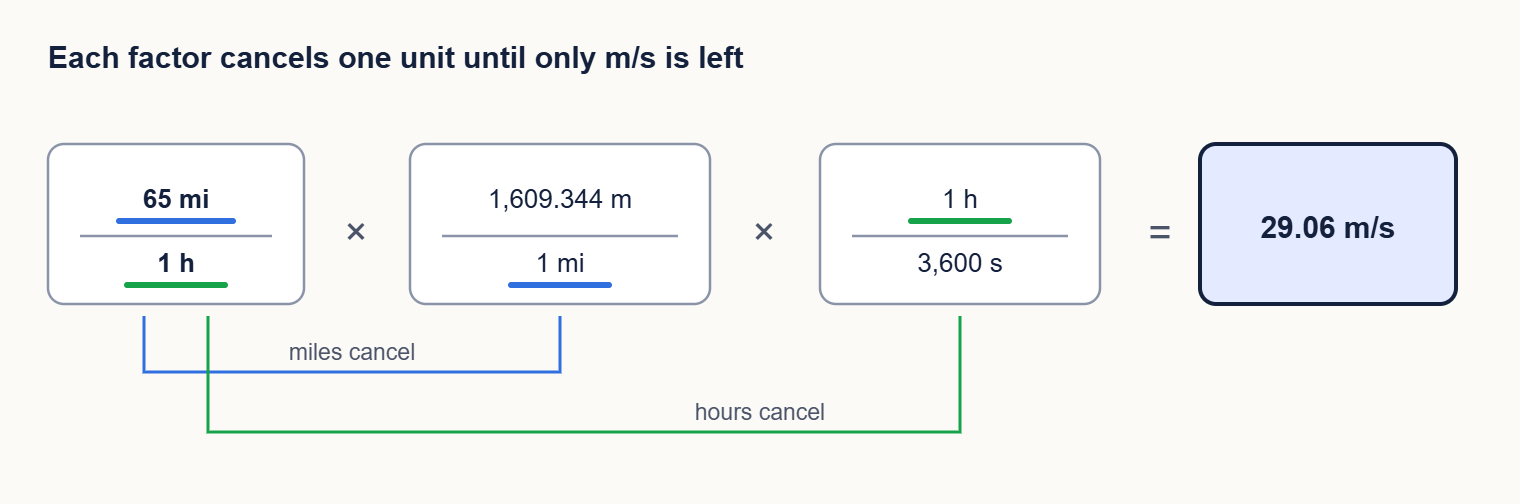
When a unit has two parts, like miles per hour, you convert each part with its own factor and multiply them all in one line. The cancellations do the bookkeeping for you.
Say a highway speed limit is 65 mph and a physics problem needs meters per second.
65 mi/h × (1,609.344 m ÷ 1 mi) × (1 h ÷ 3,600 s) = 29.06 m/s
Miles cancel against miles, hours cancel against hours, and only m/s is left. The first factor turns distance into meters; the second turns “per hour” into “per second”. Notice the 3,600 is on the bottom: there are 3,600 seconds in an hour, so a car covers far fewer meters in one second than in one hour.
The same setup gives km/h if you stop after the first factor and divide by 1,000: 65 mph is about 104.6 km/h.
Squared and Cubic Units: Why the Factor Gets Squared Too
Area and volume conversions need the factor squared or cubed, because a square foot is a foot long and a foot wide. This is the single most common conversion mistake on homework.
Here’s an example scenario: a bedroom floor measures 12 ft by 15 ft, which is 180 ft². To find square meters, you apply the 0.3048 m per foot factor twice, once for each dimension.
- Right: 180 ft² × (0.3048 m ÷ 1 ft)² = 180 × 0.0929 = 16.72 m²
- Wrong: 180 ft² × 0.3048 = 54.86 “m²”, more than three times too big
Cubic units follow the same pattern with a power of 3. A landscaping order of 3 cubic yards of mulch is 3 × 0.9144³ = 2.29 m³, because 1 yd = 0.9144 m in each of three directions.
Why Temperature Conversions Work Differently
Temperature can’t be converted with a single factor, because Fahrenheit and Celsius start counting from different zero points. You have to remove the offset first, then scale.
°C = (°F − 32) ÷ 1.8
For a body temperature of 98.6 °F, that’s (98.6 − 32) ÷ 1.8 = 37 °C. Skip the subtraction and you’d get 54.8 °C, a body temperature no person could survive, so you’d know at once that a step was missing.
The official US formulas, including the Kelvin version, are listed on NIST’s page of approximate conversions to metric.
One neat check: −40 °F and −40 °C are the same temperature, the only point where the two scales meet. If your formula doesn’t give −40 for −40, something’s off.
A Real Units Mistake: The Lost Mars Climate Orbiter
Unit errors aren’t only a homework problem. In September 1999, NASA lost its Mars Climate Orbiter, and within about a week the team traced the likely cause to a units mismatch.
According to NASA’s Jet Propulsion Laboratory, the spacecraft team in Colorado worked in English units such as pounds, while the navigation team in California worked in metric units. The error sat in information passed from one team to the other during a key operation.
JPL’s original release on how the Mars Climate Orbiter team found the likely cause of loss is still online.
The lesson for students is the same one this guide keeps repeating: write the units next to every number, and you’ll see a mismatch before it costs you anything.
Common Unit Conversion Mistakes (and How to Spot Them)
Nearly every wrong conversion comes from one of five slips, and each leaves a visible clue.
| Mistake | The clue it leaves | The fix |
|---|---|---|
| Fraction upside down | Units don’t cancel (you get m²/cm or similar) | Flip the factor so the old unit is on the bottom |
| Forgetting to square or cube | An area answer about 3 times too big (ft² to m²) | Raise the factor to the same power as the unit |
| Treating temperature like length | Absurd results, like a 54.8 °C body temperature | Subtract 32 first, then divide by 1.8 |
| Rounding mid-problem | Answer drifts from the answer key in the last digits | Keep full values; round only the final number |
| Mixing a remainder with decimals | Writing 5.87 ft as “5 ft 87 in” | Convert the decimal part: 0.87 ft × 12 = about 10.4 in |
The last row catches a lot of students on height and recipe problems. A decimal foot isn’t a count of inches; it’s a fraction of a foot that still needs its own conversion.
Frequently Asked Questions
Do you multiply or divide when converting units?
You can always multiply, as long as the conversion fraction is set up the right way round. Put the unit you want on top and the one you have on the bottom. Multiplying by 1 in ÷ 2.54 cm gives the same result as dividing by 2.54, so the fraction method simply removes the guesswork about which operation to pick.
What is a conversion factor?
A conversion factor is a ratio between two units that measure the same thing, written so its value equals 1. Examples are 60 min ÷ 1 h and 1 kg ÷ 1,000 g. Some factors are exact because they’re definitions, like 2.54 cm per inch, while others, like 3.79 liters per gallon, are rounded for convenience.
Can you convert between any two units?
Only between units that measure the same kind of quantity. Miles can become kilometers because both are lengths, but miles can’t become kilograms or seconds. If a problem seems to ask for that, there’s usually a rate hidden in it, such as speed (miles per hour) or density (grams per milliliter), and that rate becomes your conversion factor.
How many significant figures should a converted answer have?
Usually the same number as the least precise measurement you started with. Exact factors, like 12 inches per foot, don’t limit your precision at all. So 3.5 ft converts to 42 in written with two significant figures, not 42.000. Keep every digit during the working and round only once at the end.
Why does my answer differ slightly from an online converter?
Most often you used a rounded factor, such as 0.45 kg per pound, while the converter uses many more digits. Over a big number the gap shows: 150 lb × 0.45 gives 67.5 kg, while a converter shows about 68.04 kg. For homework, use whatever factor your teacher gives; for science and engineering, use exact factors where they exist.
What is the difference between unit conversion and dimensional analysis?
Unit conversion is the goal: changing a measurement into different units. Dimensional analysis is the method most science classes use to get there, tracking units through each step so they cancel. Dimensional analysis also checks formulas: if the units on both sides of an equation don’t match, the formula or the setup is wrong.
The Short Version
- A conversion multiplies by a fraction equal to 1, so the amount never changes.
- Put the unit you want on top; if the old unit doesn’t cancel, flip the fraction.
- Moving to a smaller unit makes the number bigger, and the reverse.
- Square or cube the factor for area or volume; temperature needs its own formula.
- Use exact factors like 2.54 cm per inch, and round only the final answer.
Check your work with the free Unit Converter, keep tricky decimals straight on the Scientific Calculator, and turn the exact factors from this page into a deck with the Flashcard Maker. Then test yourself on the Math Quiz or browse more mathematics articles.
NIST’s own five-step unit conversion process is a good reference if you want the official version.
Sources
- National Institute of Standards and Technology, “Unit Conversion,” updated February 6, 2026: nist.gov
- National Institute of Standards and Technology, “SI Units: Length,” updated September 19, 2025: nist.gov
- National Institute of Standards and Technology, “Approximate Conversions from U.S. Customary Measures to Metric,” updated February 6, 2026: nist.gov
- NASA Jet Propulsion Laboratory, “Mars Climate Orbiter Team Finds Likely Cause of Loss,” September 30, 1999: jpl.nasa.gov
Disclaimer
This article is for general educational purposes only. Conversion factors here are rounded for teaching except where marked exact, so use the factors your teacher, textbook or exam board specifies. For medication doses, engineering or trade measurements, rely on official tables and a qualified professional.