
Algebra is the part of math where letters, such as x, stand in for numbers you don’t know yet or numbers that can change. We use it because it turns a word problem into a short equation you can solve, and because one equation can answer the same kind of question for every possible number. That’s the short answer to what is algebra and why do we use it.
You already do a little algebra in your head. If a friend says, “I had some money, spent $7, and now I have $13,” you know they started with $20. Algebra just writes that thinking down as x − 7 = 13, so it still works when the numbers get messy.
This guide explains the handful of words you need (variable, expression, equation), where algebra came from, and five everyday problems it solves. Then you’ll solve your first two-step equation with a balance-scale picture, see which algebra courses come next, and learn the six mistakes that cost students the most marks.
Quick answer
Algebra is a kind of math where letters (variables) take the place of unknown or changing numbers, and you follow the rules of arithmetic to find them. We use it to solve problems where one number is missing, to write rules that work for any number (like a phone plan’s monthly cost), and as the base for science, coding, finance and higher math.
Key takeaways
- A variable is a placeholder: x, y or any letter stands for a number you don’t know yet.
- An equation is a balance: whatever you do to one side, you do to the other.
- One equation, endless cases: cost = 2.50 + 1.75 × miles works for every ride you’ll ever take.
- It’s 1,200 years old: the word comes from a book written in Baghdad in the early 800s.
- You use it already: spreadsheet formulas, recipe scaling and unit conversions are algebra.
What Is Algebra, in Simple Words?
Algebra is arithmetic that can talk about numbers it hasn’t met yet. In arithmetic you always know every number: 8 + 5 = 13. In algebra one or more numbers are hidden behind a letter, and the job is either to find that number or to describe how it behaves.
That letter is called a variable. It doesn’t have to be x. A phone plan might use m for minutes, a recipe might use s for servings, and a physics formula might use t for time. The letter is just a label on a box with a number inside.
The words you need to know
Most confusion in a first algebra class comes from vocabulary, not math. Here are the terms, all pointed at one small example: 3x + 5 = 20.
| Term | What it means | In 3x + 5 = 20 |
|---|---|---|
| Variable | A letter standing for an unknown or changing number | x |
| Coefficient | The number multiplying a variable | 3 (in 3x) |
| Constant | A number on its own, with no variable | 5 and 20 |
| Term | One chunk separated by + or − | 3x and 5 |
| Expression | Terms joined by operations, with no equals sign | 3x + 5 |
| Equation | Two expressions joined by an equals sign | 3x + 5 = 20 |
| Solution | The value that makes the equation true | x = 5, because 3 × 5 + 5 = 20 |
Two writing habits trip up beginners. First, a number right next to a letter means multiply: 3x is 3 × x, not 3 + x and not 35 when x is 5. Second, an expression can’t be “solved,” only simplified or evaluated; you need an equals sign before there’s anything to solve.
Expressions vs. equations
An expression is like a phrase, and an equation is like a full sentence. “2.50 + 1.75m” describes a ride-share fare for m miles, but it doesn’t claim anything. “2.50 + 1.75m = 16.50” makes a claim (the ride cost $16.50), and now you can find m. Solve it and you get m = 8 miles.
Where Did Algebra Come From?
Algebra takes its name from a book written in Baghdad in the early 800s by the mathematician Muhammad ibn Musa al-Khwarizmi. He worked at the House of Wisdom, a center of learning under the caliph al-Ma’mun, and his book’s title included the Arabic word al-jabr, which meant restoring or completing. When the book was translated into Latin in the 12th century, al-jabr became “algebra.”
Britannica’s biography of al-Khwarizmi also notes that his name gave us a second everyday word: “algorithm.”
One surprise: al-Khwarizmi’s algebra had no x at all. He wrote every problem out in words, something like “a square and ten roots equal thirty-nine.” The letters came much later.
| When | Who | What changed |
|---|---|---|
| Early 800s | al-Khwarizmi, Baghdad | Step-by-step methods for solving equations, written in words |
| 1100s | Latin translators in Europe | Al-jabr becomes “algebra” |
| 1591 | François Viète, France | First to use letters for both unknowns and known numbers (vowels for unknowns, consonants for knowns) |
| 1637 | René Descartes, France | Uses x, y and z for unknowns and a, b, c for knowns, the habit we still follow |
The University of St Andrews’ MacTutor history archive tracks these dates on its page about the earliest uses of symbols for variables, including the disputed story of why x won out over y and z.
That shift from words to letters matters more than it sounds. A sentence-long problem became one short line, and short lines are much easier to rearrange, compare and check.
Why Do We Use Algebra?
We use algebra for three jobs that ordinary arithmetic can’t do well: finding a missing number, writing a rule that works for every number, and comparing options before you choose. Each one shows up in daily life far more often than people expect.
1. Finding a number you don’t know
Whenever you know the answer but not one of the ingredients, algebra works backward for you. Say you have $90 saved for a $360 bike and can save $45 a week. How many weeks? Write it as 90 + 45w = 360, and the answer comes out as w = 6.
2. Writing one rule for every case
A formula is algebra that’s been written down once so nobody has to think about it again. To turn a Fahrenheit reading into Celsius, the rule is C = (F − 32) ÷ 1.8. Plug in 77°F and you get 25°C; plug in 212°F and you get 100°C. Every spreadsheet formula, such as =B2*1.08 for adding 8% tax, is the same idea with cell names instead of letters. Our guide on how to calculate percentages in real life uses exactly this kind of rule for discounts and tax.
3. Comparing two choices
Algebra tells you where one option overtakes another. Here’s an example scenario: Phone plan A charges a $50 setup fee plus $20 a month, and plan B has no setup fee but costs $30 a month. Set them equal: 50 + 20m = 30m, so m = 5. Before month 5, plan B is cheaper; after it, plan A wins.
The everyday problems algebra quietly solves
| Situation | The equation | Answer |
|---|---|---|
| A ride cost $16.50 at $2.50 plus $1.75 a mile. How far? | 2.50 + 1.75m = 16.50 | 8 miles |
| Weeks to save for a $360 bike with $90 saved, $45 a week | 90 + 45w = 360 | 6 weeks |
| A recipe for 4 needs 300 g of flour. How much for 10? | 300 ÷ 4 = f ÷ 10 | 750 g |
| 77°F in Celsius | C = (77 − 32) ÷ 1.8 | 25°C |
| When does plan A ($50 + $20/month) beat plan B ($30/month)? | 50 + 20m = 30m | After month 5 |
Beyond everyday life, algebra is the language for everything built on top of it. Physics formulas, computer code, interest rates and loan payments are all written in algebra; it’s how math and physics describe our world in the first place. That’s why schools teach it early: almost every later math or science class assumes you can read it.
How Do You Solve an Algebra Equation? A Worked Example
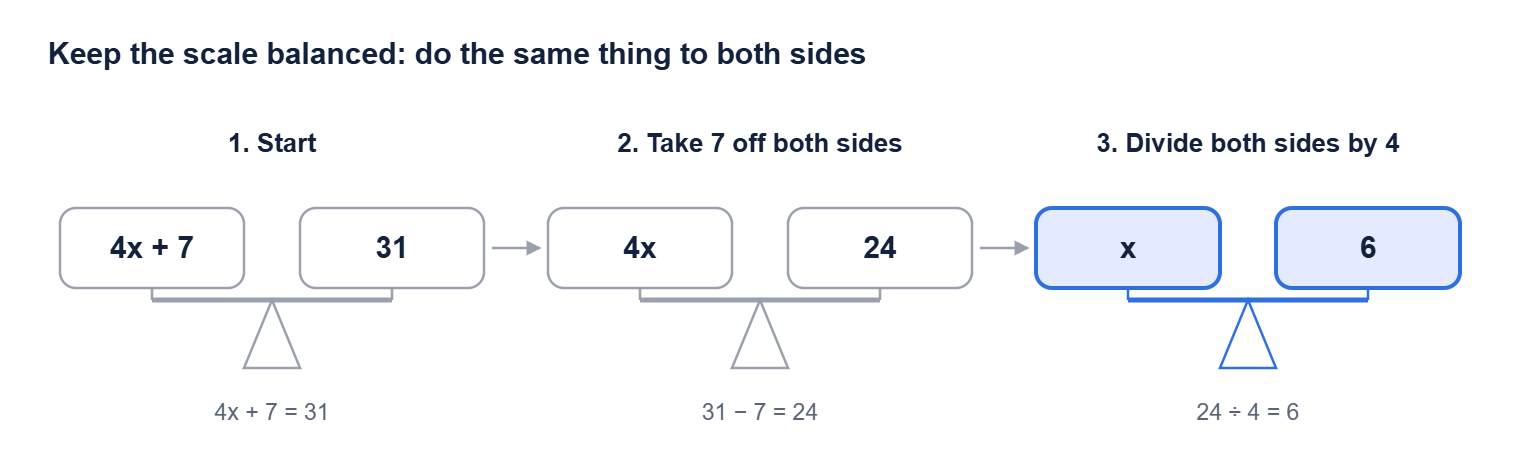
You solve an equation by undoing what was done to the variable, one step at a time, and doing exactly the same thing to both sides so the equation stays true. Picture a balance scale: if you take 7 grams off one pan, you have to take 7 grams off the other or it tips.
Here’s an example scenario. You buy 4 movie tickets online. Each ticket costs the same, the site adds a $7 booking fee, and the total is $31. What does one ticket cost?
Step 1: Turn the words into an equation
Let x be the price of one ticket. Four tickets cost 4x, the fee adds 7, and the total is 31: 4x + 7 = 31.
Step 2: Undo the addition
The last thing done to x was “add 7,” so undo it first by subtracting 7 from both sides: 4x + 7 − 7 = 31 − 7, which leaves 4x = 24.
Step 3: Undo the multiplication
Now x is multiplied by 4, so divide both sides by 4: 4x ÷ 4 = 24 ÷ 4, which gives x = 6. One ticket costs $6.
Step 4: Check your answer
Put 6 back into the original equation: 4 × 6 + 7 = 24 + 7 = 31. Both sides match, so the answer is right. This check takes ten seconds and catches most mistakes before your teacher does.
When Do You Learn Algebra, and What Comes Next?
In most US schools, algebra starts quietly in grade 6 and becomes its own course by grade 8 or 9. Under the Common Core standards that most states use or adapt, sixth graders already write expressions in which letters stand for numbers and solve one-step equations like x + p = q and px = q.
You can read the exact sixth-grade goals in the Common Core’s Expressions and Equations standards for grade 6.
After that, each course builds on the last. Exact grades vary by school and by student, so treat this as the usual order rather than a timetable.
| Stage | Typical grades (US) | What you learn |
|---|---|---|
| Early algebra (pre-algebra) | 6–7 | Variables, expressions, one-step equations, ratios |
| Algebra 1 | 8–9 | Two-step and multi-step equations, inequalities, straight-line graphs, simple systems of equations |
| Algebra 2 | 10–11 | Quadratics, exponents and logarithms, functions, polynomials |
| Precalculus and calculus | 11–12 and college | Using algebra to study change and motion |
| College algebra courses | University | Linear algebra (matrices, used in graphics and machine learning) and abstract algebra (the rules behind number systems) |
If you’re a parent, the skills that make a first algebra course easier are comfort with fractions, negative numbers and the order of operations, because every equation leans on them. Shore those up first and the letters feel much less scary. The free Fraction Calculator shows each step if fractions are the weak spot.
Common Algebra Mistakes and Myths
Most lost marks in a first algebra course come from a few small habits, not from not “getting” algebra. The table covers the six that teachers see most.
| Mistake or myth | What’s really true |
|---|---|
| “3x means 3 + x.” | A number touching a letter means multiply. If x = 5, then 3x = 15, not 8 or 35. |
| Doing a step to only one side | Every move must happen on both sides. Subtracting 7 from the left only breaks the balance and the answer. |
| “x² and 2x are the same.” | x² means x × x; 2x means x + x. When x = 5 they give 25 and 10. They only match when x is 0 or 2. |
| Losing a minus sign | In 10 − 2x = 4, subtracting 10 from both sides gives −2x = −6, so x = 3 (not −3). Write the sign every time. |
| “Algebra is just arithmetic with letters.” | The letters are the easy part. Algebra is a way of reasoning about general rules, which is why one formula can cover every case. |
| “I’ll never use algebra.” | Any time you set up a spreadsheet formula, scale a recipe or compare two price plans, you’re doing it, just without writing x. |
The fastest fix for nearly all of these is the ten-second check from Step 4: put your answer back into the original equation and see whether both sides really match.
Frequently Asked Questions
What is algebra in simple terms?
Algebra is math with letters standing in for numbers. Instead of only working with numbers you know, like 8 + 5, you work with ones you don’t know yet, like x + 5 = 13, and use the rules of arithmetic to find them. Here, x = 8.
Who invented algebra?
No single person invented it, but the name and the first full textbook come from Muhammad ibn Musa al-Khwarizmi, who wrote in Baghdad in the early 800s. Earlier Babylonian, Egyptian, Greek and Indian mathematicians solved similar problems, and François Viète and René Descartes later gave algebra the letter symbols we use today.
Why is algebra so hard for some students?
The hard part is usually the jump from specific numbers to general ones. Arithmetic always gives a single answer; algebra asks you to reason about a number you can’t see yet. Gaps in fractions, negatives or order of operations make it harder still. Most students find it clicks after enough short, regular practice with simple equations.
What is the difference between an expression and an equation?
An equation has an equals sign and an expression doesn’t. 2x + 3 is an expression: you can simplify it or work out its value when x is known, but you can’t solve it. 2x + 3 = 11 is an equation, and solving it gives x = 4.
Is algebra used in real jobs?
Yes. Nurses use it to work out dosages per kilogram, electricians use formulas linking voltage, current and resistance, and programmers write algebraic rules in nearly every line of code. Spreadsheet work in any office job is algebra with cell names in place of letters.
What should I learn before algebra?
Get comfortable with fractions, decimals, negative numbers and the order of operations (brackets first, then powers, multiplication and division, then addition and subtraction). If you can work out 3 × (4 − 6) + 10 ÷ 2 correctly (it’s −1), you’re ready to start.
The Short Version
- Algebra uses letters (variables) to stand for numbers that are unknown or that change.
- We use it to find missing numbers, write one rule for every case, and compare choices.
- The word comes from al-jabr, in a book written in Baghdad in the early 800s; the letter x arrived in 1637.
- Solve equations by undoing operations in reverse order, doing the same thing to both sides, then check.
- Most mistakes come from 3x vs. 3 + x, one-sided steps and lost minus signs.
Practice the basics with the free Math Quiz, make a deck of the key terms with the Flashcard Maker, and check tricky arithmetic on the Scientific Calculator. For more guides, browse our mathematics articles. If you enjoy the history side, the MacTutor archive’s page on the first symbols for variables is a good next read.
Disclaimer
This article is for general educational purposes only. Grade levels and course names vary by country, state and school, so check your own school’s math course sequence. For help with a specific class, talk to your math teacher or a qualified tutor.