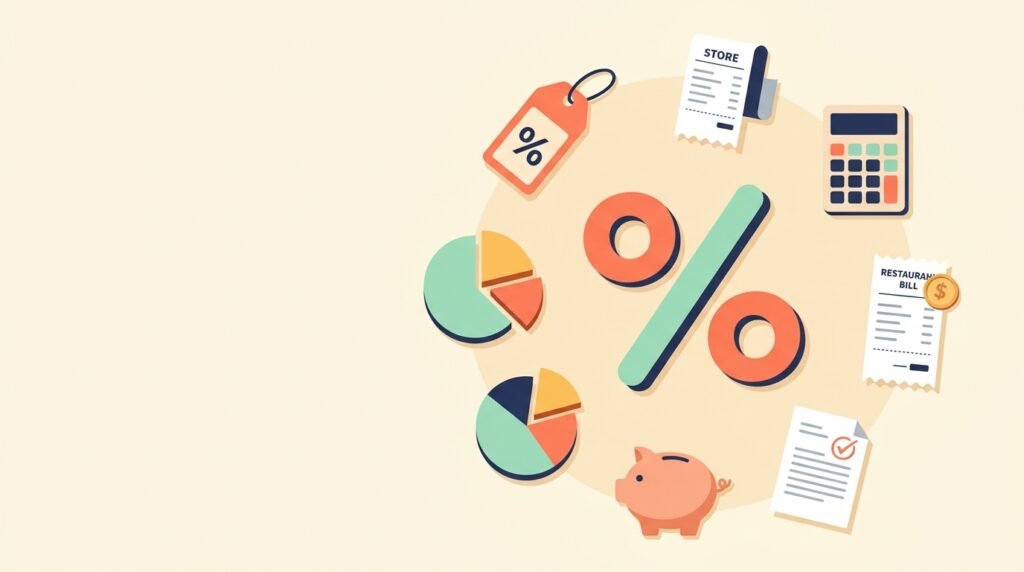
To find a percentage, divide the part by the whole and multiply by 100. That one rule is how to calculate percentages in real life, whether you’re checking a sale price, splitting a tip or working out the score you need on a final exam. Everything else is the same rule, rearranged, and it’s one of the simplest examples of how math describes our world.
The trouble is that real life rarely hands you a clean “what is 20% of 50?” question. A store adds an extra 10% off an item that’s already marked down. A news report says inflation rose from 3.4% to 3.7%. A soup can says one serving is 30% of your daily sodium. Each of those hides a small trap, and the traps are where most people get the wrong answer.
This guide gives you the formula, then walks through six everyday situations and a final-exam grade problem step by step, with the shortcuts that let you do most of them in your head. You’ll also see why a 50% loss needs a 100% gain to recover, and the five mistakes that trip up nearly everyone.
Quick answer
A percentage is a number out of 100. To find what percent one number is of another, divide the part by the whole and multiply by 100 (21 out of 28 is 21 ÷ 28 × 100 = 75%). To find a percent of a number, turn the percent into a decimal and multiply (15% of $64 is 0.15 × 64 = $9.60).
Key takeaways
- One formula does it all: percent = part ÷ whole × 100. Rearrange it to find the part or the whole.
- Percent change uses the starting value: (new − old) ÷ old × 100.
- Stacked discounts don’t add: 25% off plus an extra 10% off is 32.5% off, not 35%.
- Percent and percentage points differ: inflation going from 3.4% to 3.7% is a 0.3-point rise but an 8.8% increase.
- Start with 10%: move the decimal one place left, then build 5%, 15% or 20% from it.
What Is the Formula for Calculating a Percentage?
The formula is percent = (part ÷ whole) × 100. “Per cent” means “per hundred,” so a percentage simply tells you how many out of every 100. If 21 of the 28 students in a class pass a test, that’s 21 ÷ 28 = 0.75, and 0.75 × 100 = 75%. Out of every 100 students like these, 75 would pass.
The same formula answers three different questions, depending on which number is missing. Spotting which one you’ve been asked is half the work.
| You know | You want | Do this | Example |
|---|---|---|---|
| The part and the whole | The percent | part ÷ whole × 100 | 21 of 28 students passed: 21 ÷ 28 × 100 = 75% |
| The percent and the whole | The part | percent ÷ 100 × whole | 15% of $64: 0.15 × 64 = $9.60 |
| The part and the percent | The whole | part ÷ (percent ÷ 100) | 36 is 45% of what? 36 ÷ 0.45 = 80 |
Turning percents into decimals and fractions
To use a percent in a calculation, divide it by 100, which just means moving the decimal point two places left: 15% = 0.15, 7.25% = 0.0725, 150% = 1.5. Going the other way, multiply by 100: 0.375 = 37.5%.
A few fractions are worth knowing by heart, because they turn hard-looking percents into easy division: 50% = ½, 25% = ¼, 20% = ⅕, 10% = 1/10, and 33⅓% = ⅓. So 25% of 84 is just 84 ÷ 4 = 21. If fractions still feel shaky, the free Fraction Calculator shows the steps for converting them.
Can a percentage be more than 100%?
Yes, whenever the part is bigger than the whole you’re comparing it with. If your phone bill was $40 last year and is $60 now, the new bill is 60 ÷ 40 × 100 = 150% of the old one. What can’t go over 100% is a share of a single whole: you can’t eat 120% of a pizza or score 110% on a test marked out of 100 (unless there’s extra credit).
How Do You Calculate Percentage Increase and Decrease?
Subtract the old value from the new one, divide by the old value, and multiply by 100: percent change = (new − old) ÷ old × 100. A positive answer is an increase; a negative answer is a decrease.
- Increase: a monthly phone plan goes from $45 to $52.65. That’s (52.65 − 45) ÷ 45 × 100 = 7.65 ÷ 45 × 100 = 17%. The price rose 17%.
- Decrease: a monthly bus pass drops from $120 to $102. That’s (102 − 120) ÷ 120 × 100 = −15%. The price fell 15%.
The word that matters is old. People often divide by whichever number is bigger, and that gives the wrong answer for every decrease. If you’re unsure, ask yourself: “compared with what?” The answer is your starting value.
Percent vs. percentage points
When the thing that’s changing is already a percentage (an interest rate, a test pass rate, inflation), there are two honest ways to describe the change, and they give very different numbers.
Here is a real example. The US Bureau of Labor Statistics reported that prices rose 3.4% over the 12 months to August 2026, and 3.7% over the 12 months to September 2026.
You can read both figures in the BLS Consumer Price Index release for September 2026.
- The percentage-point change is a simple subtraction: 3.7 − 3.4 = 0.3 percentage points.
- The percent change uses the formula: 0.3 ÷ 3.4 × 100 = about 8.8%.
Both statements are true. A headline that says inflation “jumped almost 9%” and one that says it “rose 0.3 points” are describing the same numbers, so check which one you’re reading.
Working backward: finding the original number
Sometimes you know the final amount and the percent, and you need the starting value. Your receipt says $48.60 including 8% sales tax, and you want the price before tax. The tempting move, taking 8% off $48.60, is wrong because the 8% was calculated on the smaller, pre-tax price.
Instead, divide by the multiplier. Adding 8% means multiplying by 1.08, so undo it by dividing: 48.60 ÷ 1.08 = $45.00. The same trick works for discounts: a jacket that costs $51 after 25% off was $51 ÷ 0.75 = $68 originally.
Percentages in Real Life: 6 Everyday Calculations
In real life, almost every percentage problem is one of the three types above in disguise. The prices and rates below are example scenarios, chosen to show the method; swap in your own numbers.
1. Shopping: stacked discounts
A hoodie is $68, marked 25% off, and the store offers an extra 10% off at the register. It looks like 35% off. It isn’t.
Each discount applies to the price left after the one before it. First: 68 × 0.75 = $51. Then: 51 × 0.90 = $45.90. You paid 45.90 ÷ 68 = 67.5% of the original, so the real discount is 32.5%. The order doesn’t matter (10% first gives the same $45.90), but adding the percents together always overstates the savings.
2. Sales tax at the register
Tax is a percent of the price, added on top. With an example tax rate of 7.25% on a $36 purchase: 36 × 0.0725 = $2.61 in tax, so you pay $38.61. The faster way is to multiply by 1 plus the rate in one step: 36 × 1.0725 = $38.61. Rates vary by state and city, so check your local rate.
3. Tipping at a restaurant
For an 18% tip on a $47.50 bill, find 10% first by moving the decimal: $4.75. Then 20% is double that, $9.50, and 18% is a little less: 47.50 × 0.18 = $8.55. Most people round to $8.50 or $9, and that’s fine. Tip on the pre-tax total if you want to be precise.
4. Reading a nutrition label
The “% Daily Value” column on a US food label is a percentage you can check yourself. The FDA sets the Daily Value for sodium at less than 2,300 mg a day, and says 5% DV or less per serving is low while 20% DV or more is high.
The FDA explains these cutoffs on its page about using the label to cut sodium.
So a serving of soup with 690 mg of sodium is 690 ÷ 2,300 × 100 = 30% DV, which counts as high. Two servings would be 60% of a whole day’s limit in one bowl.
5. Savings and interest
Put $1,500 in a savings account that pays an example rate of 4% a year, and the first year earns 1,500 × 0.04 = $60. Leave it alone and the interest earns interest too. After three years you have 1,500 × 1.04 × 1.04 × 1.04 = $1,687.30, not $1,680, because years two and three are calculated on a bigger balance.
6. Comparing two deals
One store sells notebooks at 30% off; another offers “buy 2, get 1 free.” Turn the second deal into a percent: you get 3 notebooks for the price of 2, so you pay 2 ÷ 3 = 66.7% and save 33.3% per notebook. The free-item deal wins, but only if you actually need three.
Worked Example: What Score Do You Need on Your Final Exam?
This is the percentage problem students ask about most, and it’s a weighted average. Here’s an example scenario: your course grade is 30% homework, 30% midterm and 40% final exam. You have 88% on homework and 74% on the midterm. What do you need on the final to finish with 80%?
Step 1: Turn each weight into a decimal
30% = 0.30, 30% = 0.30, and 40% = 0.40. They must add up to 1.00, or 100%.
Step 2: Work out the points you already have
Homework adds 0.30 × 88 = 26.4 points. The midterm adds 0.30 × 74 = 22.2 points. Together that’s 48.6 points out of the 80 you want.
Step 3: Find the points the final has to supply
You need 80 − 48.6 = 31.4 more points, and the final is worth 0.40 of the grade.
Step 4: Divide by the final’s weight
31.4 ÷ 0.40 = 78.5%. Score 78.5% or better on the final and you finish with at least 80%. To check: 26.4 + 22.2 + (0.40 × 78.5) = 26.4 + 22.2 + 31.4 = 80.
The free Grade Calculator does this for any number of weighted parts, and the GPA Calculator turns the finished grades into a semester GPA.
How Can You Calculate Percentages in Your Head?
Start from 10% and build everything else from it. To find 10% of any number, move the decimal point one place to the left: 10% of $47.50 is $4.75, and 10% of 860 is 86. From there, most everyday percents take one or two quick steps.
| To find | Mental step | Example with $64 |
|---|---|---|
| 10% | Move the decimal one place left | $6.40 |
| 1% | Move the decimal two places left | $0.64 |
| 5% | Half of 10% | $3.20 |
| 15% | 10% + 5% | $6.40 + $3.20 = $9.60 |
| 20% | 10% × 2 | $12.80 |
| 25% | Divide by 4 | $16.00 |
| 50% | Divide by 2 | $32.00 |
| 3% | 1% × 3 | $1.92 |
The swap trick
x% of y always equals y% of x, because both are just x × y ÷ 100. So when one way round is awkward, flip it. 8% of 25 sounds hard, but 25% of 8 is a quarter of 8, which is 2. 4% of 75 becomes 75% of 4, which is 3.
Estimate first, then check
Before you trust a calculator, round the numbers and guess. 18% of $47.50 is a bit less than 20% of $50, so the answer should be a bit under $10. If the calculator says $85.50, you hit a wrong key. That habit catches most mistakes in under five seconds.
Want to drill these until they’re automatic? The free Math Quiz mixes mental-math questions with number facts, and you can keep your own percent shortcuts in a deck with the Flashcard Maker.
Why Does a 50% Drop Need a 100% Gain to Recover?
A 50% drop needs a 100% gain because the gain is measured from the new, smaller amount. If $200 falls 50%, you have $100. Getting back to $200 means adding another $100, and $100 is 100% of $100. The same thing happens with savings, prices, test averages and anything else that falls and climbs back.

Small drops barely matter: a 10% fall needs only an 11% gain. Past about 40%, the gain you need climbs steeply, and a 75% drop needs the amount to quadruple (a 300% gain). The rule behind every bar is gain needed = drop ÷ (100 − drop) × 100.
It works in reverse, too. Raise a price 25% and then cut it 25%, and you don’t land where you started: 100 × 1.25 × 0.75 = 93.75, so you end up 6.25% lower. The Percentage Calculator has a percent-change mode if you want to test a few of these yourself.
Common Percentage Mistakes (and the Fix for Each)
Nearly every wrong percentage answer comes from using the wrong starting number. The five mix-ups below cause most of them.
| Mistake | What’s really true |
|---|---|
| “25% off, then 10% off, is 35% off.” | Discounts multiply, they don’t add: 0.75 × 0.90 = 0.675, so it’s 32.5% off. |
| “Up 20%, then down 20%, gets you back to where you started.” | You end at 1.2 × 0.8 = 0.96, or 4% below the start, because the drop is taken from a bigger number. |
| “To remove 8% tax, take 8% off the total.” | Divide by 1.08 instead. Taking 8% off $48.60 gives $44.71, but the real pre-tax price is $45.00. |
| “Inflation going from 3.4% to 3.7% is a 0.3% increase.” | It’s a rise of 0.3 percentage points, which is an 8.8% increase in the rate. |
| “A percentage can never be more than 100%.” | Comparisons can: a price that triples is 300% of the original, a 200% increase. |
The inflation figures in row four come from the BLS releases for August 2026 and September 2026, linked in the Sources below.
Frequently Asked Questions
How do I calculate the percentage of marks?
Divide the marks you scored by the total marks and multiply by 100. If you scored 67 out of 80, that’s 67 ÷ 80 = 0.8375, and 0.8375 × 100 = 83.75%, which most teachers round to 84%. For a grade made of weighted parts, multiply each part by its weight first, as in the final-exam example above.
How do I find a percentage on a calculator?
Type the part, press ÷, type the whole, press =, then multiply by 100. For 67 out of 80: 67 ÷ 80 = 0.8375, × 100 = 83.75. To find a percent of a number, type the number × the percent as a decimal (240 × 0.15 = 36). The % key works differently on different calculators, so the decimal method is the safest.
What is 20% of 50?
20% of 50 is 10. Find 10% first by moving the decimal one place left (5), then double it. You can also multiply directly: 0.20 × 50 = 10. Questions like this are the “find the part” type: percent ÷ 100 × whole.
How do you calculate a percentage between two numbers?
It depends on what you’re asking. To see what percent A is of B, divide A by B and multiply by 100. To see how much something changed from A to B, use (B − A) ÷ A × 100. Going from 40 to 50 is a 25% increase, but 40 is 80% of 50.
How do I work out a discount percentage from two prices?
Subtract the sale price from the original price, divide by the original price, and multiply by 100. A $90 pair of shoes on sale for $63 has a $27 discount: 27 ÷ 90 × 100 = 30% off. Always divide by the original price, not the sale price.
Why is a 50% loss so hard to recover from?
Because the recovery is measured from the smaller number. If $200 drops 50% to $100, getting back to $200 means gaining $100 on a base of $100, which is a 100% gain. The chart above shows how the gain you need grows much faster than the loss.
The Short Version
- Percent = part ÷ whole × 100. Rearrange it to find the part (multiply) or the whole (divide).
- Percent change = (new − old) ÷ old × 100, always measured from the starting value.
- Discounts and changes stack by multiplying, not adding: 25% off plus 10% off is 32.5% off.
- A percentage-point change and a percent change are different; say which one you mean.
- For mental math, start at 10% and build up, or use the swap trick (8% of 25 = 25% of 8).
Check your answers with the free Percentage Calculator, which handles marks, percent of, and percent change, then test yourself with the Math Quiz. For more guides like this, browse our mathematics articles, and if you’re preparing for a test, pair this with our tips on how to study effectively. For real-world practice, the FDA’s guide to the % Daily Value on food labels is a good place to read percentages you’ll see every day.
Disclaimer
This article is for general educational purposes only. Prices, tax rates and interest rates in the examples are illustrations, not current offers or financial advice. For grades, follow your teacher’s or school’s rounding and weighting rules.