
You were born with dozens more bones than you have today. Over the first couple of decades of life, many of them quietly join together, and the total settles at a number every anatomy student learns.
So, how many bones are in the human body? An adult has 206. A newborn has roughly 270 to 300, depending on the source, because many bones start as separate pieces and fuse as a child grows. If you have seen “206 to 213” somewhere, that range comes from how different sources count a few small, variable bones.
This guide counts the skeleton region by region so the numbers add up to 206, shows which bones fuse after birth, explains why sources disagree, and covers the five bone shapes, the biggest and smallest bones, and five common mix-ups. It ends with memory hooks for exams.
Quick answer
An adult human skeleton has 206 bones: 80 in the axial skeleton (skull, spine and rib cage) and 126 in the appendicular skeleton (the arms, legs and the girdles that attach them). Babies are born with about 270 to 300 bones, and growth fuses many of them together.
Key takeaways
- The number: 206 bones in a typical adult, split into 80 axial and 126 appendicular.
- Babies have more: about 270 to 300 at birth, and the spine alone loses seven bones to fusion (33 vertebrae at birth, 26 spine bones in adults).
- Hands and feet: together they hold 106 bones, a little more than half the skeleton.
- Counts vary: extra ribs and small sesamoid bones differ from person to person, which is why some sources say 206 to 213.
- Extremes: the thigh bone (femur) is the largest bone, and the stirrup bone (stapes) in the middle ear is the smallest.
How Many Bones Does an Adult Have?
An adult has 206 bones. Anatomists sort them into two groups: the axial skeleton, which forms the central line of the body, and the appendicular skeleton, which holds the limbs and the girdles that attach them. he diagram below splits the 206 into eight regions.
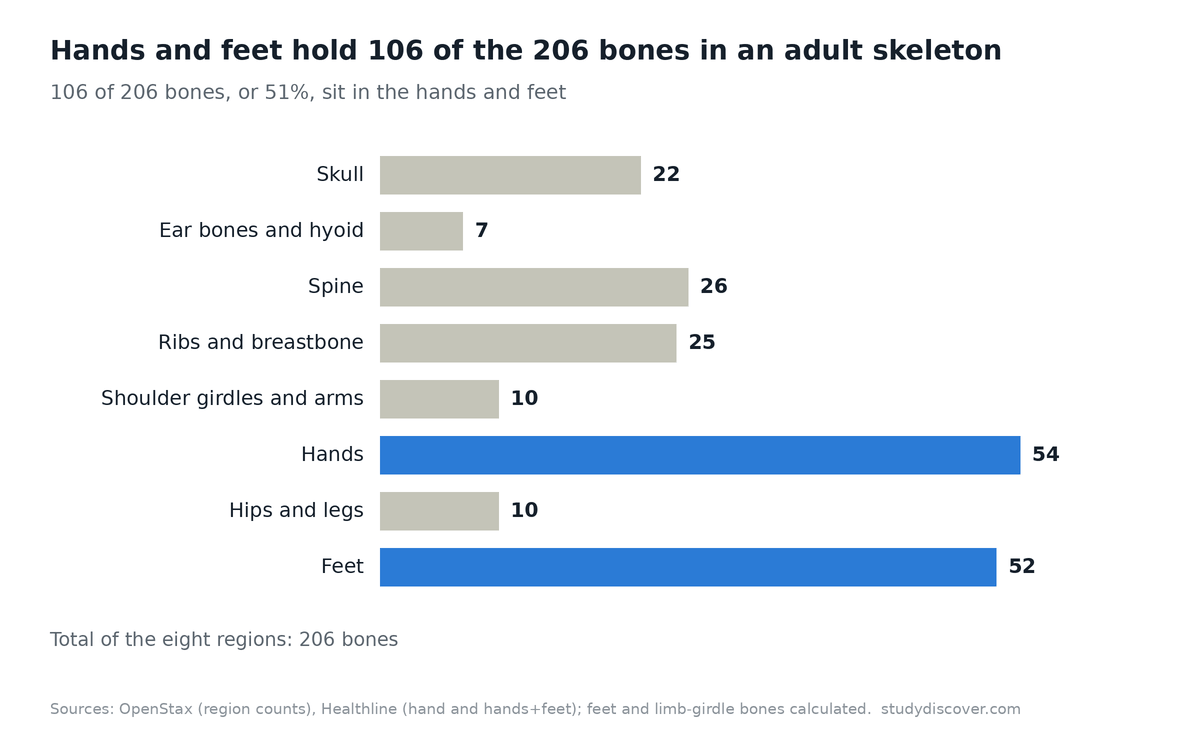
Hands and feet are the surprise. Between them they hold 106 bones, so a little more than half of your skeleton sits in the parts you use to grip, stand and walk. For the bigger picture of how the skeleton fits in with the rest of you, see our guide to how the human body works.
Axial skeleton: 80 bones
The axial skeleton is the head, neck and trunk. The skull has 22 bones (8 around the human brain and 14 in the face). Each middle ear holds three tiny bones, so six in total, and the hyoid is a U-shaped bone in the throat. The spine has 24 separate vertebrae plus the sacrum and the coccyx (tailbone), which makes 26. The chest has 12 pairs of ribs (24) and the breastbone. In sum: 22 + 6 + 1 + 26 + 24 + 1 = 80.
Appendicular skeleton: 126 bones
The appendicular skeleton is the limbs plus the bones that connect them to the trunk. Each hand has 27 bones, so 54 for both. The hands and feet together have 106, which leaves 52 for the feet (26 each). The last 20 bones are the collarbones and shoulder blades (4), the upper-arm and forearm bones (6), the two hip bones (2) and the thigh, kneecap, shin and calf bones (8). The check: 54 + 52 + 20 = 126.
The 80 and 126 totals, the 22-bone skull and the 24 ribs come from OpenStax’s chapter on the divisions of the skeletal system.
The split of the skull into 8 brain-case and 14 facial bones, and the vertebra counts, are in the OpenStax Chapter 7 review.
The 27-bone hand is stated in Healthline’s article on how many bones a baby has.
The 106 bones in the hands and feet are stated in Healthline’s 15 fun facts about the skeletal system. The feet figure and the 20 limb-girdle bones are our own subtraction from those numbers, so treat the foot count as calculated, not quoted.
How Many Bones Does a Baby Have?
A newborn has roughly 270 to 300 bones, depending on the source. OpenStax gives 270 to 300, Healthline says about 300, and Cleveland Clinic says about 270. Part of the gap is likely that some of a baby’s bones are still partly cartilage, so sources may not classify every piece the same way.
Bones begin to form around the eighth week of development before birth. After that, separate pieces join. The process is slow: growth typically ends by about age 25, which is when the last fusing finishes.
| What fuses | At birth | In an adult |
|---|---|---|
| Vertebrae in the spine | 33 | 24 vertebrae, plus the sacrum and coccyx (26 spine bones) |
| Sacrum | 5 separate sacral vertebrae | 1 bone |
| Coccyx (tailbone) | 4 separate vertebrae | 1 bone |
| Skull | Soft gaps called fontanelles between bones | Gaps close and the skull is rigid |
| Whole skeleton | About 270 to 300 bones | 206 bones |
The spine alone accounts for 7 of the lost bones (33 minus 26). The full drop is 64 to 94 bones (270 minus 206, or 300 minus 206), so many other bones around the body join up too. The sources we opened do not list every one, and we will not guess at them here.
The 270 to 300 range and the point about cartilage come from OpenStax’s page on bone classification.
The 33 vertebrae at birth and the sacrum and coccyx details are in the OpenStax Chapter 7 review.
The eighth-week start of bone formation and the closing of the soft spots are described in Healthline’s baby bones article, and Cleveland Clinic’s bones page gives the figure of about 270.
The age-25 point is from Live Science’s guide to the human skeletal system.
Why Do Some Sources Say 206 to 213 Bones?
Because 206 is the textbook count for a typical adult, and a few bones either vary between people or are left out of it. Cleveland Clinic’s bones page gives the range 206 to 213 without explaining it. These are the usual suspects.
| What changes the count | Effect |
|---|---|
| Sesamoid bones | Small, round bones that grow inside tendons, mostly in the hands, feet and knees. Their number and position vary from person to person. Only the kneecaps are present in everyone, and the standard 206 leaves the variable ones out. |
| Teeth | Not counted among the 206 bones. |
| A 13th rib | Most people have 12 pairs of ribs. A 13th (cervical) rib turns up in about 1% of people. |
| Fused bones | The sacrum and coccyx are each counted as one bone, even though they began as 5 and 4 pieces. |
Printed numbers do not always agree with themselves, either. A 2008 review from Mayo Clinic’s endocrinology division states 213 bones excluding sesamoids, yet it breaks the skeleton into 126 appendicular, 74 axial and 6 ear bones, which adds up to 206. That is one reason this guide counts region by region, so you can check every step.
For exams, learn 206. If a question asks why a source shows a higher number, the answer is variable bones such as sesamoids and extra ribs.
The point that 206 excludes teeth and sesamoid bones is in Johns Hopkins Medicine’s page on the anatomy of the bone.
The sesamoid variation and the kneecap exception are described in OpenStax’s bone classification page.
The 13th-rib figure of about 1% comes from Healthline’s fun facts about the skeletal system.
The 213 and 74 + 126 + 6 figures are in Clarke’s review, Normal Bone Anatomy and Physiology, published in the Clinical Journal of the American Society of Nephrology in 2008.
What Are the Five Types of Bones?
Bones are sorted by shape into five types: long, short, flat, irregular and sesamoid. The shape tells you the bone’s job.
| Type | Examples | What the shape does |
|---|---|---|
| Long | Femur, humerus, radius, ulna, tibia, fibula, finger and toe bones | Work as levers when muscles pull on them |
| Short | Wrist bones (carpals), ankle bones (tarsals) | Give stability and support with a little movement |
| Flat | Skull bones, shoulder blades, breastbone, ribs | Protect organs and give muscles a wide surface to attach to |
| Irregular | Vertebrae, many face bones | Complex shapes; vertebrae protect the spinal cord |
| Sesamoid | Kneecaps (patellae) | Form in tendons under pressure and help them resist compression |
“Long” describes shape, not size. A finger bone is a long bone because it is longer than it is wide, even though it is tiny.
The five types, their examples and jobs follow OpenStax’s page on bone classification.
Which Bone Is the Largest and Which Is the Smallest?
The femur (thigh bone) is the largest bone, and the stapes in the middle ear is the smallest. The gap between them is huge: a typical adult femur is nearly 20 inches (50 cm) long, while the stapes measures about 0.1 inch (roughly 3 mm).
| Record | Bone | Key fact |
|---|---|---|
| Largest and longest | Femur | Nearly 20 inches (50 cm) in a typical adult |
| Strongest | Femur | Can support up to 30 times body weight, according to Cleveland Clinic |
| Smallest | Stapes (stirrup) | About 2.6 to 3.4 mm long and 2 to 4.3 mg in weight |
| Not joined to another bone | Hyoid | The U-shaped bone in the throat |
| Present in every person | Kneecap (patella) | The one sesamoid bone everyone has |
The stapes is one of three ear bones, with the malleus and incus, and the three together are about the size of an orange seed.
The femur length and the stapes size and weight are reported in Live Science’s largest and smallest bone article, published August 16, 2022.
The strength figure is on Cleveland Clinic’s bones page, last updated October 17, 2025.
The hyoid fact is stated in the OpenStax Chapter 9 introduction.
Are Bones Alive and Do They Keep Changing?
Yes. Bone is living tissue, and your skeleton keeps rebuilding itself long after the fusing is done. Channels in the bone carry blood to it, and cells called osteoblasts build new bone while osteoclasts break old bone down.
A 2008 review puts the yearly turnover of adult cortical (outer, dense) bone at 2 to 3%, and says this remodeling continues until death. Inside many bones, marrow makes blood cells. In an adult it is roughly half red marrow, which makes blood cells, and half yellow marrow, which is mostly fat. A baby’s marrow is all red. Healthline also notes that bones make up about 15% of an adult’s body weight.
The living-tissue description and the bone cell types are from Johns Hopkins Medicine’s anatomy of the bone page.
The turnover rate is in Clarke’s Normal Bone Anatomy and Physiology, and the marrow split is in Live Science’s skeletal system guide.
The 15% of body weight figure is from Healthline’s baby bones article.
How Can You Remember the Bone Counts?
Break 206 into chunks that add up, and learn each chunk with a small hook. The table uses only the counts from this guide. The hooks are memory aids written for this article, not facts from a source.
| Number | What it counts | Memory hook |
|---|---|---|
| 206 | Adult skeleton | The total every other number must add up to |
| 80 + 126 | Axial + appendicular | Trunk first (80), limbs second (126) |
| 22 | Skull | 8 around the brain + 14 in the face |
| 24 | Ribs | A dozen pairs |
| 26 | Spine | 24 vertebrae + sacrum + coccyx |
| 54 + 52 | Hands + feet | 27 in each hand, 26 in each foot |
To practice, turn the table into cards with the Flashcard Maker, then test yourself with the Science Quiz. Our guide on how to study effectively shows how to set that routine up. Bones are one part of a larger system, so for the bigger picture read our guide to how the human body works.
Common Mix-Ups About Human Bones
Five popular ideas about the skeleton are only partly true.
| Myth | Reality |
|---|---|
| Everyone has exactly 206 bones. | 206 is the standard adult count. Sesamoid bones vary, and about 1% of people have a 13th rib. |
| Babies have the same bones as adults, only smaller. | Babies have about 270 to 300, including 33 vertebrae against 26 spine bones in an adult. |
| Hands and feet are small, so they hold few bones. | They hold 106 of the 206 bones. |
| Bones are dry, dead scaffolding. | Bone is living tissue that rebuilds itself throughout life. |
| The smallest bone is in a finger or toe. | It is the stapes, deep in the middle ear. |
Frequently Asked Questions
How many bones are in the hands and feet?
Each hand has 27 bones, so both hands have 54. Hands and feet together hold 106, which leaves 52 for the feet, or 26 per foot (found by subtraction). That is a little more than half of the 206 bones in an adult skeleton, even though hands and feet are a small part of the body’s size.
How many bones are in the human skull?
The skull has 22 bones: 8 that surround the brain and 14 in the face. Each middle ear adds three tiny bones, and the hyoid sits in the throat. Some pages count those with the head, which gives 29 head bones. This guide counts the ear bones and hyoid separately, so the skull itself stays at 22.
How many ribs do humans have?
Most people have 12 pairs, or 24 ribs. The top seven pairs are true ribs, and the lower five pairs are false ribs, the last two of which are floating ribs. About 1% of people have an extra 13th (cervical) rib, so 24 is typical rather than universal.
How many bones are in the spine?
An adult spine has 26 bones: 24 separate vertebrae (7 cervical, 12 thoracic and 5 lumbar), plus the sacrum and the coccyx. Babies have 33 because the sacrum starts as 5 vertebrae and the coccyx as 4, and these join during growth.
Are teeth counted as bones?
No. The standard count of 206 leaves out teeth and the variable sesamoid bones. Healthline notes that tooth enamel is even stronger than bone, but teeth still sit outside the 206-bone total.
The skull, rib and vertebra counts in these answers come from the OpenStax Chapter 7 review, and the 29-bone head count is listed on Britannica’s page on the axial skeleton.
The enamel comparison and the 13th-rib figure are in Healthline’s fun facts about the skeletal system.
The Short Version
- An adult has 206 bones: 80 in the axial skeleton and 126 in the appendicular skeleton.
- Babies have about 270 to 300, and the spine alone loses seven bones to fusion (33 at birth, 26 in adults).
- Hands and feet hold 106 bones, a little more than half the skeleton.
- Sources say 206 to 213 because sesamoid bones and extra ribs vary between people.
- The femur is the largest bone, the stapes is the smallest, and bone stays alive and keeps remodeling for life.
To check what you remember, try the Science Quiz, and browse the Science category for more guides like this one.
For a medically reviewed overview, see Cleveland Clinic’s bones page.
Disclaimer
This article is for general educational purposes only. Bone counts differ slightly between people and between sources, and the foot and limb-girdle figures here are calculated from published numbers. It is not medical advice, so for questions about a fracture, bone pain or your bone health, consult a doctor or another qualified healthcare professional.