
Your brain weighs about 3 pounds, yet it burns roughly one in every five calories your body uses. Behind that appetite are about 86 billion nerve cells that never stop passing messages.
So, how does the human brain work? It works by sending electrical and chemical signals between nerve cells called neurons. Different regions take different jobs, such as vision, balance, memory and breathing, and they trade messages constantly, so no single spot runs the show.
This guide covers the parts of the brain, how neurons talk to each other, and how one signal travels from a stubbed toe to your reaction. It also looks at where the energy goes, how learning and sleep change the brain (useful if you study for exams), and five popular brain myths set straight with checked numbers. The brain is one part of a bigger system, so for the full picture, see our guide to how the human body works.
Quick answer
The brain is a network of about 86 billion neurons. Each neuron receives signals, passes them down its axon, and hands them to the next cell across a tiny gap called a synapse. The cerebrum, cerebellum and brainstem split the work, and connections strengthen with use, which is how you learn.
Key takeaways
- Three main parts: the cerebrum handles thinking, senses and voluntary movement, the cerebellum handles balance and coordination, and the brainstem handles breathing and heart rate.
- Two kinds of signal: neurons send electrical impulses along their axons and chemical messengers across synapses.
- Size misleads: the cerebellum is only about 11% of brain weight but holds roughly four-fifths of the neurons.
- A costly organ: the brain is about 2% of body weight and uses about 20% of your energy.
- Learning is physical: practice strengthens connections between neurons, and sleep helps tie new facts together.
How Is the Human Brain Built?
The brain has three main parts, the cerebrum, the cerebellum and the brainstem, and together they weigh about 3 pounds (1.4 kg) in an adult. A newborn’s brain weighs roughly 1 pound, so most of the growth happens after birth.
| Part | Main jobs | A fact worth knowing |
|---|---|---|
| Cerebrum | Thinking, senses, language, memory, voluntary movement | About two-thirds of brain mass, split into two halves (hemispheres) |
| Cerebellum | Balance and smooth, coordinated movement | About 11% of brain weight, but about 69 billion of the 86 billion neurons |
| Brainstem | Breathing, heart rate and sleep | Connects the brain to the spinal cord |
| Hypothalamus | Helps manage eating and sleeping | Sits deep inside the brain, below the cerebrum’s surface |
| Hippocampus | Forming new long-term memories | Also deep inside, part of the limbic system |
The cerebellum is the surprise in that table. Judged by weight it looks like a minor add-on, yet it holds about four-fifths of all your neurons, which fits its job of coordinating movement and balance.
Why the cortex is wrinkled
The cerebrum’s outer layer is the cerebral cortex, a sheet of nerve tissue only 2 to 4 mm thick (about the thickness of a stack of two or three coins). It has six layers and holds 14 to 16 billion neurons. Folding it into ridges and grooves packs far more surface area into the skull, so more nerve cells fit.
Two halves, one connection
The left and right hemispheres mostly handle the opposite side of the body: the left hemisphere controls the right side, and the right controls the left. A thick bundle of about 200 million nerve fibers, the corpus callosum, links the two halves so they can share information.
Gray matter and white matter
Gray matter is the cortex: neuron cell bodies and their receiving branches. It looks gray because it lacks myelin, a fatty wrapping. White matter lies underneath and is made of bundles of axons, the long cables of neurons, which myelin wraps and turns whitish.
The weight, neuron and lobe figures in this section come from Cleveland Clinic’s page on the brain.
The cortex thickness, layers and gray and white matter details come from Cleveland Clinic’s page on the cerebral cortex.
The cerebellum’s share of weight and neurons, and the corpus callosum count, are reported in Simply Psychology’s guide to the parts of the brain, which credits Herculano-Houzel (2009) for the neuron counts.
Mayo Clinic’s article on how your brain works supports the brainstem, cerebellum and inner-brain jobs listed above.
What Are Brain Cells and How Do Neurons Send Signals?
The brain’s signaling cells are neurons, and each one passes a message in two stages: an electrical impulse along its axon, then a chemical handoff across a gap called a synapse. A second group, the glial cells, supports the neurons and is just as numerous.
| Part of a neuron | What it does |
|---|---|
| Dendrites | Short, branching receivers that collect incoming signals from other cells |
| Cell body (soma) | Holds the nucleus and keeps the cell alive |
| Axon | A long fiber that carries the outgoing impulse away from the cell body |
| Myelin | A fatty wrapping (about 80% lipid and 20% protein) around many axons |
| Axon terminals | Release chemical messengers at the synapse |
Myelin has small gaps in it, called nodes of Ranvier. In the brain and spinal cord, glial cells named oligodendrocytes build the myelin. In nerves outside them, Schwann cells do the job.
How does a signal pass from one neuron to the next?
Here is the handoff in four steps, like a relay race where the baton is a chemical.
- Receive. Dendrites pick up signals from neighboring neurons.
- Fire. The cell generates a nerve impulse at the start of its axon, called the axon hillock, and the impulse runs down the axon.
- Release. Axon terminals let go of neurotransmitters, chemical messengers stored in tiny packages called vesicles.
- Bind. The neurotransmitters drift across the synaptic cleft and attach to receptors on the next cell, which passes the message on.
Each neuron makes thousands of such connections, and researchers estimate the brain holds more than 100 trillion synapses. That web is what lets one thought trigger another.
What do glial cells do?
Glial cells have no axons and do not form synapses. Oligodendrocytes, one type, build the myelin that wraps axons, and glial cells in general help maintain the brain and keep the ability to divide throughout life. Current estimates put them at roughly one glial cell for every neuron, not the ten-to-one ratio that older references repeat.
The neuron parts, myelin figures and synapse steps follow Britannica’s entry on the nervous system and the axon.
The 86 billion neuron count and the one-to-one glia estimate come from Cleveland Clinic’s brain overview.
The estimate of thousands of connections per neuron appears in Encephalitis International’s guide on how the brain works.
The figure of more than 100 trillion synapses comes from the Australian Institute of Policy and Science article on why brains are so energy hungry.
How Does the Brain Control the Body?
The brain controls the body by collecting signals from your senses, working out a response in specialized regions, and sending commands back out through nerves to muscles and organs. Each half of the cerebrum has four lobes, and each lobe has its own main jobs.
| Lobe | Handles |
|---|---|
| Frontal | Decision-making, problem-solving, attention, personality, speech production and body movement |
| Parietal | Touch, pressure, pain, temperature and a sense of where you are in space |
| Temporal | Hearing, language comprehension, learning and memory |
| Occipital | Vision: color, motion, depth, and recognizing objects and faces |
These labels are a guide, not walls. Most everyday tasks use several lobes at once, which is why the next example needs almost the whole brain.
What happens when you stub your toe?
One small accident sends a signal through six steps. The drawing below follows it from your skin to your muscles.
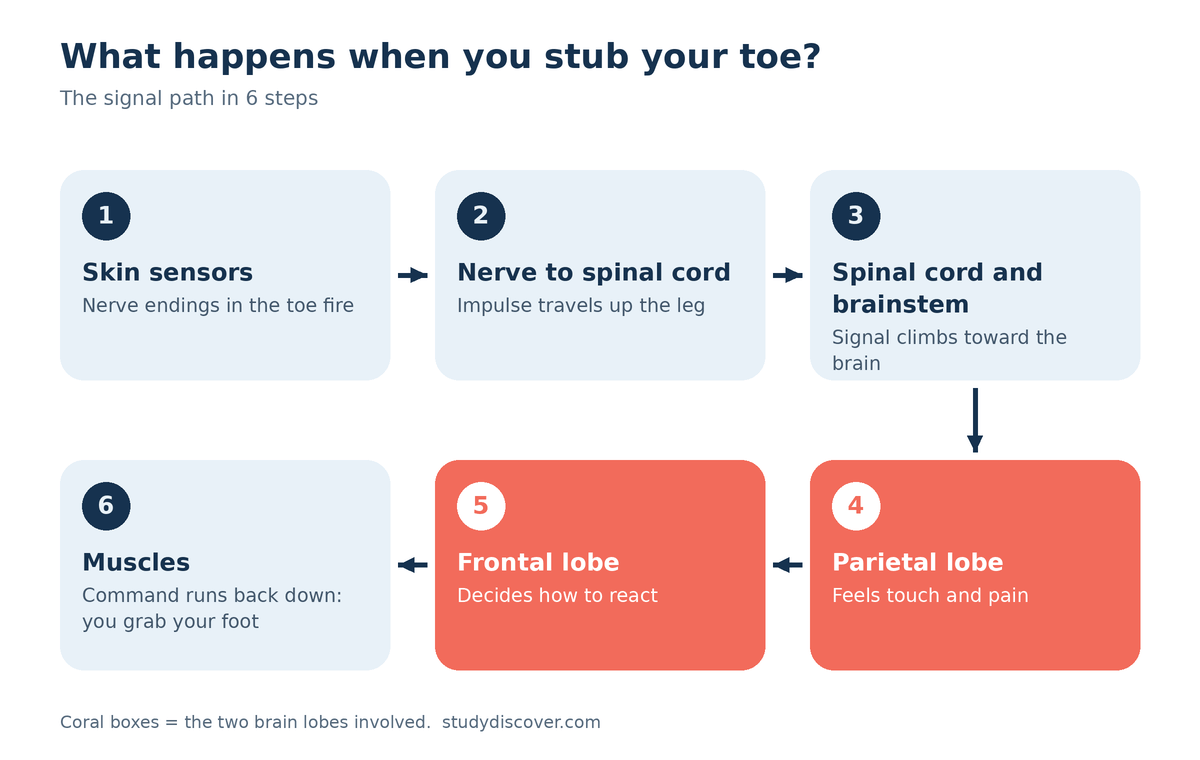
The spinal cord, about 18 inches long, carries messages between the brain and the rest of the body, so every signal on this trip passes through it twice: once on the way up and once on the way back down. Because each hemisphere mostly serves the opposite side of the body, a stubbed left toe is felt mainly in the right hemisphere.
What does the brain run without you noticing?
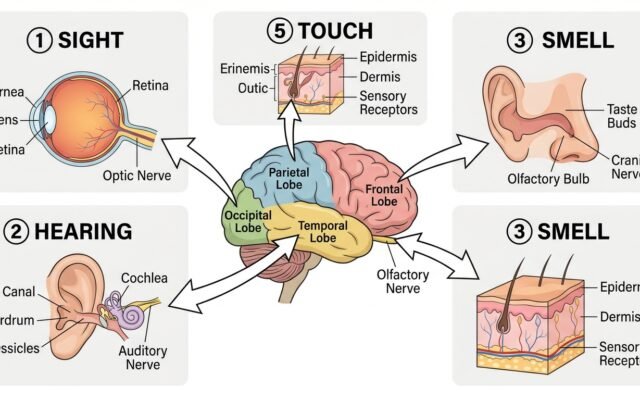
Much of the control happens with no effort from you. The brainstem keeps your breathing and heart rate going and takes part in sleep, and the hypothalamus helps manage eating and sleeping. Your five senses work the same way: each one turns light, sound waves, chemicals or pressure into nerve signals that travel to the brain for processing.
The lobe jobs come from Cleveland Clinic’s article on the cerebral cortex.
The spinal cord length and the way senses reach the brain are described in KidsHealth’s guide to the brain and nervous system.
The opposite-side rule for the hemispheres is stated in Britannica’s entry on the brain.
How Much Energy Does the Brain Use?
The brain is about 2% of your body weight but uses about 20% of your energy, roughly one calorie in every five. In a resting adult that works out to around 300 to 340 kilocalories a day, or a steady 15 to 16 watts.
The table below uses organ masses and energy rates from a published model of resting energy use (Wang et al., PubMed Central). The kilocalories and watts are calculated here from the paper’s printed numbers, so treat them as model estimates for average adults, not measurements of one person.
| Measure | Men | Women |
|---|---|---|
| Brain mass | 1.40 kg | 1.26 kg |
| Brain share of body mass | about 1.7% | about 1.9% |
| Brain energy use per day | about 336 kcal | about 302 kcal |
| Brain share of resting energy | about 18.8% | about 21.5% |
Most of that energy goes to signaling. After every impulse, neurons run chemical pumps to reset their electrical charge, and they spend more energy making, releasing and clearing neurotransmitters at synapses. This work continues at rest, which is why the brain’s bill barely drops when you sit still.
The brain is not the most energy-hungry organ per kilogram. In the same model, the heart and kidneys each use about 440 kcal per kilogram per day, against 240 for the brain. The brain still uses more in total than either of them because it is so much heavier. Our guide to the human body shows this organ by organ in a chart.
The 2% and 20% figures and the explanation of where the energy goes are in the Australian Institute of Policy and Science article on why brains are so energy hungry.
The organ masses and energy rates behind the table come from the Wang et al. study on PubMed Central.
How Does the Brain Learn and Remember?
The brain learns by changing its connections: some synapses grow stronger, new ones form and unused ones are pruned away. Scientists call this ability neuroplasticity, and it is the reason practice makes a skill easier.
The numbers show how dramatic the early changes are. A cortex neuron has about 2,500 synapses at birth. By age two or three that rises to about 15,000, roughly twice the average adult level. During adolescence the brain prunes back the extras and keeps the connections that experience has reinforced. Plasticity is strongest in the first few years of life, but it does not switch off: practicing a skill such as playing an instrument can enlarge the brain-map region devoted to it, and the brain keeps developing into the mid-to-late 20s.
Where do memories form?
The hippocampus is central to forming new long-term memories. The clearest evidence is the famous patient H.M., who lost the ability to form new long-term memories after surgeons removed his hippocampus in the 1950s. The temporal lobes, which also handle hearing and language comprehension, take part in learning and memory too.
What does sleep do for learning?
A Harvard-reported experiment gave 56 adults aged 18 to 30 a set of shape pairs that secretly formed a ranked chain. People who slept before being tested were best at spotting the hidden chain, while those tested after 20 minutes did worst. Researcher Matthew Walker suggested that during sleep the hippocampus interacts with the cortex so new memories link up with older ones, though the article called that idea untested. It was a small study from 2007, so read it as a pointer, not proof.
What does this mean for studying?
- Repeat to strengthen. Experience reinforces some connections over others, so revisiting material beats reading it once. The Flashcard Maker turns notes into quick repetitions.
- Protect your sleep. The Harvard findings suggest sleep helps link new facts together, so trading a night of sleep for extra hours of cramming may cost you more than it gains.
- Expect gradual change. Because plasticity builds with practice, a skill that feels clumsy in week one is already changing the connections behind it. Our guide on how to study effectively shows how to turn that into a routine.
The synapse counts, pruning and map details come from Britannica’s entry on neuroplasticity.
The H.M. case and the hippocampus’s memory role are described in Simply Psychology’s guide to the parts of the brain.
The sleep experiment is reported in the Harvard Gazette story Learning while we sleep and dream, published May 3, 2007.
The point that brain development continues into the mid-to-late 20s appears in Cleveland Clinic’s brain overview.
Common Mix-Ups About the Human Brain
Five popular ideas about the brain sound plausible but fall apart when you check them.
| Myth | Reality |
|---|---|
| We only use 10% of our brain. | Neuroscientist Nick Spitzer says plainly, “We use all of our brain.” An organ that was 90% idle would also not need about 20% of your body’s energy. |
| The brain has 100 billion neurons. | That older round number was overturned. The count is about 86 billion. |
| Glial cells outnumber neurons 10 to 1. | Current estimates put glial cells at roughly one per neuron, though some older references still print 10 to 1. |
| Left-brained people are logical and right-brained people are creative. | Language is handled mainly by the left hemisphere and spatial tasks lean right, mostly in right-handed people. That is not a logic versus creativity split. |
| The brain stops developing in childhood. | Development continues into the mid-to-late 20s, and plasticity continues in adults, though it is strongest early. |
Spitzer’s quote comes from a short video interview on the Society for Neuroscience’s BrainFacts site, published June 19, 2019.
The correction of the 100 billion figure and the hemisphere details come from Simply Psychology’s guide to the parts of the brain.
The 86 billion neurons, the glial estimate and the development timeline are on Cleveland Clinic’s brain page.
Frequently Asked Questions
How many neurons are in the human brain?
About 86 billion. Roughly 69 billion of them sit in the cerebellum and another 14 to 16 billion in the cerebral cortex. You will still see 100 billion quoted in older material, but that rounder figure was overturned by newer counts. Glial cells add roughly as many support cells again.
How much does the human brain weigh?
An adult brain weighs about 3 pounds (1.4 kg) on average. At birth it is closer to 1 pound, and in childhood it reaches about 2 pounds. Weight varies with sex and body size, so 3 pounds is an average, not a target.
Which part of the brain controls memory?
No single part does. The hippocampus is central to forming new long-term memories, and the temporal lobes also take part in learning and memory. Memory draws on several regions working together.
Why does the brain use so much energy?
Because signaling is expensive. After every nerve impulse, neurons spend energy resetting their electrical charge, and they spend more making, releasing and clearing chemical messengers at synapses. With about 86 billion neurons working at once, even at rest, the brain uses about 20% of the body’s energy while being only about 2% of its weight.
When does the brain stop developing?
It does not stop so much as slow down. Brain development continues into the mid-to-late 20s, and the brain can still rewire itself in adulthood through learning and practice, a property called neuroplasticity. Connection building is fastest in early childhood.
What is the difference between gray matter and white matter?
Gray matter is the brain’s outer layer, made of neuron cell bodies and their receiving branches, and it looks gray because it has no myelin. White matter lies beneath it and is made of bundles of axons wrapped in myelin, which gives it a whitish color. Gray matter processes information, and white matter carries it between regions.
The Short Version
- The brain has three main parts, the cerebrum, cerebellum and brainstem, and about 86 billion neurons that signal electrically along axons and chemically across synapses.
- Weight and neuron count don’t match: the cerebellum is about 11% of brain weight but holds roughly four-fifths of the neurons.
- A signal from your skin reaches the parietal lobe, the frontal lobe decides what to do, and a command travels back down to your muscles.
- The brain is about 2% of body weight and uses about 20% of your energy, mostly for signaling.
- Learning physically changes the brain, and one small study suggests sleep helps tie new facts together.
To check what you remember, try the Science Quiz, then build a deck of the lobes and neuron parts with the Flashcard Maker. For a routine that uses what the brain does well, read how to study effectively, and browse the Science category for more guides like this one.
For a medically reviewed overview of brain anatomy, see Cleveland Clinic’s brain page.
For more on how experience reshapes the brain, see Britannica’s entry on neuroplasticity.
Disclaimer
This article is for general educational purposes only. Energy figures from the model are estimates for average adults, not measurements of any one person, and the sleep study mentioned is small and from 2007. It is not medical advice, so for questions about your own health, memory, headaches or other symptoms, consult a doctor or another qualified healthcare professional.