Look up on a clear afternoon and the answer seems obvious: the sky is blue because it just is. Ask why is the sky blue in a physics class, though, and the real explanation turns out to be one of the neatest ideas in science. It involves sunlight, the size of air molecules, and a rule that favors short waves of light over long ones.
The same rule explains orange sunsets, white clouds and the strange butterscotch sky on Mars. Once you see how it works, you will never look at a sunset the same way.
Quick answer
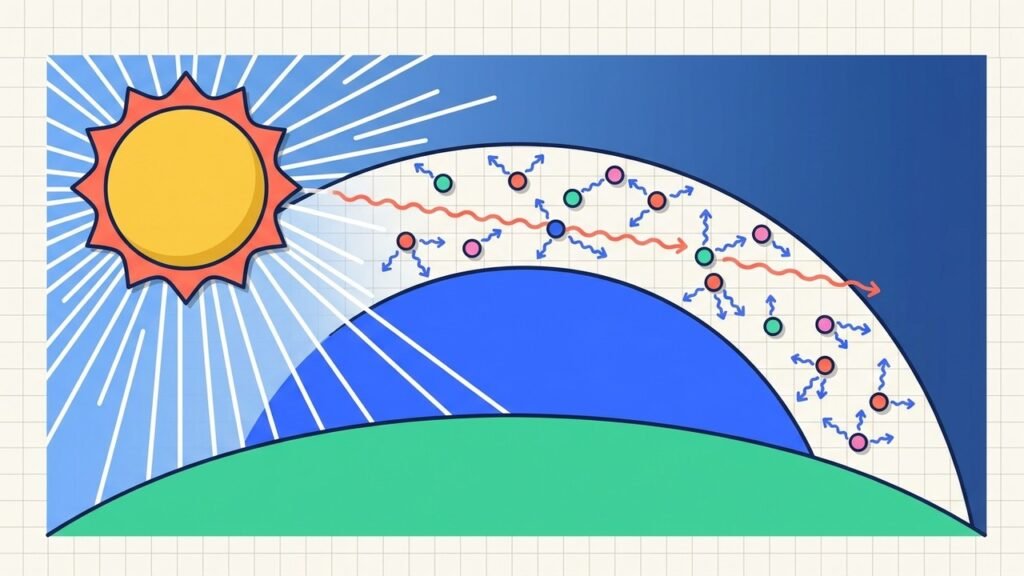
The sky is blue because of Rayleigh scattering. Sunlight contains every color, and the nitrogen and oxygen molecules in air scatter short wavelengths far more than long ones. Blue light (about 450 nanometers) is scattered roughly five to six times more than red light (about 700 nanometers), so scattered blue light reaches your eyes from every direction. Violet scatters even more, but sunlight holds less violet and our eyes are less sensitive to it. At sunset, light crosses much more air, most of the blue is scattered away, and reds and oranges remain.
Key takeaways
- White light is a mix: sunlight contains all the colors of the rainbow.
- Short waves scatter most: scattering grows with the fourth power of how short the wavelength is.
- Blue beats violet: the Sun gives off less violet, and human eyes respond more strongly to blue.
- Sunsets are filtered light: a long path through air strips out blue and leaves red and orange.
- Clouds are white: water droplets are big enough to scatter all colors equally.
Sunlight Is a Mix of Every Color
Sunlight looks white or pale yellow, but it is really a blend. Pass it through a glass prism, or through raindrops after a storm, and it fans out into red, orange, yellow, green, blue and violet.
Each color is light with a different wavelength, the distance between one wave crest and the next. Red light has the longest visible wavelength, around 700 nanometers (a nanometer is one billionth of a meter). Blue sits near 450 nanometers, and violet is shorter still, around 400.
That difference in wavelength is the whole story. Air treats short waves and long waves very differently.
Why Does Blue Light Scatter More?
Air is about 78 percent nitrogen and 21 percent oxygen. Those molecules are tiny, thousands of times smaller than a wavelength of visible light. When sunlight passes through them, the light’s electric field makes the electrons in each molecule jiggle. A jiggling electron sends light back out in all directions. That redirected light is called scattered light.
In the 1870s the British physicist Lord Rayleigh worked out how much light gets scattered this way. His result is now called Rayleigh scattering, and it has one striking rule: the amount of scattering is proportional to 1 divided by the wavelength to the fourth power.
A worked example
Compare blue light at 450 nanometers with red light at 700 nanometers:
- Divide the wavelengths: 700 ÷ 450 = 1.56.
- Raise that to the fourth power: 1.56 × 1.56 × 1.56 × 1.56 ≈ 5.9.
- So blue light is scattered almost six times more strongly than red.
As sunlight streams through the atmosphere, blue light keeps getting bounced sideways, off one molecule and then another. Wherever you look in the sky, some of that bounced blue light is heading toward your eyes. The result is a sky that glows blue from horizon to horizon.
Why Isn’t the Sky Violet?
If shorter means more scattering, violet should win. It scatters even more than blue. Two facts keep the sky looking blue instead.
- The Sun sends less violet. Sunlight is not an equal mix of colors. By the time it reaches the ground, it carries noticeably less violet than blue.
- Your eyes favor blue. The color-sensing cone cells in your retina respond weakly to violet. The blend of scattered light, mostly blue with some violet and green, registers in your brain as sky blue.
Scientists sometimes say the sky is really “blue-violet,” and a spectrometer would agree. Human vision simply tips the balance to blue.
Why Are Sunsets Red and Orange?
At noon, sunlight comes in steeply and crosses a fairly thin slice of atmosphere. Near sunrise and sunset, the Sun sits low and its light skims sideways through the air. Right at the horizon, the light passes through nearly 40 times more air than it does when the Sun is straight overhead.
Along that long path, blue light is scattered out of the beam again and again. By the time the beam reaches you, most of the blue is gone. What is left is the longer-wavelength light: yellow, orange and red.
Smoke, dust and sea salt can make sunsets even more intense. Those extra particles scatter still more light out of the beam, which is why sunsets after a volcanic eruption or during wildfire season can look deep red.
Why Are Clouds White and the Horizon Pale?
Cloud droplets are huge compared with air molecules, often 10 to 20 micrometers across. Particles that large scatter all visible wavelengths about equally, a process called Mie scattering. Since every color is scattered by the same amount, the light leaving a cloud stays white. Thick storm clouds look gray because less light makes it all the way through them.
The sky near the horizon also looks paler than the sky overhead. Light from that direction has traveled through a lot of air and been scattered many times. All that mixing blends the colors back toward white.
What Color Is the Sky Elsewhere?
Go high enough and the blue fades. Pilots and mountain climbers see a deeper, darker blue because there is less air above them to scatter light. Astronauts in orbit see a black sky in daytime, because space has almost no air at all.
Mars is a different case. Its thin atmosphere is full of fine reddish dust, so its daytime sky looks butterscotch or pinkish tan. Martian sunsets look blue, because the dust scatters blue light forward, toward the person watching. NASA rovers have photographed both.
| Where | Daytime sky | Sunset | Main reason |
|---|---|---|---|
| Earth, sea level | Blue | Orange to red | Rayleigh scattering by gas molecules |
| Earth, high mountain | Deep blue | Orange | Less air above to scatter light |
| Orbit | Black | Thin colored band at the edge | Almost no air |
| Mars | Butterscotch | Bluish | Fine dust scatters blue forward |
Common Mix-Ups About Why the Sky Is Blue
Myth: The sky is blue because it reflects the ocean. The sky is just as blue over deserts and the middle of continents. If anything, it works the other way: the open ocean looks blue partly because it reflects the sky, and partly because water absorbs red light.
Myth: Air is blue, like colored glass. Air is not tinted. It redirects blue light more than red, but a jar of air looks perfectly clear.
Myth: Dust and pollution make the sky blue. The blue comes from the gas molecules themselves. Haze and pollution usually make the sky paler and whiter, not bluer.
Myth: The sky is blue because blue light is the strongest color in sunlight. Sunlight’s output peaks closer to green. Blue wins because of scattering, not because there is more of it.
Frequently Asked Questions
Who first explained why the sky is blue?
John Tyndall showed in the 1850s and 1860s that fine particles scatter blue light more than red. Lord Rayleigh gave the mathematical explanation in the 1870s, showing that even single gas molecules do it. Einstein later refined the theory around 1910.
Is the sky blue at night?
On a moonlit night the sky is still faintly blue, because moonlight is reflected sunlight and scatters the same way. Our night vision cannot see color well, so it looks black or gray to us. Long-exposure photos often reveal the blue.
Why is the sky darker blue directly overhead?
Light from overhead travels through the least air, so it has been scattered only once or twice and stays a strong blue. Light from near the horizon crosses much more air and gets mixed toward white.
What is Rayleigh scattering in simple words?
It is the way tiny particles, much smaller than a light wave, bounce light in new directions. Short wavelengths such as blue get bounced far more than long ones such as red.
Why do sunsets look redder after a wildfire or volcano?
Smoke and ash add many more particles to the air. They scatter even more blue and green light out of the low, sideways sunbeam, leaving deeper reds and oranges.
The Short Version
- Sunlight contains every color, each with its own wavelength.
- Gas molecules scatter short wavelengths much more than long ones (about six times more for blue than red).
- Scattered blue light reaches you from all over the sky, so the sky looks blue.
- At sunset, light crosses far more air, the blue is stripped out, and reds and oranges remain.
NASA’s Space Place sky color guide has a simple animation of scattering, and the National Weather Service explains why the sky changes color through the day. For more answers like this one, browse our science explainers or read how plants use sunlight. Then test yourself with the free Science Quiz.